The Shift
From Tool Stacks to Work Systems: Stop Being the Integration Layer
A tool stack quietly makes you the integration layer. A work system gives that job to a work-graph and one brain. Here's the difference that matters.
A tool stack quietly makes you the integration layer. A work system gives that job to a work-graph and one brain. Here's the difference that matters.
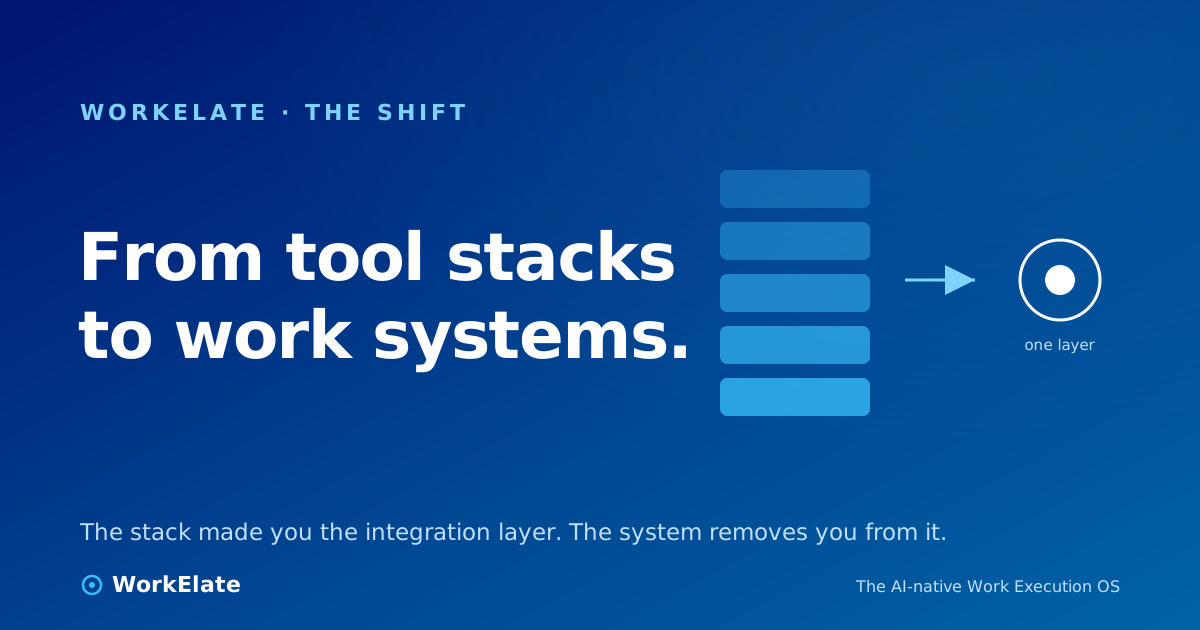
Open your laptop on a Monday and count the tabs. Inbox. A board of cards. A spreadsheet someone shared at 11pm. A doc with three comment threads. A form that collected last week's responses and is now waiting for a human to decide what they mean. Each of those tabs is good at its one job. None of them know about each other.
So you become the thing that connects them. You read the form response, you remember why it matters, you open the board and make a card, you ping the right person, you paste the context they're missing, you go back and mark the first thing "done." You are, right now, the integration layer of your own company. And nobody put that on your job description.
That's the real story of the tool stack. The problem was never how many apps you have. The problem is that the wiring between them runs through a person.
Here's the trap, stated plainly. Every tool in your stack holds a piece of work. The work itself flows across all of them — a conversation becomes a decision becomes a task becomes a document becomes a follow-up. But no single tool sees that whole flow. So the connective tissue — "this response should become that task, which is for this person, because of that conversation" — lives nowhere except in your head and your copy-paste muscle memory.
Three things quietly fall on you as a result.
Context doesn't travel. When you move a thought from a chat into a task, the why doesn't come with it. You either re-type it, link back manually, or hope a teammate reconstructs it later. Multiply that by every boundary your work crosses in a day.
Coordination is manual labor. Somebody updates status in two places. Somebody notices the design is ready and tells the next person. Somebody checks four tabs to answer "where are we?" That somebody is always a human, and it's usually your best one — the person you hired for judgment, spending their afternoon being a router.
It gets worse as you grow. With five people you can hold the wiring in your head. With fifty you can't. New hires don't just learn the tools; they learn the undocumented map of how things connect, who to ask, where things stall. The connecting work scales faster than the headcount does.
The usual fix is integration: pipe the form into the spreadsheet, sync the calendar to the tasks, fire a notification when something changes. Useful. But integration moves data. It doesn't move understanding.
An integration can copy a form response into a board. It can't decide whether that response is urgent, route it to the right owner with the original context attached, draft the reply, and remember it did so the next time something similar shows up. Integration gives you connected silos — data flowing between tools that still don't comprehend the work. You're left doing the part that requires a brain, which is most of it.
What work actually needs isn't more pipes between tools. It needs one system that understands the whole and acts on it.
This is the shift. A work system isn't a thirteenth app you add to the stack. It's a layer that sits across your apps, keeps a live map of how the work connects, and does the coordinating itself.
At WorkElate we call that map the cross-app work-graph — every form response, card, doc, event, and message, linked by the client or project they belong to, in one continuously updated structure. The apps emit to it as you work; they don't have to be stitched together after the fact. And one orchestrating intelligence — we call it WAO — reads that graph and acts on it.
The cognitive loop it runs has two stages most assistants skip: it recalls what's already known and remembers what just happened. Sense, recall, reason, decide, act, remember. Because of those bookends, context isn't something a person re-pastes at every boundary. It's something the system carries by default.
One concrete proof that this is real and not a slide: in WorkElate's form app, a "book my time" request doesn't produce a dead dropdown someone has to act on later. It produces a genuinely bookable scheduler — a slot that locks, an event that lands on the calendar, a link that can be cancelled — and it emits that into the work-graph so the rest of the system knows the booking happened. The form didn't just collect data. The work moved itself one step, and the system remembered.
Picture the customer-feedback loop a different way. In a tool stack: a response arrives, a person reviews it, a person makes a card for the urgent ones, a person notifies the team with the backstory, a person logs the decision, a person updates the customer. Six handoffs, six chances for something to quietly die in a tab.
In a work system: the response is captured with its context already attached, the urgent ones surface with that context intact, the decision is logged where it's made, and the routine notifications happen on their own. The consequential moves — the ones touching a client or money — still pause for a human to confirm, because trust is the whole point. What disappears isn't oversight. It's the manual relay running between every step.
That's the difference between a collection and an organism. A stack accumulates. A system coordinates.
The honest part: this is additive, not a migration. You keep the surfaces your team already likes. What changes is that they stop being islands and start emitting into one graph that a single brain can read and write. The coordination tax — the hours your sharpest people spend being glue — is what comes off the table, not your tools.
So the question worth sitting with isn't "do we have too many apps?" You probably don't. It's quieter and more uncomfortable than that: how many hours a week is your best person spending as the wiring between them — and what would they build if that job belonged to the system instead?
▶ Watch on WorkElate See WAO move work across apps, with no human relay youtube.com/@WorkElate · videoId: TODO — swap when publishedRelated reading: