Coordination
The Real Cost of a Task Is the Coordination It Creates
Task tools count tasks. They never count the coordination each one spawns — and coordination doesn't add up, it squares. That's the bill that drowns you.
Task tools count tasks. They never count the coordination each one spawns — and coordination doesn't add up, it squares. That's the bill that drowns you.
When you add a task to a tool, you think you've created a unit of work. You haven't. You've created a unit of work plus a small, invisible debt: every future message, alignment, and handoff that task will demand before it's actually done. The task is the part you can see. The debt is the part that runs your week.
We've built an entire industry of tools to count the visible part. None of them count the debt.
This essay is about that debt — where it comes from, why it grows faster than the work that spawns it, and why almost everything we've built to manage work makes it worse. It's a single idea, and I want to follow it all the way down: the real cost of a task is not the task. It's the coordination the task creates. Once you see that, a lot of confusing things about modern work stop being confusing. The team that got bigger and slower. The week that felt full and produced nothing. The dashboard that says everything's on track while everyone is quietly drowning. None of it is a mystery. It's all the same bill, arriving in a currency the tools don't measure.
Open any task manager and it will tell you, proudly, how many cards moved to Done this week. It will not tell you how many Slack messages it took to move them. It won't count the standup where four people described work the other three already knew about. It won't tally the "hey, did legal sign off?" pings, the calendar Tetris to find a thirty-minute slot, the email thread that existed only to re-explain context someone already had on Tuesday.
That uncounted work has a name. It's coordination overhead, and for most teams it's the larger number by far. The tasks are the tip. The coordination is the iceberg, and the dashboard is pointed at the sky.
Here's the part that should worry you: the tools don't just fail to reduce that overhead. They manufacture it. Every new status field is a thing someone now has to keep current. Every dependency arrow is a handoff someone has to chase. Every assignee is a person who now has to be told. The tool that promised to organize the work quietly became one more place the work has to be coordinated.
Your task tool isn't lying about the work. It's just measuring the cheap half of it.
Think about what a card on a board actually represents. The card is a five-word summary — "Ship the onboarding email." The work the card stands for is a negotiation between four people about what onboarding even means, a wait on copy from marketing, a dependency on a feature that isn't done, a review nobody scheduled, and a launch date someone picked in a meeting two weeks ago and never wrote down anywhere the card can see. The card holds the five words. The coordination holds everything else. And the coordination is invisible to the very tool that's supposed to be the system of record.
This is the original sin of task management. It treats the task as the atom of work. But the task isn't the atom. The atom is the task plus its relationships — and relationships are exactly the thing a list of cards is built to ignore.
A single task in isolation costs almost nothing to coordinate. You know what it is, you do it, you mark it done. The expense doesn't live in the tasks. It lives in the wires between them.
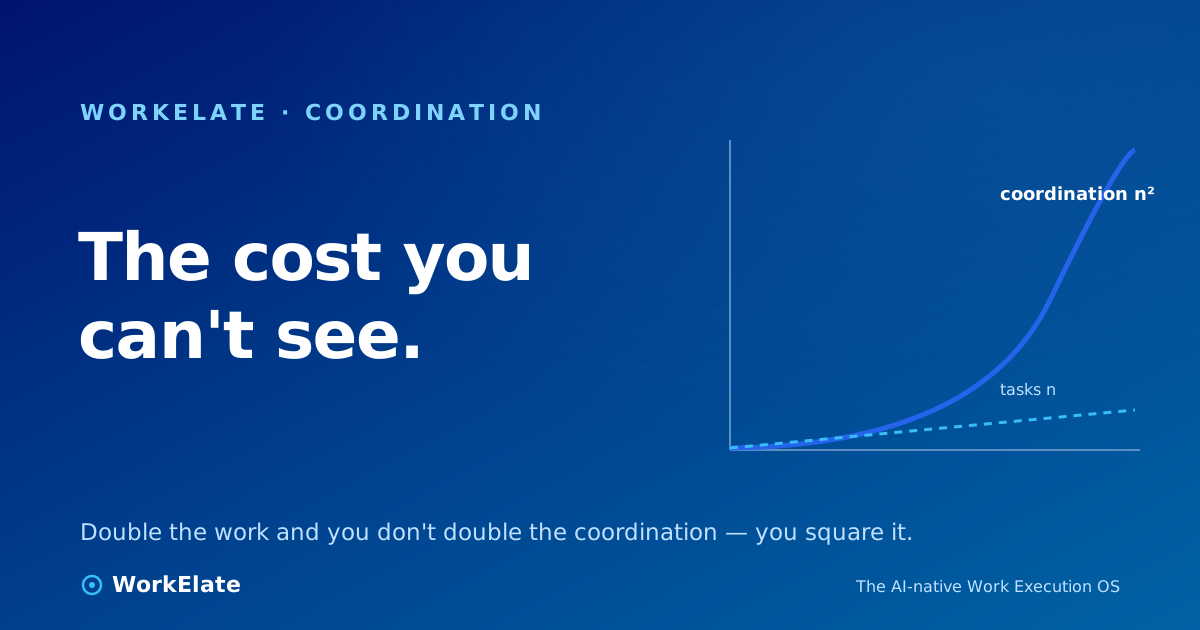
And the wires don't add up — they multiply.
This is the whole essay in one sentence, so it's worth being precise about why it's true. If you have n people or n moving pieces of work, the number of pairs that might need to talk to each other isn't n. It's n × (n − 1) / 2 — which, as n grows, behaves like n². Two people have one relationship to maintain. Three people have three. Four have six. Ten have forty-five. A team of twenty has a hundred and ninety possible channels of "wait, are we aligned on this?" Nobody added 189 channels on purpose. They came free with the headcount, the way interest comes free with debt.
Tasks behave the same way. Ten tasks, each touching five others, isn't ten coordination points. It's closer to fifty. Each one is a small standing obligation for some human to check status, relay an update, and confirm a handoff landed. Double the work and you don't double the coordination. You square it.
This is why teams hit a wall that makes no sense on paper. You hired more people, you bought a better tool, and somehow everyone is busier and shipping less. Nobody got lazy. Nobody got worse at their job. The coordination surface grew faster than the team did, and your best people are now spending their best hours being the glue.
Fred Brooks made a version of this point about software teams in 1975 — adding people to a late project makes it later, because the new people don't reduce the work, they multiply the communication. That was about engineers. The same curve governs an agency adding account managers, a marketing team adding stakeholders, a company adding a layer of management whose entire job, when you describe it honestly, is coordination. The pattern isn't specific to software. It's specific to the shape of connected work. Anywhere tasks depend on tasks and people depend on people, the cost lives in the wires, and the wires square.
The instinct, when work piles up, is to add people. It's the most natural move in the world, and for the visible half of the work it's the right one — more hands do more tasks. But you're not just buying hands. You're buying every relationship those hands have to maintain to do anything useful, and you're buying it at the n² price.
Here's the trap in plain numbers. A five-person team has ten possible pairings to keep in sync. Grow it to ten people — you doubled the team — and you now have forty-five. You doubled the headcount and quadrupled the coordination surface. The work each person can do went up linearly. The work it takes to keep them aligned went up with the square. Somewhere in there is the exact moment a team stops feeling fast, and most leaders can name the week it happened without being able to explain it.
So organizations reach for the only lever that seems to fit: structure. Teams, pods, squads, swim lanes, a manager per group, a director over the managers. What is org structure, really? It's an attempt to cut wires — to draw boxes so that not everyone has to coordinate with everyone, so that the n² is broken into smaller, cheaper n²s that mostly talk through their leads. It works, a little. It also adds a new job — the lead — whose day is spent on coordination, and a new artifact — the cross-team dependency — which is the most expensive wire of all, because now the handoff crosses a boundary where context doesn't flow freely.
The org chart is a coordination-reduction device. The status meeting is the tax you pay when it fails.
This is why the answer to "we're overwhelmed" is so rarely "hire someone." More often the honest answer is: the coordination is the bottleneck, and another person adds more coordination than they remove. You don't have a capacity problem. You have a wiring problem, and you're trying to fix it with more nodes.
Coordination overhead doesn't bill you in one lump. It bills you in fragments, all day, in the currency of attention.
You're deep in a design and you have to stop to check whether the contract cleared. You're in the middle of a hard function and you break to confirm an API spec with another team. You're three slides from finishing the deck and you need a number that only finance has. Each switch feels small — a few seconds to open a tab, find a thread, ask. But the real cost isn't the seconds. It's the climb back. The unloading of one context and the slow reload of another.
The University of California, Irvine research that gets quoted everywhere — Gloria Mark's work on interrupted work — puts the reload at roughly twenty-three minutes to return to the original task after a detour. Take that number at half its value and it still indicts you: coordinate ten handoffs in a day and you've spent the productive core of that day not working, but re-finding your place. The work was never the bottleneck. Getting back to it was.
And notice what kind of work the interruptions are. They are almost never the actual task. They're the coordination around the task — the status check, the confirmation, the "did you see my message." The interruption tax and the coordination tax are the same tax, billed twice: once in the time it takes to do the coordinating, and again in the focus it costs to recover. The person who looks busiest in your company is often not doing the most work. They're absorbing the most interruptions, which is to say they've become the place the coordination routes through. We have a word for that person. We call them indispensable. We should call them overloaded.
There's a darker second-order effect, too. When focus is this expensive and this fragile, people stop attempting the work that requires deep focus. The hard refactor, the strategy memo, the genuinely creative deck — the things that need a long unbroken runway — quietly get deprioritized in favor of work that survives interruption. Shallow work isn't just what's left after coordination. Coordination selects for it. Your most valuable output is the first thing the tax kills, and it dies silently, because nobody files a ticket for the brilliant thing they didn't have the uninterrupted hours to make.
Notice what every fix above has in common. They're all someone reporting. You write the update. You attend the standup to say the update out loud. You answer the "what's the status?" because the system that holds the work has no idea what state the work is in — so a human has to look, interpret, and narrate.
That's the absurdity at the center of it. The tool is the system of record, and it still can't tell you what's happening. So status becomes a manual export from people's heads, performed on a schedule, for an audience.
Call it what it is: status-update theater. Everyone takes a turn describing reality to people who could have just looked, if there were anything to look at. The daily standup, in most companies, is a ritual where humans verbally serialize state that a system should already hold. The weekly status report is a document whose entire reason for existing is that the tools can't answer the question the report answers. The "quick sync to align" is two or more people manually reconciling versions of reality that drifted apart because nothing was holding the single version.
Run the cost of that. A team of eight, fifteen minutes of standup a day, is two hours of human attention burned daily on narration — five hundred hours a year — to maintain a shared picture that's stale by lunch. Add the status report someone writes on Friday afternoon, the "where are we on this?" Slack threads, the recurring sync that exists only because the last sync's decisions didn't propagate. None of it is on the dashboard. All of it is the coordination tax, and most of it is theater, because the information being performed already exists — it's just trapped in eleven different tools and a dozen different heads, and the only integration layer connecting them is a meeting.
The premise was wrong from the start. Status should be something the system knows, not something humans produce. Every minute a person spends producing status is a minute the system failed to do its one job.
Here is the thing almost no one says out loud. The reason status is a job, the reason coordination squares, the reason the dashboard lies — all of it traces to a single fact about how work software is built.
Each tool holds its own little island. The task board knows about cards. The calendar knows about events. The doc knows about words. The inbox knows about messages. And the connections between them — this design feeds that ticket, that contract gates this kickoff, this person is waiting on that approval — don't live in any of the tools. They live in the chatter between them. The dependency that the contract has to be signed before the kickoff can be scheduled isn't a field in any system. It's a sentence someone said in a meeting, an assumption in three people's heads, a "obviously we can't start until legal's done" that everyone knows and nothing records.
The connective tissue of your work isn't in your software. It's in your people's mouths. That's the whole bill, and that's why it's invisible.
That's why coordination can't be automated by the current tools, no matter how many integrations they bolt on. An integration moves data between islands — it copies a card from one place to another. It doesn't move understanding. It can't, because the understanding was never written down anywhere a machine could read it. The dependency, the priority, the "this is actually urgent because the client's board meets Thursday" — that context is the thing doing the coordination, and it lives in human memory, which is why a human has to keep doing the coordinating.
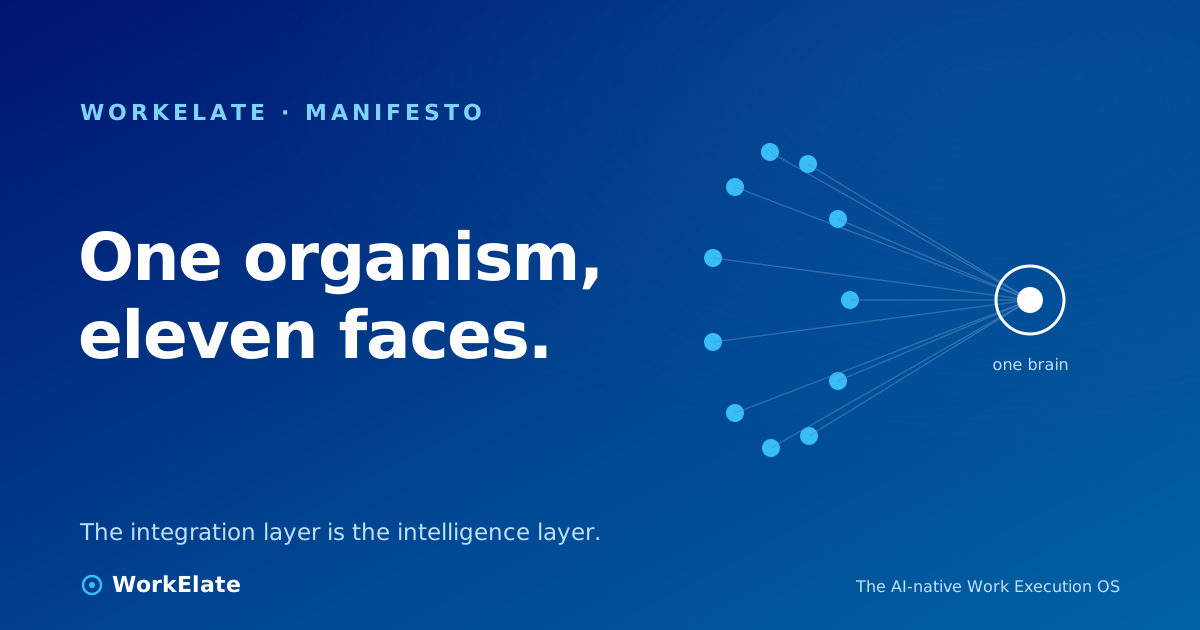
So when people say their work tools are disconnected, they're pointing at the wrong layer. The tools aren't the problem. The disconnection is — and the disconnection isn't a missing API. It's a missing brain. There's no single thing that holds the whole picture of the work, so the only thing that can is the team itself, paying the n² price in messages and meetings and interrupted afternoons, forever.
This is the real diagnosis, and it's worth stating flatly because the whole tool industry has trained us to miss it: you don't have too many tools. You have no connective intelligence between them. Adding a twelfth tool doesn't help. Ripping out eleven tools for one "all-in-one" doesn't help either — an all-in-one is just eleven islands under one login, and the connections still live in the chatter. The fix isn't fewer tools or more tools. It's something that reads across all of them and holds the wiring so your people don't have to.
It's easy to say the system should just know the status. It's worth being honest about what that actually takes, because it's a real engineering claim, not a wish.
For a system to know status instead of asking humans for it, three things have to be true, and all three are missing from a stack of disconnected tools.
First, the work has to emit. Every meaningful thing that happens in any app — a card moving, a doc getting approved, a contract getting signed, a meeting getting booked — has to announce itself into a shared place. Not get copied. Emit. A signal that says "this happened," with enough context attached to mean something. Most tools don't do this. They record the event in their own database and keep it. The event never leaves the island, which is exactly why a human has to be the one to carry the news.
Second, those emissions have to land in one shared graph, not eleven separate logs. A graph, specifically — because the value isn't in the events, it's in the relationships between them. The system has to be able to represent "this design feeds that ticket," "this contract gates that kickoff," "this person is waiting on that approval" as first-class facts, keyed on the thing the work is actually about — the client, the account, the project. A pile of disconnected event logs is just status theater with extra steps. A graph is the wiring, finally written down.
Third, one intelligence has to read across the whole graph. Not eleven copilots, one per app, each blind to the other ten — that just rebuilds the islands in AI form, and a copilot that can only see the inbox can't tell you the inbox reply is blocked on a contract in another tool. One brain, reading the entire connected picture, is the only shape that can answer the question "what's the actual state of this work" without asking a person.
Emit. Graph. One brain. That's the architecture of a system that knows status. Anything less and you're back to humans as the integration layer — which is where almost every company is today, paying the n² bill and calling it work.
This is the shift WorkElate is built around, so let me describe exactly what it does and — just as important — what it doesn't claim to do.
Every app — task, calendar, docs, mail, board, the rest — emits what happens into one shared work-graph. Not a copy-paste integration between islands; an actual emission, keyed on the client and the account, so the connections live in the system instead of in the chatter. When a design moves, the graph already holds that the ticket depends on it, because the dependency was recorded when the work was created, not narrated after the fact in a standup. One brain — we call it WAO, the WorkElate AI Orchestrator — reads across all of it.
So status stops being a thing you report and becomes a thing that's simply true and visible. The "what's the status?" question dissolves, not because a human answered it faster, but because the system holds the answer. That's the difference between status as a manual export from people's heads and status as a property the system already has.
And then the brain can act on what it reads — draft the handoff the moment the dependency clears, flag the blocker before it becomes a fire, line up the review while the work is still warm. But here's the part the honesty of this matters most: it acts with your confirmation. Suggest, confirm, execute. The brain proposes the handoff and waits; you approve it. It surfaces the blocker; you decide. You stay in command of every decision that carries weight — you just stop being the router for the ones that don't. The coordination still happens. It simply stops happening in your people's heads.
I want to be careful here, because this is exactly the place where work software overpromises and loses your trust. WorkElate does not magically run your company. It doesn't make the judgment calls that are yours to make. It doesn't pretend the coordination disappears — coordination is real work and it still has to occur. What changes is where it occurs: in the system that already holds the work, instead of on your calendar, in your DMs, in your best person's interrupted afternoon. The brain reads the whole picture and does the mechanical coordination — the tracking, the relaying, the drafting, the flagging. The decisions stay with you. That's the line, and we hold it on purpose, because the moment a system claims to make your decisions for you is the moment you can no longer trust it with your coordination.
The coordination doesn't vanish. It moves — out of your people's heads, into the system that already holds the work.
If you want the longer argument for why this is a different category of software and not a better task manager, it's here: How an AI Work OS Is Replacing Traditional Project Management. And if you want the architectural reason the connection layer is where the value lives — why owning the wiring beats owning the tools — that's the thesis of Work Systems Are Eating SaaS.
▶ ▶ Watch on WorkElate See WAO handle a coordination chain across apps youtube.com/@WorkElate · videoId: TODO — swap when publishedIt's worth naming the kind of intelligence this requires, because "AI for work" has come to mean a chat box in the corner of every app, and that is almost the opposite of what coordination needs.
A chat box is loud AI. It waits for you to type, it answers, you read, you copy, you check. It adds a step. For coordination, that's worse than nothing — you've replaced "ask a coworker for status" with "ask a bot for status," and you're still the one doing the asking, still the one stitching the answer into the next action. The bottleneck didn't move. It got a nicer interface.
The intelligence coordination needs is the quiet kind — the kind that reads the graph in the background, does the mechanical work without an audience, and surfaces only the decisions that are genuinely yours. Three things need you; two I already handled. The two it handled, it didn't perform for you; it tracked the dependency, moved the work, kept the context attached, and told you after. That's the shape of an AI that reduces coordination instead of adding a new place to coordinate. We argue this case in full in Invisible AI: The Only AI That Matters at Work, but the short version is the same as this whole essay: the best coordination tool is the one you don't have to operate.
Suppose you take all this seriously. Suppose you accept that the real cost of a task is the coordination it spawns, that coordination squares, and that the squaring happens because the wiring lives in human memory instead of in the system. What follows?
A few things, and they're uncomfortable for how most companies are run.
You'd stop measuring output by tasks closed. Tasks closed is a measure of the cheap half. A team can close a hundred cards a week while the coordination tax eats every hour of deep work behind them. The number that matters is closer to: how much of our people's time went to the work only they can do, versus the work of being glue? No dashboard shows you that today, which tells you how thoroughly we've trained ourselves to watch the wrong number.
You'd stop reaching for headcount first. If coordination is the bottleneck, a new hire is a new node, and a new node adds wires at the n² rate. Sometimes that's still the right call. But "we're overwhelmed, let's hire" should trigger the question "are we capacity-bound or coordination-bound?" — and most overwhelmed teams, if they're honest, are coordination-bound.
You'd treat meetings as a symptom, not a tool. Every recurring status meeting is a place the system failed to hold state, so humans are reconciling it by mouth. The goal isn't better meetings. It's fewer of them, because the information they exist to move is finally held somewhere a machine can read.
And you'd stop buying tools and start buying connection. The twelfth tool doesn't reduce the bill; it adds an island. The thing that reduces the bill is the layer that reads across all the islands and holds the wiring — the connective intelligence that does the coordination the humans are doing now. That's a different purchase than "a better task manager," and recognizing it as a different purchase is most of the insight.
Look at your most expensive person this week. Then ask what fraction of their hours went to the work only they can do, and what fraction went to being a router for everyone else's.
If the second number is large, your task tool isn't underperforming. It's working exactly as designed — counting the tasks, and quietly billing you for the coordination it can't see. The tool was never broken. It was just measuring the half of the work that's easy to measure, and leaving you to pay, in attention, for the half that isn't.
You don't have a productivity problem. You have a coordination problem wearing a productivity problem's clothes. And the reason it's been so hard to fix is that the cost was never on the dashboard, the wiring was never in the software, and the only system holding the whole picture of your work was the exhausted, interrupted, indispensable people you keep asking for a status update.
Imagine giving them the afternoon back.