Manifesto
One Organism, Eleven Faces: A Concept Note for the Future of Work
Work isn't broken because you have too many tools. It's broken because they don't share a mind. The case for One Brain across all your work.
Work isn't broken because you have too many tools. It's broken because they don't share a mind. The case for One Brain across all your work.
A senior account manager opens her week. Her board says the client launch is on track — three cards in "Done," two in "In Progress," everything green. She believes it for about nine minutes, until a chat thread, an unread email, and a forwarded contract tell her the truth: the client moved the date, the design lead is out, and the deliverable that's marked "Done" is waiting on her sign-off she never gave.
The board lied. Not maliciously — it lied the way every tool lies, by knowing only its own corner of reality and reporting that corner as if it were the whole. Her task tool knows tasks. Her inbox knows email. Her calendar knows time. None of them knows the client. So she does. She is the integration layer. She holds the work-graph in her head, and she pays for it in attention every single day.
This is the real condition of modern work, and it is the thing almost no one names correctly. We have built a generation of software that is individually excellent and collectively blind, and then we have asked human beings to make up the difference. The difference is enormous. It is, in most companies, the actual job.
So this note is an argument, not a brochure. The argument is that the thing everyone calls a tooling problem is something else entirely, that the cure being prescribed makes it worse, and that there is one idea — a single, load-bearing idea — that flips the whole picture once you see it. Everything after this paragraph is a consequence of that one idea.
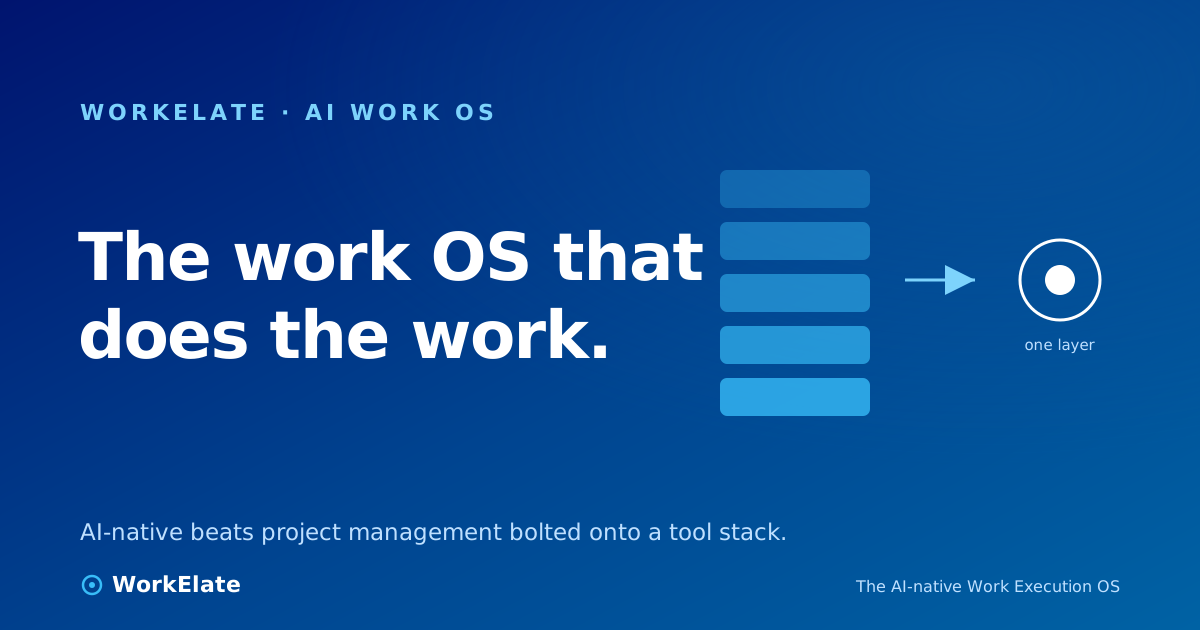
The popular story is that we have too many tools. Twenty-nine dashboards, a notification firehose, a tab graveyard, a Tuesday lost to context-switching. The prescribed cure is consolidation: one suite to replace them all, fewer logins, less sprawl. Buy the all-in-one, retire the rest, and the chaos subsides.
That story is wrong, and the cure makes things worse.
The number of surfaces was never the problem. A surgeon uses dozens of instruments laid out on a tray; a pilot reads a wall of dials and switches; a chef's kitchen is a sprawl of specialized stations. Nobody looks at an operating room and concludes the surgeon would do better with one universal instrument. Specialized surfaces are good — a spreadsheet should be different from a whiteboard, a doc should feel nothing like an inbox, a calendar should be a grid of time and not a list of tasks wearing a costume. Force them all into one undifferentiated canvas and you don't get clarity; you get a worse spreadsheet, a worse whiteboard, and a worse inbox, all in one window.
The problem isn't that you have eleven tools. The problem is that your eleven tools don't share a mind.
Watch where the day actually leaks. It isn't inside the apps. Inside the spreadsheet, the account manager is fast and fluent. Inside the inbox, she's fast. Inside the board, fast. The loss happens in the seams — the moment she has to leave one app, carry a fact in her head, and re-enter another. The client's new date lives in email. The vacated slot lives in calendar. The blocked deliverable lives on the board. The contract lives in a doc. Four facts, four surfaces, and the only place those four facts ever meet is inside her skull. She is the join. She is the query engine. She is the thing that turns four disconnected corners into one coherent picture of the client — and she rebuilds that picture from scratch every Monday, because the software forgot it over the weekend.
Every app in the last fifteen years optimized the work inside itself and quietly abandoned the work between. The coordination — the chasing, the re-asking, the manual status updates, the "wait, did anyone actually tell the client" — fell into the gap between the apps. And because no software lived in that gap, a person had to. Usually your best person, because holding the whole graph in your head requires judgment, memory, and care, which is exactly what your best people have and exactly what you can least afford to spend on glue.
That's the tax. Not too many tools. One missing brain.
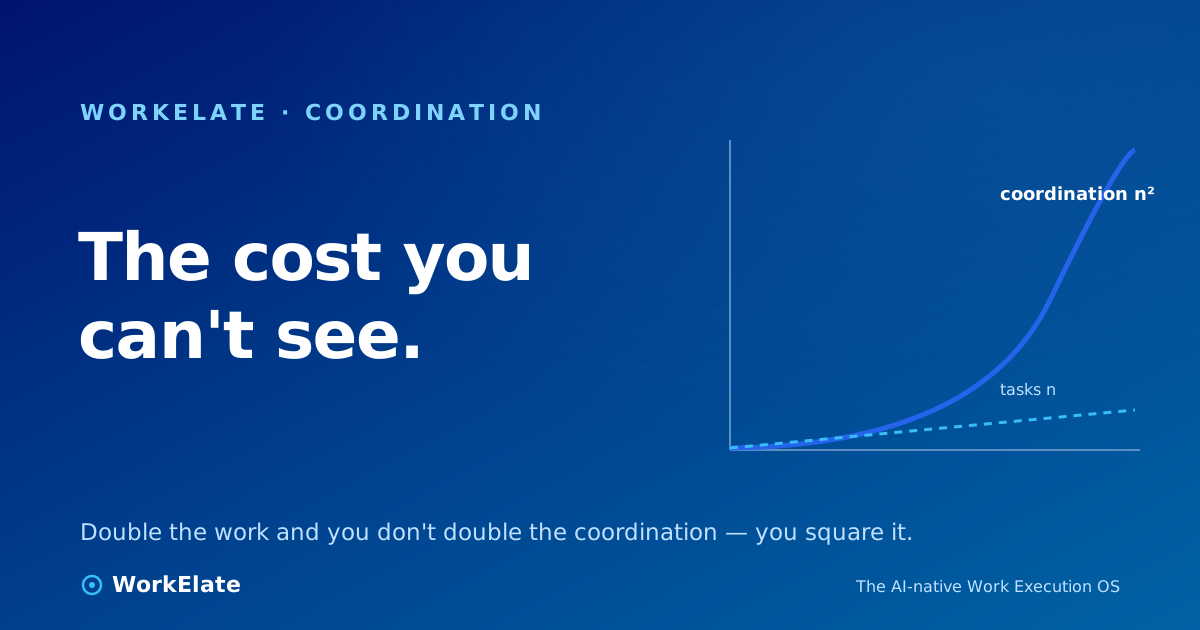
It's worth being precise about the size of this. A large share of the average knowledge-worker's week goes not to creation but to coordination — finding things, re-asking for things, updating status, sitting in alignment meetings, reconstructing context that some tool already had and threw away. You don't need a precise figure; you felt it last Monday. The point is that this slice is mechanical. It is not the irreducible difficulty of doing hard, creative work. It is the entirely reducible difficulty of doing that work across tools that refuse to talk to each other. The creative part is sacred and should stay with humans. The glue part is a structural defect we've been paying salaries to patch.
So here is the one idea this whole note is built on, and everything else is a consequence of it:
The integration layer is the intelligence layer.
Sit with how counter-intuitive that is for a second. For two decades we treated integration as plumbing — webhooks, Zapier flows, "connect your apps," the boring layer that lives underneath the smart layer. Integration was the thing you set up once and forgot, the pipes behind the wall. The smart stuff happened in the apps. The pipes just moved data.
That was backwards.
The connective tissue between your apps is not plumbing. It is the only place in the entire system from which the whole picture is visible. The spreadsheet can only ever see the spreadsheet. The inbox can only ever see the inbox. But the layer between them — the join, the place the account manager occupies in her own head — is the single vantage point with a line of sight into all of it at once. Whoever owns that layer doesn't just move data between tools. They are the only entity in the building that can reason over all the work at the same time. The glue was never the dumb part. The glue is where the mind goes.
Once you see that, a lot of confident industry strategy starts to look like a category error. The race to put a copilot inside every app is a race to add intelligence in exactly the wrong place — at the surfaces, where the view is narrowest, instead of at the seams, where the view is total.
A model living inside your inbox is brilliant about email and blind about everything else. It can draft a flawless reply. It cannot know the client moved the date, because the date lives in a tool it has never seen and never will. Give every app its own copilot and you don't get one intelligence — you get eleven separate blindnesses, each one articulate about its own corner and silent about the corner next door. Eleven copilots cannot add up to one mind, for the same reason eleven people each reading one page of a contract cannot tell you what the contract says. Comprehension isn't additive across isolated views. It requires a single vantage that sees the whole.
The intelligence has to sit above the surfaces, with a line of sight into all of them, or it isn't intelligence about your work — it's autocomplete with good manners. (We've written more about why a smarter widget inside one app is a dead end in Invisible AI: the only AI that matters.)
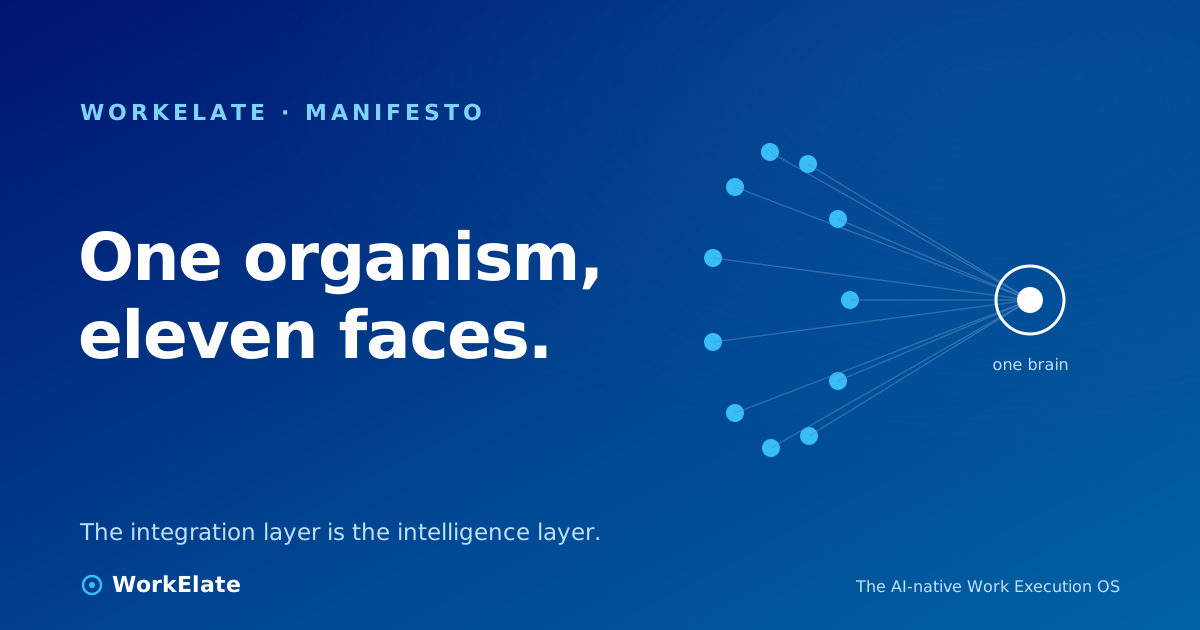
So picture work software differently. Not eleven apps with AI sprinkled on top, the way you'd salt a finished dish. One organism with eleven faces.
The apps — hub, weMail, chat, data, docs, ppt, calendar, task, board, journey, form — are the hands and senses. They see, they touch, they show, they let a human do the part a human should do, beautifully, in a surface built for exactly that job. Behind all of them is one mind: a single orchestrating intelligence we call WAO, the WorkElate AI Orchestrator. The apps are organs. WAO is the brain they share. Not eleven brains coordinating. One brain, looking out through eleven faces.
The metaphor matters because it predicts the architecture. In an organism, the eyes don't reason and the hands don't remember — they sense and they act, and a central nervous system does the thinking and makes the call. Bolt a tiny independent brain into each eyeball and you don't get a smarter creature; you get a twitching one. A body works because sensing is distributed and cognition is central. Work software has had it inverted: cognition scattered into every app, and no center at all. The account manager was the center. We just never gave her any help.
A brain isn't a brain because it's clever in the moment. A large language model on its own is clever in the moment — a genius with amnesia and no hands. Ask it a question and it dazzles; come back tomorrow and it has forgotten you exist, and in between it could touch nothing in your actual world. Cleverness in the moment is necessary and nowhere near sufficient.
What makes a mind is a loop that runs over time. It senses what happened. It recalls what it already knows about this client, this account, this person, this kind of situation. It reasons about what the new fact means in light of the old facts. It decides. It acts — asking before anything irreversible. And then, crucially, it remembers the result, so the next pass through the loop starts from a better place than the last one. Sense → recall → reason → decide → act → remember.
Look hard at those six verbs and notice which ones the current crop of copilots actually has. They have the middle. They can sense a prompt, reason, and produce. What they almost universally lack are the two on the ends — recall and remember — and those two are not minor. They are the difference between a tool you re-explain your whole world to every morning and a colleague who already knows it. Recall is what lets WAO open Monday already understanding that this client always slips the date, that this design lead's backup is reliable, that this deliverable has been stuck twice before. Remember is what lets today's resolution become tomorrow's starting context instead of evaporating. Without the ends of the loop, you have a very articulate stranger. With them, you have something that compounds — a system that is more useful in month six than it was in week one, because it has been accumulating the texture of how your company actually runs.
This is also, not coincidentally, the part nobody can copy by shipping a feature. A clever answer is reproducible in an afternoon. The accumulated memory of how your specific organization works, the shape of your specific clients, the pattern of your specific recurring fires — that is earned over time and lives in the relationship. We think it's the only durable advantage in this entire category, and we'll come back to why.
A loop needs something to loop over. The substance WAO reasons across is the part that can't be faked, and it has a name: a cross-app work-graph, keyed not on a tool but on the thing you actually care about — the client, the account, the deliverable, the launch.
Here is the quiet shift in how to see your own work. The launch is not a card on a board and an email in a thread and a row in a sheet and a slot on a calendar — four strangers who happen to share a name. The launch is one node, and every one of those is an edge running into it. The card is an edge. The email is an edge. The vacated calendar slot is an edge. The unsigned form is an edge. When the account manager's board said "Done," the graph already knew the sign-off was missing — because the form that needed her approval, the calendar slot the design lead vacated, and the email where the client moved the date are all edges on the same node, and a thing that can see the node can see that the node is not, in fact, done.
The board could never have told her that. The board can only ever describe the board. But a mind sitting above all eleven surfaces, holding the launch as a single node with all its edges visible at once, can see exactly what she has to leave five tools and assemble in her head to see. That assembly — that nightly, manual, error-prone reconstruction of the graph — is the work we're proposing to move out of her head and into the organism.
There's a deeper distinction hiding inside that, and it is the whole moat, so it deserves its own paragraph.
A tool that connects to your apps from the outside can only infer this graph by reading their APIs from across a boundary — and it can only read. It watches your work through a window. It sees the shadows the apps throw off and guesses at the shape that cast them. WorkElate emits the graph from inside the apps as the work actually happens — the form that gets built emits that it's a real bookable scheduler, the card that moves emits the move, the slot that's vacated emits the gap — and because it lives inside the surfaces, it can write back through the same ones. Inferring-and-reading is a guess you can look at. Emitting-and-writing is a fact you can act on.
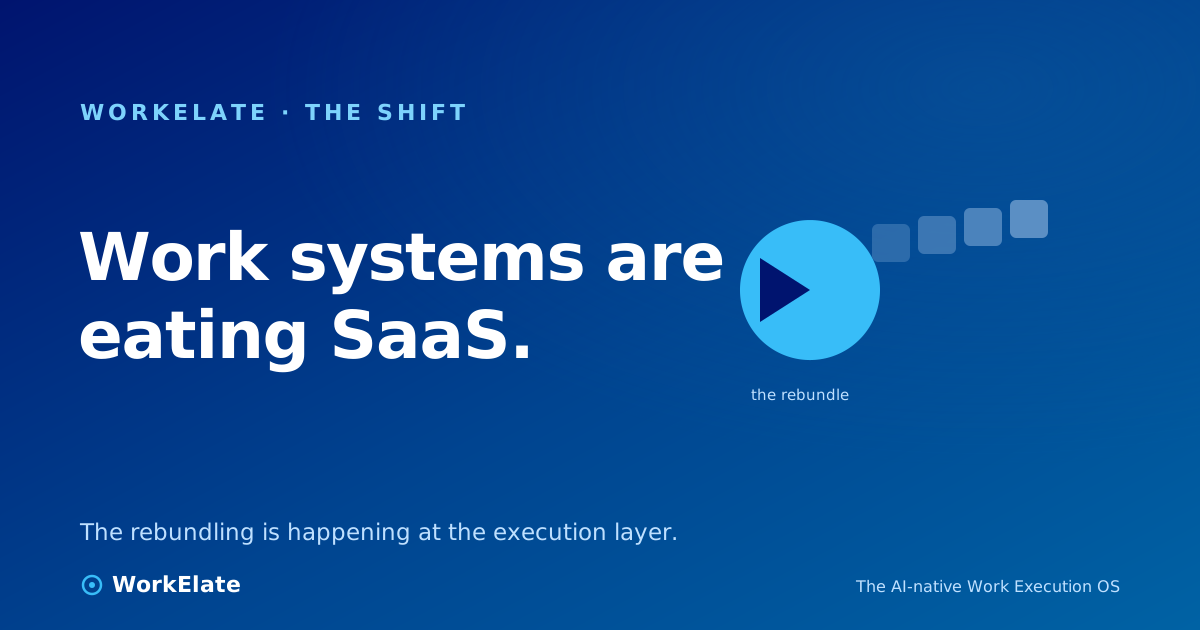
That gap sounds technical and is actually the entire ballgame. The first kind of system can narrate your work back to you, sometimes impressively, always at one remove and always slightly behind. The second kind can do some of the work, because it isn't guessing at the state from outside — it is part of how the state comes to exist. Reading is for systems that watch. Writing is for systems that help. One produces a very smart dashboard. The other produces a colleague. We've made the case at length for why writing the graph — not reading it — is where the durable advantage lives, in Work systems are eating SaaS.
Abstractions are cheap, so let's go back to the account manager and her ruined Monday, and run it again with the organism in place.
She doesn't open five tools to reconstruct the truth. She opens one, and the brain has already done the reconstruction over the weekend, because the loop never stopped sensing and remembering. The opening line is not a dashboard with twelve widgets and a sparkline. It's a sentence: three things need you; two I already handled.
The two it handled were low-stakes and reversible, so it just did them and logged why. It moved a misfiled draft into the right client folder. It nudged the design lead's backup about the slot that opened up, since the calendar already knew the slot was vacant and the graph already knew who covers for whom. Neither of those needed her. Neither could cause harm if the model was slightly wrong, because both are trivially undoable. So the reflex is: act, and leave a clean record.
The three it surfaced are the ones with judgment or consequence baked into them, the ones that should never be done silently on someone's behalf. The client's new date needs a real re-plan, and re-planning a launch is a human call. The "Done" card needs her actual sign-off — software does not get to forge her approval. A clause in the forwarded contract needs a human eye, because contracts are exactly the place you want a person, not a probability, making the final read. For anything irreversible, client-facing, or touching money, WAO stops and asks first. It proposes; she confirms; then it executes. Suggest, confirm, execute — the same reflex she would want from a good delivery manager who is trusted with a lot precisely because he knows which decisions aren't his to make.
That last frame is the soul of the thing and worth saying plainly: WAO is the delivery manager. She manages WAO. It is not her replacement and it is not her boss. It is the tireless, perfectly-briefed operator who carries the coordination load she used to carry alone — and who escalates, every time, the moment a decision needs a human. She is freed to do the part of her job that is actually hers: the relationship, the judgment, the call that needs a person who understands what's really at stake. The line we hold ourselves to is narrow on purpose. We are not claiming to do her thinking. We are claiming to do the glue. (That distinction — what coordination really costs, and why it's the reducible part — is the whole subject of The real cost of a task is coordination.)
None of this is worth anything if you can't trust it, and trust is not a vibe. It's an architecture. A brain you cannot audit is a brain you cannot hand work to, full stop — and most of the reason "AI assistants" stall at the demo is that the moment real stakes appear, nobody can see why the thing did what it did, so nobody lets it do anything that matters.
So the trust is built into the structure, not bolted on as reassurance.
Every action WAO takes writes a row: what it did, why it did it, when, and on whose behalf. Not a log file engineers grep in an incident — a first-class record, because explainability is a requirement of the design rather than a feature request for later. If WAO moved the draft, you can see that it moved the draft, what triggered it, and that it judged the move reversible. There is no silent action. There is no "it just did something and we're not sure what."
When WAO makes a high-stakes call, it has to cite the document it relied on. Not gesture at a vibe — point to the source: the client agreement that sets the SLA, the brief that defines what "done" means here, the policy that says this kind of thing always needs a second pair of eyes. And when it isn't sure enough, it does the thing that separates a trustworthy system from a confident one: it abstains and asks rather than inventing an answer. No fact, no claim. It would rather hand you a question it can defend than an answer it can't.
This is the same honesty posture we try to hold everywhere, including in how we talk about ourselves: separate what's shipped from what's planned, label what's self-reported, keep the gaps in plain sight. We would rather earn your conviction with something true than your applause with something inflated, because a system whose whole value proposition is trust me with the coordination cannot afford to be loose with the truth anywhere — least of all about itself.
And to be honest about the present tense: this is the organism we're building, not a finished one we're describing as done. The loop is wired to the live runtime — the spine, on, end to end, with the same AI surface mounted across the apps so they reach one brain rather than eleven. The reach of what WAO can fully act on, app by app, is something we extend deliberately and report on plainly. The wager is the architecture, and the architecture is real and running. The frontier is how much of the graph it can write, and how deep the memory compounds. We'll keep showing both, including the parts still red.
Step back and assume, for the length of this section, that the central claim holds — that the integration layer really is the intelligence layer, and that whoever builds the one mind above the surfaces, with memory and a line of sight across all of them, wins the next decade of work software. What follows from that? More than a better product. A small change in what a company is.
Start with the thing every operator has watched happen and quietly grieved. A great account manager leaves. Two weeks' notice, warm exit, knowledge transfer doc dutifully written. And then her replacement spends three months slowly, painfully rediscovering what she knew in her bones — that this client always slips the date and you build in the buffer, that that stakeholder needs the heads-up before the meeting or he torpedoes it in the room, that the launch checklist has an unwritten step everyone just knows. None of that was in the doc. It couldn't be. It lived in the work-graph she carried in her head, and when she left, the graph left with her. Every great person who leaves takes a private database with them, and the company pays to rebuild it from scratch, every single time, forever.
Now put the graph in the organism instead of in eleven heads. The texture of how this client behaves, the pattern of how this launch always goes sideways, the record of every decision and why it was made — that stops being something each person privately accumulates and privately removes. It becomes something the company holds. Knowledge stops evaporating and starts compounding. New people inherit context on day one instead of reconstructing it over a quarter. The institution gets a memory, and an institution with a memory is a categorically different thing from one whose memory walks out the door at five o'clock.
It changes what leaders do with their hours, too. Today a frightening amount of senior time goes to gathering — asking the same status question across five systems, chasing the update, reconstructing the picture before any decision can even begin. That isn't leadership; it's manual data integration performed by your most expensive people. When the brain surfaces the picture already assembled, the gathering disappears and what's left is the part that actually required a leader: the judgment, the call, the thing only a person with authority and context can do.
And it changes the texture of the work itself, for everyone, not just the executives. The coordination doesn't vanish — it's real work, it has to happen, the date really did move and someone really does have to re-plan around it. But it stops landing on your best people as a tax on their attention. The glue gets done by the thing built to do glue, and the humans get back the hours they were spending being human routers between systems that should have been talking to each other all along.
Human beings have always been capable of extraordinary work. Mostly, for the last fifteen years, they've been forced to spend their best hours being the connective tissue between tools that wouldn't talk — translating, re-asking, status-updating, remembering on the software's behalf. The wager behind WorkElate is narrow and, we think, checkable: build the one mind those tools never had, give it memory and a line of sight across all of them, and let people get back to the work they were actually hired to do.
If you want the deeper version of any of this, three threads run through everything we publish, and they're the threads to pull:
We're putting the working sessions, the demos, and the build-in-public footage on the channel as they happen.
Walkthroughs of the cognitive loop, the cross-app work-graph, and the Monday-9am scene — shown, not told. New footage as it ships.
Subscribe to @WorkElate →So the question worth sitting still for isn't how many tools should we have. That question has been wrong the entire time, and consolidating down to one undifferentiated suite just gives you fewer, worse surfaces and the exact same missing mind.
The real question is the one underneath it. The integration layer — the connective tissue between your apps, the place the whole picture is visible — is doing cognitive work right now in your company. Someone is sensing what happened across the tools, recalling the context, reasoning about what it means, and remembering it for next time. That work is happening. It is not free.
So: if the connective tissue between your apps could think and remember — who is doing that job in your company right now, and what is it costing them?
You already know her name. She's the one who believed the board for nine minutes on Monday.