Comparison
Asana, Monday, ClickUp: Why Project Tools Don't Deliver
Asana, Monday, and ClickUp organize your work beautifully. The structural reason they can't do it for you — and what changes when an AI can act on the work-graph.
Asana, Monday, and ClickUp organize your work beautifully. The structural reason they can't do it for you — and what changes when an AI can act on the work-graph.
Here is a number that should unsettle the entire project-management category. Microsoft shipped Copilot into Microsoft 365 in November 2023, attached it to the most distributed productivity suite on earth, and priced it at $30 a seat. By most public estimates, roughly 3.3% of M365 users have actually become paying Copilot seats. The distribution was unmatched. The conversion was not.
That gap — between a suite everyone already lives in and an AI almost nobody pays to use inside it — is the most important fact in work software right now. It tells you that bolting an assistant onto a tool built for humans clicking buttons does not, on its own, change how work gets done. And it raises an uncomfortable question for the three tools most teams reach for first: if the AI add-on isn't the answer, what is?
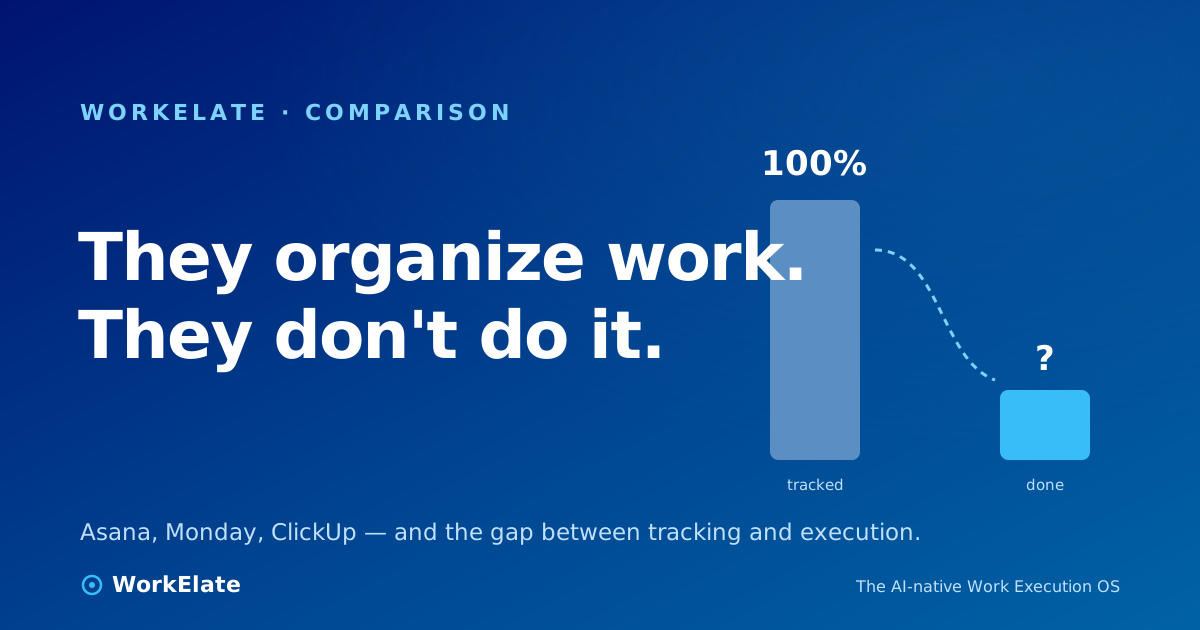
Asana, Monday, and ClickUp are genuinely good software. This isn't a takedown of their craft — it's a look at a ceiling all three share by design. They are built to organize work. The thing teams actually want is for the work to get done. Those are not the same problem, and the second one was never the one these tools set out to solve.
Start with what's true, because the fair version is more useful than the strawman.
Asana made a bet most of its peers didn't: model work as a connected graph, not a pile of lists. Founded in 2008 by two ex-Facebook engineers who were tired of "work about work," Asana spent years building a data model where tasks link to projects, projects to goals, goals to owners and dependencies. TechCrunch, back in March 2018 when Timeline launched, called it groundwork for the "team brain." That Work Graph is the real asset — it's exactly why Asana can now layer AI Studio and AI Teammates on top. The graph was the foresight.
Monday made a different, equally sharp bet: one configurable visual board, with colored status columns, that anyone could read in three seconds. It started life as "dapulse," nearly died as a team-chat tool, and found its footing only when it centered everything on that board primitive. From there it scaled one engine into CRM, Dev, Service, and ITSM. The board's instant legibility is why Monday crossed roughly $1.2B in revenue and ~245,000 paying customers — people genuinely enjoy using it.
ClickUp made the breadth bet: kill the "toggling tax" of fifteen disconnected tools by putting tasks, docs, goals, dashboards, whiteboards, chat, and forms under one roof. It reached 100,000+ teams in about three years on near-zero paid ad spend, riding a generous free tier and a relentless weekly-shipping roadmap that made power users feel like co-authors.
Three real strengths: a graph, a board, and breadth. None of them is the problem. The problem is what all three do after they've organized the work — which is, structurally, nothing.
A project board is a beautiful representation of intent. It is also, most of the time, slightly wrong. The card says "In Progress" because someone moved it there on Tuesday; the actual work stalled on Wednesday when a dependency slipped, and the board has no idea. Operators have a phrase for this: the board always lies. Not because the tool is bad — because the tool can only know what a human last typed into it.
That single fact cascades into the four ways these tools quietly hand the real work back to you.
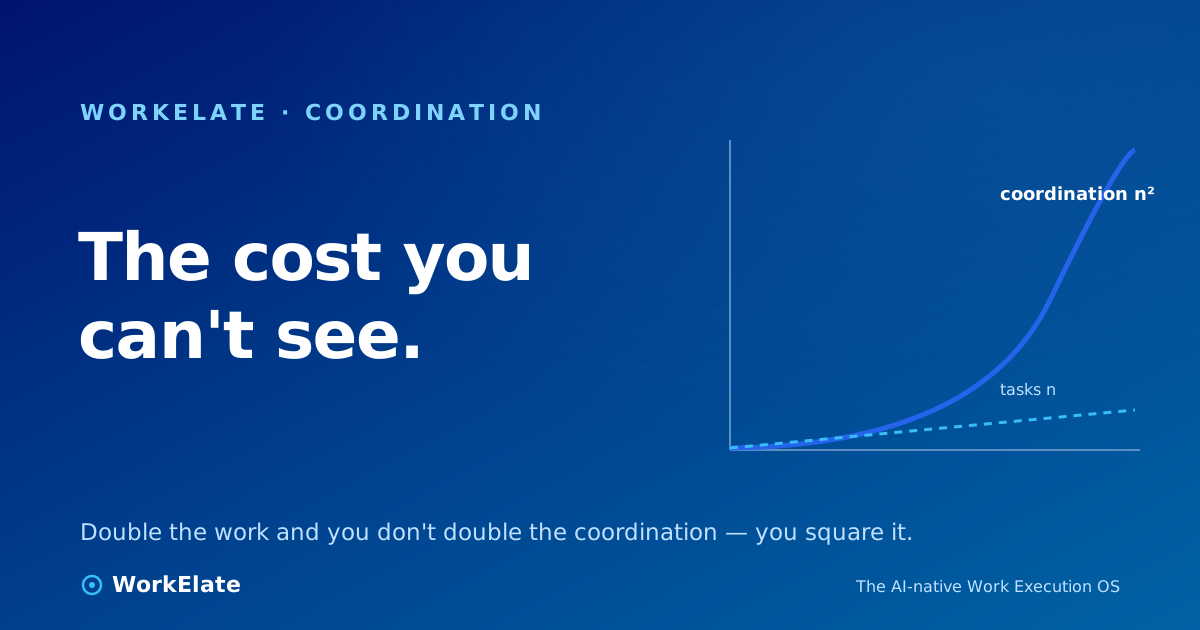
They run on manual updates. Status doesn't change until a person changes it. Someone has to move the card, ping the next owner, and reconcile what the board says against what's true. That labor — updating the system of record so the system of record stays honest — is the coordination tax. It's invisible on the invoice and enormous in the aggregate.
They don't carry context across the seam. A task in Asana doesn't know what was decided in yesterday's call, what the latest version of the spec says, or what the client already approved. The context lives somewhere else, so every handoff is a re-explanation. The tool holds the label for the work, not the understanding of it.
They display dependencies; they don't resolve them. Yes, you can draw a line from Task B to Task A. But the line doesn't do anything. A human still has to notice A finished, check that B is unblocked, and nudge the owner. The arrow is a drawing of coordination, not coordination.
They sit beside the work, not inside it. This is the deepest one. The plan lives on the board; the work lives in docs, sheets, inboxes, decks, and conversations. So teams maintain two realities — one where work happens, one where it's tracked — and spend real effort keeping them in sync. The tracking system can't act on the work because it was never wired to.
Add these up and you get the illusion of control. The board looks organized. Every card has an owner and a date. Everything seems handled. But when forward motion depends on humans manually coordinating across disconnected surfaces, the plan is a snapshot, not an engine.
All three companies see this. Asana has AI Teammates. Monday has Magic, Sidekick, and Agents. ClickUp has Brain and Brain MAX. The market is voting that AI agents do real work — which is the right instinct.
But look at the shape of these features. They are AI layers sitting on top of apps that don't emit a shared work-graph the AI can act on. ClickUp Brain indexes across its modules; Asana's AI reasons over Asana's graph; Monday's agents act on Monday's boards. Each is a smart reader of one walled dataset, retrofitted onto an architecture designed for humans to drive. That's why the Copilot 3.3% number matters as the category's tell: an assistant pinned to a CRUD suite is still an assistant. It can summarize the board and draft the update. It cannot be the thing that keeps every surface true.
The incumbents know this is the fork. Asana's growth has decelerated to roughly 9–11%, and on the day its founder announced retirement alongside soft guidance, the stock fell about 25% — the market pricing the question of whether tools built for humans clicking get commoditized by AI that does the work. Monday dropped about 22% in a single February 2026 session on the same fear. The anxiety isn't irrational. It's structural. You cannot easily retrofit a board-per-product architecture into one brain that reasons across everything.
There's a tell from history here too: Google needed roughly fourteen years to make Gemini reason across Gmail, Chat, and Drive together. Monolithic suites are slow to rewire for cross-app reasoning, because the wiring was never there. That slowness is the opening.
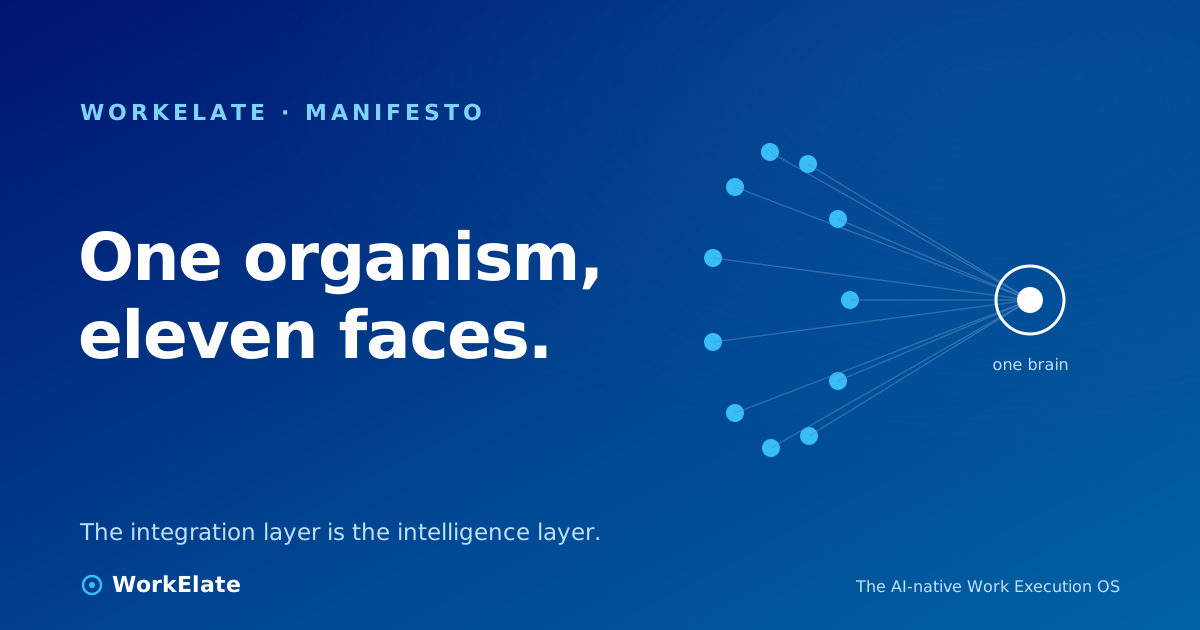
WorkElate starts from the opposite end. It is eleven surfaces — hub, weMail, chat, data, docs, ppt, calendar, task, board, journey, form — but the surfaces aren't the point. The point is that every one of them emits into a shared cross-app work-graph the moment something changes, and one orchestrating intelligence — WAO — can read and write to that graph. Not eleven apps with AI bolted on. One brain across the work.
The difference is the difference between inferring a graph and emitting one. Asana, Monday, and ClickUp infer structure from what humans type and can only read it back. WorkElate's apps emit the graph as a side effect of the work itself, so the brain can act on it. The integration layer, in other words, is the intelligence layer.
Concretely, WAO runs a loop most copilots don't have: it senses a change, recalls the relevant context and memory, reasons, decides, acts — and on anything high-stakes or irreversible, it stops and asks before executing. Suggest, confirm, execute. One example you can watch in the product: ask form to "book my time" and it builds a real bookable scheduler that actually locks the slot and creates the calendar event — not a fake dropdown that looks like Calendly and does nothing. The two stages that make it more than a chatbot are recall and remember: the brain carries context across the handoff instead of asking you to re-explain it.
Two honest caveats, because this brand treats honesty as the product. WorkElate emits and acts across its own eleven surfaces — it is not a universal agent reaching into your existing Figma or Slack today. And the brain confirms before destructive or client-facing actions by design; it is a delivery manager you oversee, not an unsupervised autopilot. The claim is scoped on purpose: an AI that does the mechanical coordination work across a connected work-graph, with you in the loop.
| | Asana | Monday | ClickUp | WorkElate |
|---|---|---|---|---|
| Core strength | The Work Graph data model | One legible board engine | All-in-one breadth | One brain over a cross-app work-graph |
| Primary job | Organize & report on work | Visualize & track work | Consolidate the toolset | Execute the coordination work |
| AI posture | AI on top of Asana's graph | Agents on top of boards | Brain indexing its modules | AI-native from the spine |
| Cross-app graph | Inferred, read-only | Inferred, read-only | Indexed, read-only | Emitted, read and write |
| Memory across handoffs | Limited | Limited | Limited | Recall + remember loop |
| Acts, then confirms | Drafts, you act | Drafts, you act | Drafts, you act | Acts on the graph, confirm-gated |
The table isn't a feature scoreboard — breadth and polish are real and these tools win on them. It's a map of one axis: does the system read your work, or can it act on it?
Asana, Monday, and ClickUp solved organizing. They solved it so well that we mistook a clear board for a finished job. But a board is a representation of intent, and intent doesn't ship itself. As long as forward motion depends on humans manually updating disconnected surfaces, the tool can show you the plan and then hand the plan back to you to run.
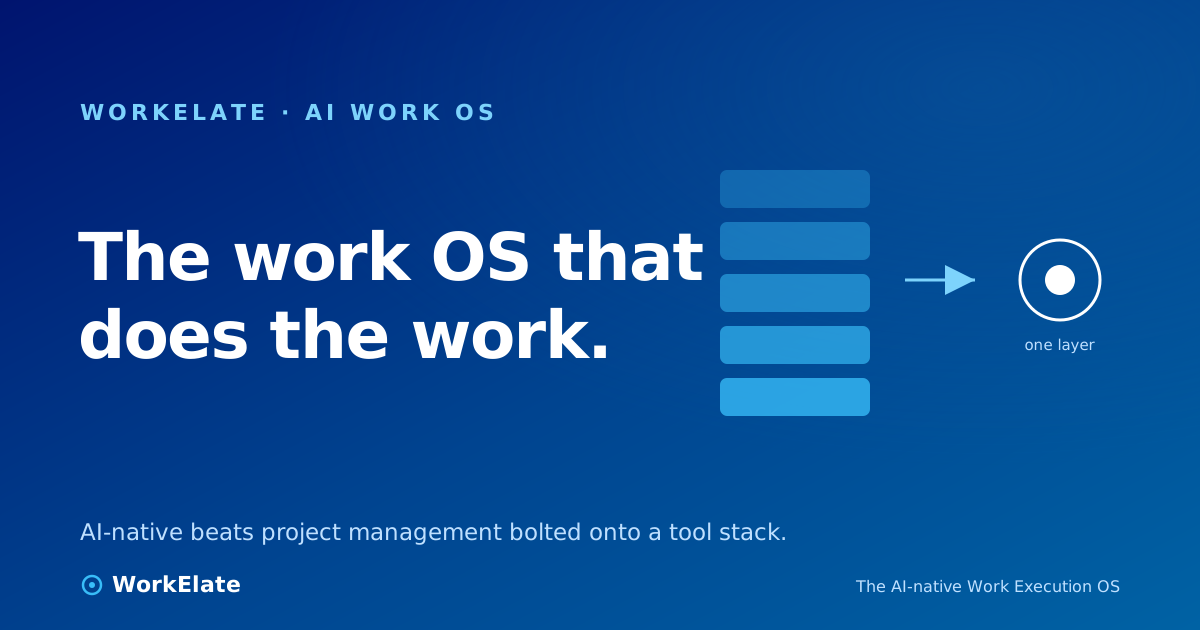
The shift underway isn't from one project tool to a better one. It's from software that tracks work to software that does the mechanical share of it — because the apps finally emit a work-graph an AI can act on, with you confirming the calls that matter. That's a different category, and the incumbents' own AI scramble is the loudest evidence it's real.
If you want the deeper argument, see the real cost of a task is coordination and why AI work systems are eating SaaS. For the head-on version of this thesis, read the AI work OS replacing project management.
Watch: track vs. do, shown not told See the cross-app handoff on @WorkElate — video coming soon.What's the difference between project management and execution?
Project management organizes work — tasks, owners, dates, status — and relies on people to keep all of it true and to coordinate the handoffs. Execution is the coordination itself: noticing a dependency cleared, carrying context to the next step, updating the record, moving the work forward. Asana, Monday, and ClickUp do the first. The gap is the second.
Isn't WorkElate's AI the same as ClickUp Brain or Asana AI Teammates?
Same instinct, different architecture. Those features are AI layers on apps that don't emit a shared work-graph, so the AI mostly reads one walled dataset. WorkElate's apps emit a cross-app work-graph as work happens, and the brain can read and write to it — then confirm before high-stakes actions. The difference is emitting a graph the AI acts on versus inferring one it can only read.
Does WorkElate work with my existing tools like Figma or Slack?
Today WorkElate acts across its own eleven surfaces, not as a universal agent inside third-party apps. That's a deliberately scoped, present-tense claim — the point is one brain over a connected work-graph it can actually act on, not a thin layer over tools that stay disconnected.