Work Systems
All-in-One Work Platform vs. Best-of-Breed: Who Owns the Connection?
All-in-one work platform vs. best-of-breed stack: the value lives in the connection between tools — and in a stack, you are the integration layer.
All-in-one work platform vs. best-of-breed stack: the value lives in the connection between tools — and in a stack, you are the integration layer.
There's a question buried inside the all-in-one work platform vs. best-of-breed debate that almost nobody asks out loud, and it's the only one that matters: when the work moves from one tool to the next, who carries it?
Not the file. Not the task. The work — the meaning of the thing, the context of why it exists, the decision about what happens next. When a form gets submitted and a task should be created and the client should be told and the deadline should land on someone's calendar, something has to carry that intent across four surfaces. In most companies, that something is a person. A human being, opening tabs, retyping the same fact, reminding people, checking whether the thing actually got done.
That person is the integration layer. And the entire all-in-one-vs-best-of-breed argument is really an argument about whether you want to keep that job — or hand it to software.
Let's kill the lazy version of this argument first, because it's everywhere and it's wrong.
The lazy version says: you have too many tools, tools are bloat, consolidate everything into one suite and your problems disappear. It's a comforting story and it sells suites. It's also nonsense for any team doing real work. Your designers want the design tool that's genuinely the best at design. Your engineers want the issue tracker that fits how engineers actually think. Your finance lead has a spreadsheet they will pry from your cold hands. Specialized tools exist because specialization is good. A team that adopts the single best tool for each job is not being undisciplined. It's being good at its job.
So the tool count was never the enemy. Here's the test that proves it: imagine your stack stayed exactly the same size — same eight tools, same logos — but the moment a client emailed, the relevant task updated itself, the right doc surfaced, the deadline appeared on the right calendar, and the status everyone could see was actually true. Would you still feel the pain? You wouldn't. Same number of tools. The pain is gone.
Which means the pain was never the tools. The pain lives in the gaps between them. Every gap is a place where work has to be carried by hand. Every handoff is a tax. The form-to-task handoff. The chat-to-calendar handoff. The "wait, which doc is the latest one" handoff. Each one is small. There are hundreds of them a week. Added up, they are most of what a coordinator's day actually is.
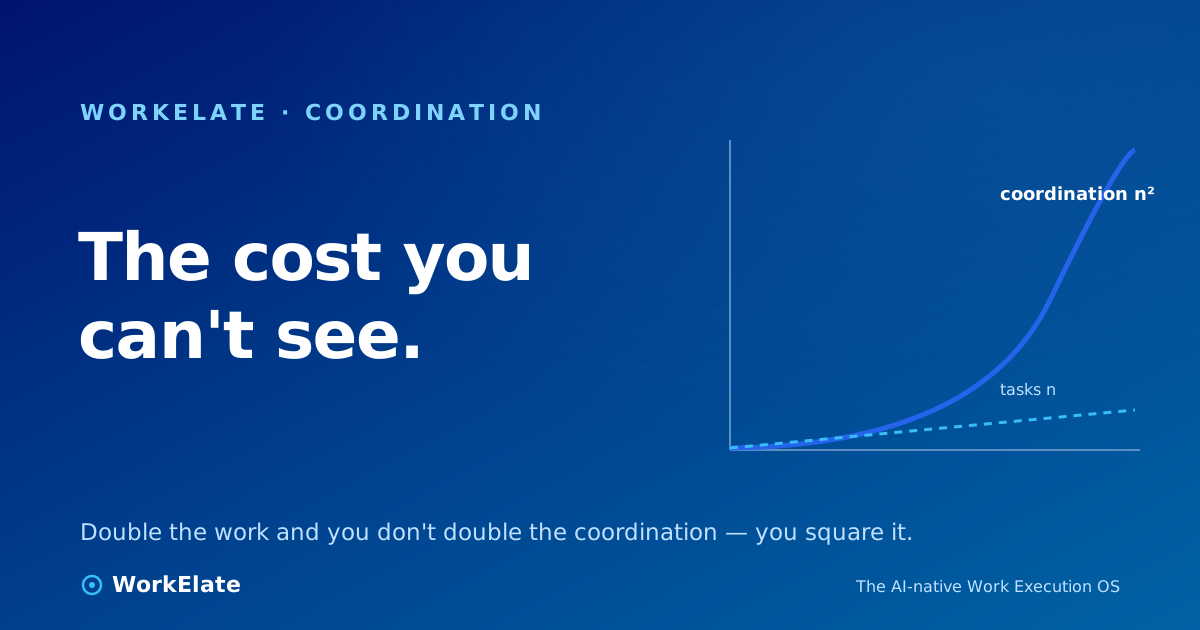
This is the coordination tax, and your best people are the ones paying it. The senior account manager who should be deepening the client relationship is instead the human router between six apps. That's the real cost — not the SaaS bill, the people bill.
And it's worth naming why the gap feels invisible until it isn't. No single handoff is expensive enough to show up on any dashboard. Retyping a date takes nine seconds. Checking whether a task was updated takes a tab switch. Reminding someone takes one message. Nothing here is a fire, so nothing here gets fixed, and the cost hides in the spaces between the line items on your budget. You can't point to the meeting where the coordination tax was decided, because it was never decided — it accumulated. The teams that feel it most aren't the ones with the most tools; they're the ones doing the most cross-functional work, where every deliverable touches four roles and three apps before it's done. The more your work crosses surfaces, the more of it lives in the gaps, and the gaps are exactly the part no tool's feature list describes.
Here's where the marketing gets slippery, so let's be precise.
A lot of products sell themselves as "all-in-one." Open the box and you find: a tasks module, a docs module, a chat module, a whiteboard, a form builder — a respectable catalog of apps, all under one brand, one login, one bill. And for that you do get something real: one vendor, one onboarding, one place to look. Consolidation has genuine value, and we won't pretend otherwise.
But notice what consolidation doesn't give you. If those modules each keep their own data, their own state, their own little island of context, then sharing a login screen changed nothing about the work. The task module still doesn't know what the form module just learned. The chat still can't see the calendar. You, the human, are still the one carrying meaning from one to the next. You've replaced eight invoices with one invoice. You have not replaced yourself as the integration layer.
That's the trap hiding inside the word "all-in-one." It quietly promises connection but often only delivers co-location. Apps living in the same building is not the same as apps that talk. A suite where the modules don't share a model of your work is a best-of-breed stack wearing a uniform.
So the real spectrum isn't "many tools → one suite." It's this:
Co-located (one bill, separate brains) → Integrated (wires connecting separate brains) → Connected (one shared brain across every surface).
Most "all-in-one" platforms get you to co-located. A pile of Zapier zaps and native integrations gets a best-of-breed stack to integrated. Almost nobody gets you to connected — and connected is the only state where the integration job actually leaves your team's hands.
When people say "but my tools are connected," they mean one of two things. They're worth separating because only one of them does the job.
This is the world of native integrations, iPaaS, and automation builders. You draw a wire: when a form is submitted, create a task; when a deal closes, post to a channel. It's genuinely useful and we're not knocking it. For deterministic, "if-this-then-that" plumbing, it's the right tool.
But integration has a ceiling, and the ceiling is judgment. A wire fires the same way every time. It can copy a field from A to B. It cannot decide that this particular submission is from your biggest client and the deadline is unrealistic and someone senior should look before it goes out. The moment a handoff needs a decision — is this in scope, is this at risk, does this need a human — the wire can't make it. So the wire hands it back to you. Integrations don't remove the integration layer; they automate its easiest 30 to 40 percent and return the rest. The judgment, the exceptions, the "it depends" — that's still your team, and that's the expensive part.
And wires break. Every iPaaS user knows the maintenance reality: an API changes, a field renames, a sync silently stalls, and now you have a new job — babysitting the connections that were supposed to save you work. The brittleness is real, but it's the smaller problem. The bigger one is that a graph of brittle point-to-point wires has no shared picture of your work. It has a hundred opinions about individual handoffs and no understanding of the whole.
The other way is structurally different. Instead of wiring separate apps together after the fact, the surfaces all emit into one shared model of your work, and one intelligence reasons over that whole model and can act back on any surface.
The distinction the industry keeps blurring is read vs. act, and it's the whole ballgame. Plenty of AI tools can now read across your stack — index your apps, answer questions, summarize. That's real and it's useful. But reading is observation. The integration layer isn't an observation job; it's an action job. The work isn't carried until something actually creates the task, books the slot, sends the update. A system that owns the write-path — that can act across the surfaces, not just describe them — is the only kind that can take the integration job off your plate. Everything else just narrates the work you're still doing by hand.
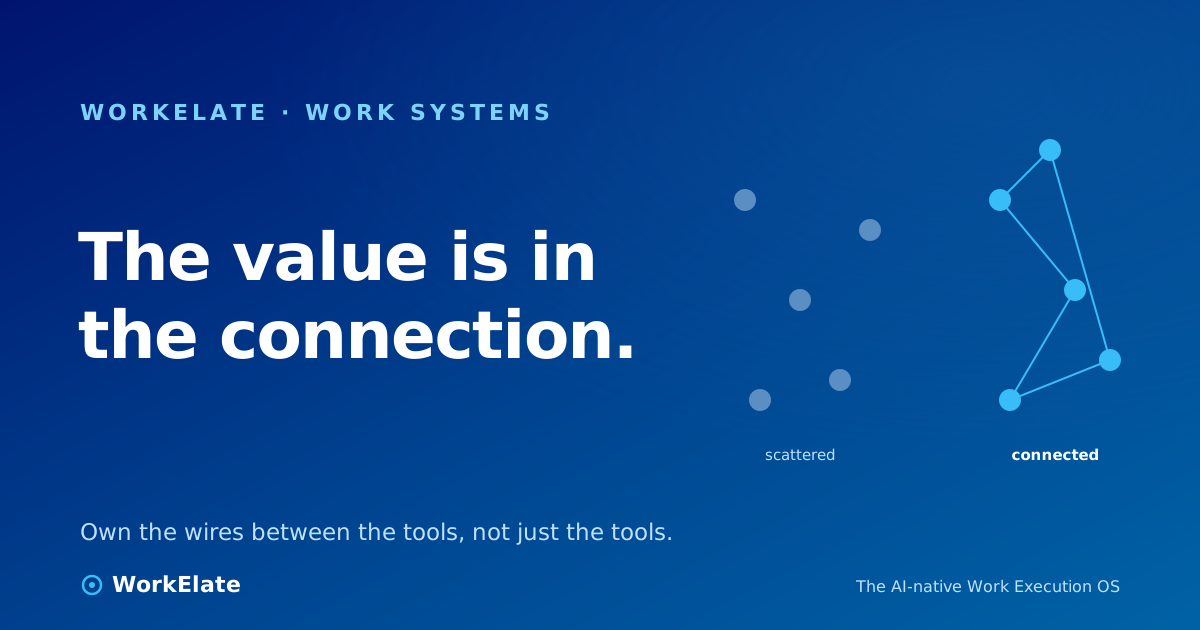
That's the line worth drawing on a whiteboard:
On the left, you are the hub. Every handoff routes through a human. On the right, the surfaces feed one graph, and one brain works the graph. Same apps. Completely different question about who's doing the carrying.
It's easy to say "one brain, one graph." It's worth being concrete about what a platform has to actually have for that to be true, because this is the checklist you should hold every "all-in-one" vendor to.
When something happens in any app — a form submitted, a card moved, a doc edited, a slot booked — the platform has to record it as an event into a shared model, not just save it inside that one app's database. There's a sharp test here: they infer the graph and can only read it; we emit the graph and can write to it. A system that owns its surfaces gets the events for free, the moment they happen, with full fidelity. A system bolted on from outside has to reconstruct what happened by polling APIs and guessing. The first one is connective tissue. The second is a detective.
A connected model isn't "here are events from five apps." It's "here is everything that ever happened for this client, across every app, in one thread." The graph is keyed on the account, the project, the thing-being-delivered — so the brain can ask a question no single app can answer: what's the real state of this client's work, everywhere? That cross-app view is the asset. It's also the thing a pile of point-to-point integrations can never assemble, because wires connect apps, not work.
This is the part that gets faked most often. The convincing version is one orchestrating intelligence with the same context across every surface — so the AI you talk to in your inbox knows what the AI in your task board knows, because it's the same brain reading the same graph. The unconvincing version is a separate copilot bolted onto each app, each blind to the others. Per-app copilots are the multi-agent anti-pattern: a smart assistant in your docs that has no idea what your calendar just learned is just a faster way to produce disconnected work. If the assistants don't share context, you're back to being the integration layer — now with extra chatbots.
Reading is table stakes; acting is the job. But acting across people's real work demands a trust reflex, not a free-for-all. The pattern that works is suggest → confirm → execute: the brain proposes, you approve the things that matter, it carries out the rest. The reversible, low-stakes work it can just do. The client-facing, irreversible, money-touching work it brings to you first. That's not a limitation — it's the only way owning the write-path is safe enough to actually want.
Run that four-part test against any platform calling itself all-in-one. Most pass on the catalog and fail on the connection. The catalog was never the hard part.
Abstractions are cheap, so here's a concrete one — the kind of handoff that happens dozens of times a week at any agency.
A prospect fills out your intake form: "I need help, and I'd like to book a call this week."
In the tool-stack world: the form tool stores a submission. Someone has to notice it. They read it, decide it's real, open the task tool and create a task, open the calendar to find a slot, email the prospect a time, and then remember to follow up if the prospect doesn't reply. Five surfaces, one human carrying the work across all of them, and a real chance one step gets dropped because it was Friday at 5pm. If you wired up a form-to-task integration, the task gets made automatically — but the wire can't tell that this person asked to book a call, so the scheduling, the judgment about urgency, and the follow-up are still yours.
In the connected world: the form is one surface that emits into the graph. The brain reads the submission, understands "book a call this week" as an intent, and — here's the part the catalog can't fake — produces a real bookable scheduler, not a dead dropdown that captures a preference and locks nothing. It can hold the slot, create the task, surface the right context for whoever takes the call, and keep the thread alive. You confirm the things that matter; the carrying is done. (WorkElate's form app does exactly this today: "book my time" yields a genuine scheduler with tokenized cancel links, not a fake Calendly that books nothing — a small, checkable proof that the surfaces and the brain are actually wired together.)
The difference between those two stories is not the number of apps. Both have a form, a task board, a calendar. The difference is whether the connection between them is a person or a system.
Notice, too, what the connected version doesn't claim. It doesn't say the form builder is prettier than the best standalone form builder, or that the calendar out-features a dedicated scheduling app. It might not. The win isn't on any one surface — it's in the seam, the place where the work moves from the form to the task to the calendar without a human carrying it across. That's the thing you cannot buy as a feature, because it isn't a feature of any app. It's a property of how the apps relate. And a property of the relationship is, almost by definition, something only a system that owns the relationship can give you. You can bolt a great form tool and a great calendar tool side by side forever and never get it, because the relationship between them was never theirs to own — it was yours.
Here's the comparison laid flat, without putting a thumb on the scale. Best-of-breed has genuine strengths. The point isn't that one is good and one is bad — it's that they answer the "who owns the connection" question very differently.
| Dimension | Best-of-breed stack | "All-in-one" suite (co-located) | A connected work system |
|---|---|---|---|
| Per-app excellence | Highest — pick the best of each | Varies — modules rarely all best-in-class | Varies — bet is connection > peak per-app polish |
| Who owns the connection | You (and your iPaaS wires) | Mostly still you | The platform — shared graph + one brain |
| Cross-app context | Lives in your head | Lives in your head | Lives in the work-graph |
| Handoffs | Manual or wired (brittle) | Manual within one bill | Reasoned, then acted, with confirm gates |
| AI | Per-app copilots, blind to each other | Per-app copilots, blind to each other | One brain, same context everywhere |
| Acts or just reads? | Reads; you act | Reads; you act | Reads and writes the work-path |
| Failure mode | Wires break; you're the glue | One vendor, still disconnected inside | Trust: it must earn the right to act |
| Right when | Each tool's peak quality is the priority | One bill + one onboarding is the priority | Coordination across tools is the bottleneck |
Read the last row first. If your bottleneck is the quality of any single tool, best-of-breed is correct and you should ignore every all-in-one pitch. If your bottleneck is the coordination between your tools — the handoffs, the status, the carrying — then no amount of per-app excellence fixes it, and no amount of shared-login co-location fixes it either. Only owning the connection does.
A playbook that can't name when it's wrong isn't a playbook, it's an ad. So: keep your best-of-breed stack when the specialized tool's depth is the whole point. A film studio's color-grading suite, a quant fund's execution platform, a surgeon's imaging software — the peak capability is irreplaceable and "connection" is a distant second concern. Keep it when a niche tool encodes domain knowledge no general platform will match. Keep it when switching cost dwarfs the coordination tax you'd save.
The mistake isn't choosing best-of-breed. The mistake is choosing it and then pretending the coordination tax doesn't exist — paying it in your team's hours, quietly, forever, while telling yourself the tools are "integrated" because you drew some wires. If you're going to be the integration layer, at least know that's the job you signed up for, and price it.
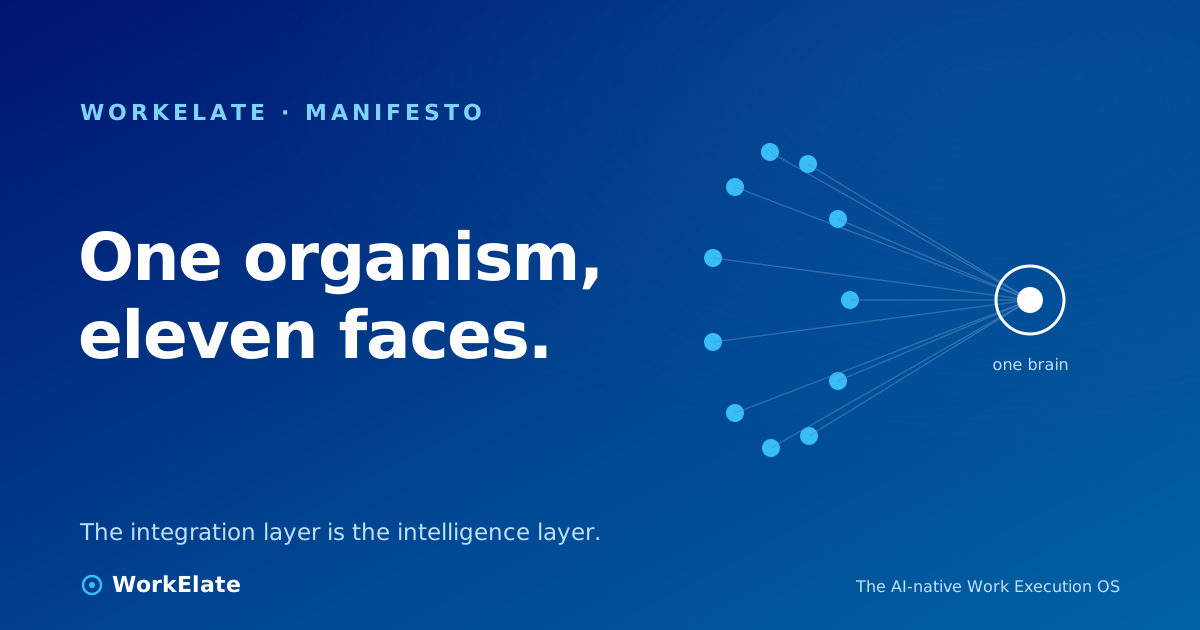
We'll be precise, because precision is the brand. WorkElate is eleven surfaces — hub, weMail, chat, data, docs, ppt, calendar, task, board, journey, form — and we don't pretend each one out-polishes the single best standalone tool in its category. That's not the bet.
The bet is the connection. All the surfaces emit into one cross-app work-graph, and one brain — WAO, the orchestrator — reads that whole graph and can act back on any surface, through a sense → recall → reason → decide → act → remember loop, with confirm gates on anything that matters. One SDK AI drawer, one brain behind it, mounted across every web app: not eleven copilots, one. That's the difference between a suite that shares a login and a system that shares a mind.
We're not the only software that can read across your stack — that would be a false claim, and false claims fail diligence. What's rare is owning the surfaces and the write-path, so the brain can carry the work, not just narrate it. The honest one-liner: most tools infer your work-graph and can only read it; we emit it and can write to it. That's the whole position, and it's checkable.
If you want the longer argument for why this shape is winning the market, it's the same one in why work systems are eating SaaS and how an AI work OS is replacing project management. And if you want the dollar figure under "coordination tax," we put real numbers on it in the real cost of a task is coordination.
A best-of-breed stack is the single best tool for each job, connected by you and your integrations. An all-in-one work platform puts many functions under one roof — but the real differentiator isn't the catalog, it's whether the apps share one model of your work and one intelligence that can act across them. Co-location under one bill is not the same as connection.
It can be exactly that — and that's the trap. If the modules each keep their own data and context, you've consolidated your invoices without connecting your work. A real work system is defined by the shared work-graph and the single brain across surfaces, not by how many apps live under one login.
Not necessarily, and not always immediately. The question to ask is where your bottleneck is. If it's the depth of one specialized tool, keep it. If it's the coordination between your tools — the handoffs, the status, the carrying — that's the part a connected system takes over, and that's where the time goes.
Integrations handle the deterministic, "if-this-then-that" slice — roughly the easiest 30–40% of the work — and they hand the judgment back to you. They also break when APIs change. They're genuinely useful for plumbing, but a graph of point-to-point wires has no shared picture of your work and can't make the decisions that handoffs actually require.
Four things: the apps emit events into a shared model (not just store data locally), the model is keyed to your work (the client/project, not the app), one brain reasons across the whole model with the same context everywhere, and it can act across surfaces — not just read — under a suggest → confirm → execute trust reflex.
Because reading across your stack is now common — lots of AI can summarize and answer questions. But the integration layer is an action job. Work isn't carried until something creates the task, books the slot, sends the update. Owning the write-path — the ability to act, not just observe — is what actually takes the coordination job off your team's plate.