POV
Your Task List Is a Lagging Indicator
The board always lies.
The board always lies.
The board always lies.
Not maliciously, and not because your team is sloppy. It lies the way a photograph lies: it shows you a moment that has already passed. A card sits in "In Progress" for four days. You look at it Monday morning and think, that's moving. But the card hasn't told you the truth. The designer finished her part Friday afternoon, dropped it in a Slack thread, and is now waiting on a copy review nobody has picked up. The card says "In Progress." The reality is "stalled, two handoffs deep, and no one knows." The board won't catch up until someone remembers to drag the rectangle to the next column — which, if they remember at all, will be long after the moment that mattered.
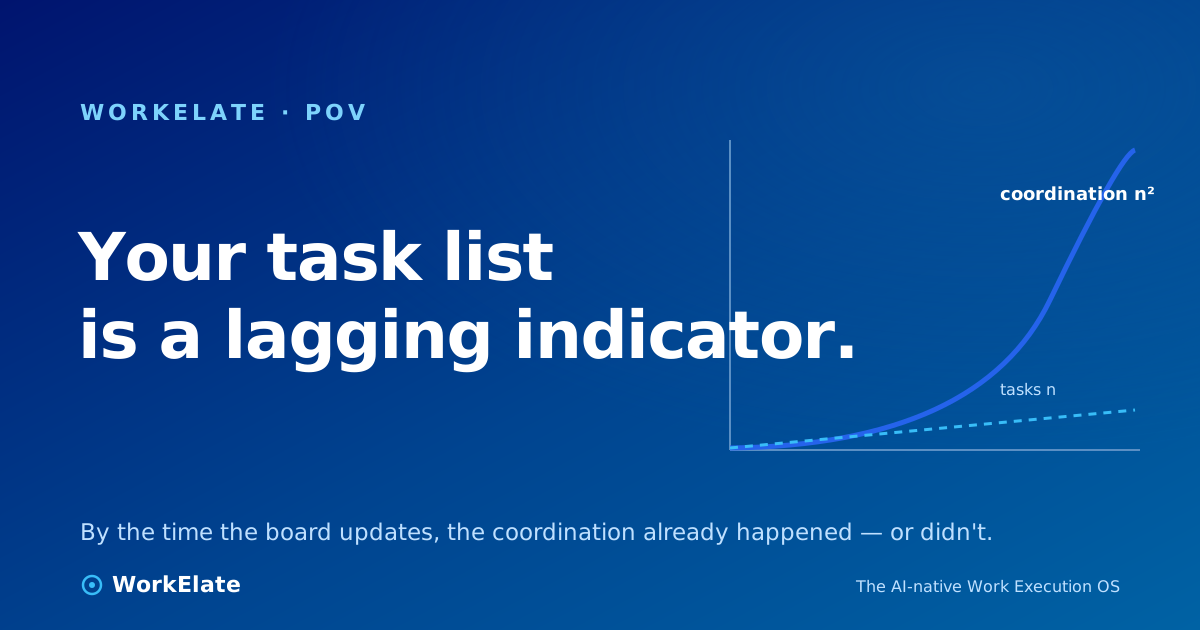
This is the quiet problem at the center of every project tool, and almost nobody names it. A task list is a lagging indicator. It records what already happened. By the time a card moves, the coordination it represents has already succeeded or already failed. You are reading a report, not watching the work.
There's a useful distinction from operations: leading indicators predict an outcome, lagging indicators confirm it. A fire alarm is leading. A burn mark is lagging. Task management tools are built almost entirely out of burn marks.
A task is late — you find out when the due date passes. A dependency is blocked — you find out when the person downstream stalls and complains. A handoff dropped — you find out when the client emails asking where the thing is. In every case, the board reports the failure after the window to prevent it has closed. The information arrives too late to be worth much, which is a strange thing to say about your primary instrument for running the work.
And the metrics built on top of the board inherit the lag. Velocity, burndown, tasks-completed-this-sprint — they all measure volume of motion, not whether anything was coordinated correctly. You can close fifty cards and still have shipped late, because forty-nine of them moved on time and the one handoff that mattered sat dead in a DM for three days. The board will show you a tidy burndown and a happy team. It will not show you the one place the work actually broke.
Here is the part that's easy to miss. The reason the board lies isn't that people are bad at updating it. It's that the board was never where the truth lived.
Think about what actually happens when work moves. A file gets uploaded. A message gets sent. A doc gets a comment. An email goes out. A form gets submitted. A calendar invite gets accepted. Each of those is a real event, with a real timestamp, happening in a real app. That is the coordination — the live wire of the work. The card in "In Progress" is a hand-typed summary somebody is supposed to produce on the side, after the fact, when they get around to it. We have built our entire sense of "where things stand" on the least reliable signal in the building: a human remembering to update a label.
The events are already happening, in real time, across every tool the team touches. The board asks a person to notice them, interpret them, and re-type them into a rectangle. No wonder it lags. We've taken the one thing the system already knows for free — what just happened — and made it a manual chore.
This is the reframe WorkElate is built on, and it's worth saying plainly: status should be something the system observes, not something a person produces.
Underneath the eleven apps — weMail, chat, data, docs, ppt, calendar, task, board, form, and the rest — every meaningful action emits a signal. A card moves, a doc is edited, a form is submitted, a scheduler slot gets booked: the mutation announces itself. Those signals assemble into one cross-app work-graph keyed to the client and the account — a live picture of who is waiting on whom, what handed off to what, and where the chain went quiet. Not a column somebody updated. The actual events, as they land.
The difference from a normal dashboard is the direction of the data. Most tools infer status by reading whatever you remembered to type. WorkElate emits status as a byproduct of the work itself. The first approach is always one human memory behind reality. The second is reality. That's why the WorkElate philosophy holds that the integration layer is the intelligence layer — the value isn't a prettier board, it's that the system can finally see the work without anyone narrating it.
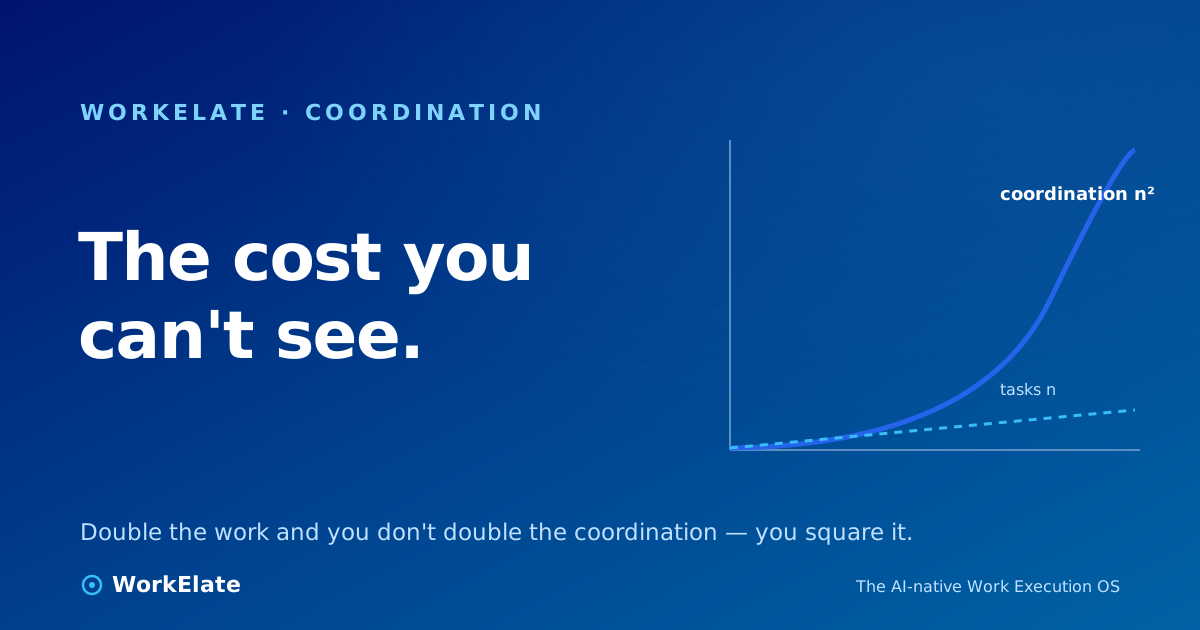
And once the graph is live rather than typed, the manual status update stops being theater — the standup where everyone recites what the system already knows. The dependency that used to sit silent until it became a fire is visible the moment the upstream signal goes quiet. The work-graph makes plain what the board structurally hides: that the real cost of a task is the coordination around it, not the checkbox at the end.
▶ Watch on WorkElate See the work-graph update itself across apps youtube.com/@WorkElate · videoId: TODO — swap when publishedNone of this is about better cards or smarter columns. A faster horse is still a horse. The shift is moving the source of truth off the manually-updated list and onto the live stream of work the team is already generating — so that "where do things stand" becomes a question the system answers continuously, instead of a question a person answers late.
When status is observed rather than reported, a few things stop happening. You stop running your week off a snapshot that was already stale when you opened it. You stop holding meetings whose only purpose is to refresh that snapshot out loud. And your best people stop spending their attention being the glue — the human middleware that watches for the dropped handoff because the tool can't.
That's the real cost of the lagging indicator, and it's hidden in plain sight. It isn't the late card. It's that you built your operating picture out of the one signal that's always behind, and then asked your sharpest people to make up the difference by hand.
So here's the question worth sitting with: if every tool your team touches already knows what just happened, why is the most important fact in your business — where does the work actually stand right now — still something a tired human is supposed to type into a box?