POV
Manual Status Updates Are Coordination Theater
Status updates are theater — narrating reality to people who could have just looked, if the system actually knew the state. Status should be something the system knows, not something humans produce.
Status updates are theater — narrating reality to people who could have just looked, if the system actually knew the state. Status should be something the system knows, not something humans produce.
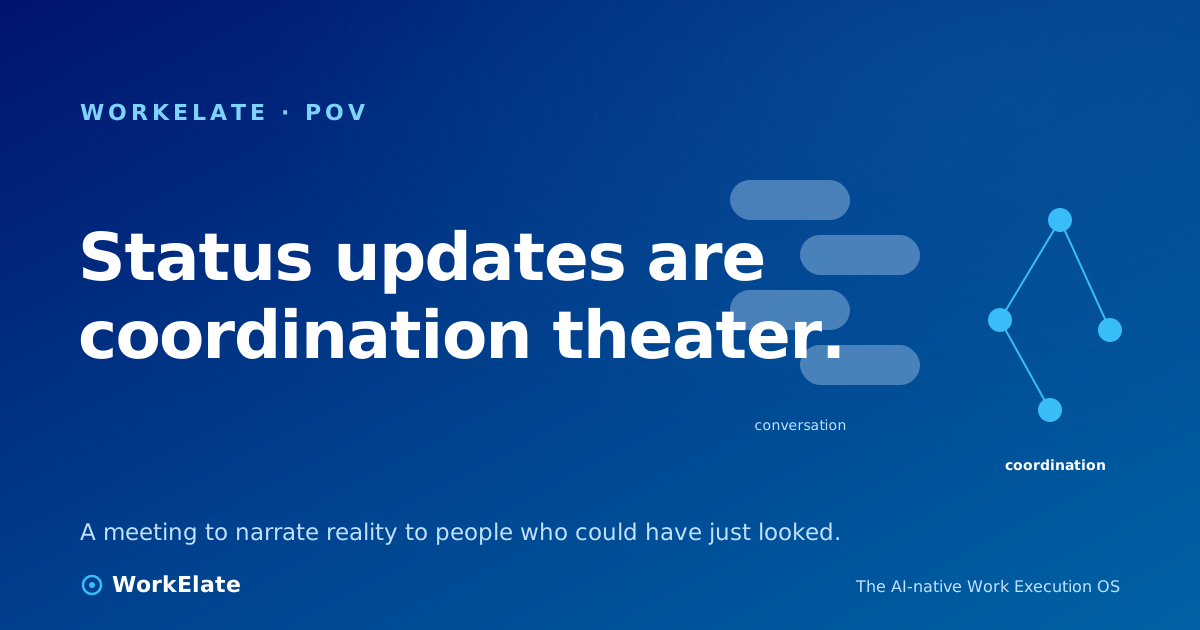
Think about what a status update actually is. A person stops working, reconstructs the state of that work in their head, translates it into a few sentences, and reads them out loud to a room — most of whom could have learned the same thing by glancing at the system, if the system knew it. That last clause is the whole problem. The reason we hold the meeting is that the system doesn't know. So a human becomes the system: the index, the query engine, the live read-out of a database that exists only in their memory.
We've called this "communication" and "alignment" for so long the strangeness has worn off. But strip the ritual back and it's theater — a performance of knowing-where-things-stand, staged because nobody can simply look and find out. The standup, the weekly status email, the thread that opens with "what's the status on X?" — these aren't work. They're the cost of work-state that no system holds.
It isn't that people write bad updates. The format itself fails, in three ways no discipline fixes.
It's lagging. A status update is a snapshot of a moment already gone. You say "I'm on the client deck" at the 9am standup; by 11 you're unblocking a teammate and the deck hasn't moved. The update was true when you said it and false an hour later — you're coordinating off a photograph of a thing that's still moving.
It's lossy. A person reporting status decides what others "need to know," filtered through their read of the situation. The detail that the client's approval is contingent on legal — the thing that blows up Thursday — gets left out, because it wasn't the headline. Status passed through a human narrator is status compressed, and the compression throws away the edge cases coordination exists to catch.
It's labor-intensive. Someone refocuses for roughly 23 minutes after each interruption, and "what's the status?" is an interruption with a polite face. Multiply the writing, attending, answering, and chasing across a team across a week, and you've spent a real fraction of your most expensive people's time narrating work instead of doing it. The narration produces nothing — it only describes.
Here is the move: stop treating status as an artifact people make, and treat it as a state the system holds.
When you drag a card to "done," the system knows the task is done — the exact instant it happens, zero lag, zero loss. When a form submission books a calendar slot, the system knows that slot is taken. When a doc gets final approval, the system knows the deliverable cleared. None of these needs a human to narrate it, because every one is something a surface did. The status already exists, fully accurate, the moment the work moves. The only question is whether anything captured it.
Most tools don't, and that's why the theater persists. Each app knows its own slice — task knows the card moved, calendar knows the meeting booked, inbox knows the client replied — but none shares that slice into a common model. So the "real status" of a deliverable lives nowhere as a whole; it's only fragments across tools that don't talk. The one place it assembles into a picture is inside a person's head, and the one way it gets out is the meeting. The status meeting isn't a communication problem — it's the symptom of a system that can't read its own state.
"Make status automatic" is easy to say and a specific architecture to build — and the half-measures fail in instructive ways. A dashboard that scrapes one tool knows one slice, so cross-tool status still gets assembled by a human. A bot that auto-posts "daily standup" prompts just automates the theater. For status to be something the system genuinely knows, three properties have to be true at once.
First, every surface emits what it did into one shared model — the task move, the booked slot, the approval, the client reply — not into its own private log. A mutation that emits nothing is invisible; as far as cross-app status goes, it didn't happen. Second, that model is keyed to the work itself — this client, this deliverable — so the fragments from task, calendar, form, and inbox assemble into one object you can ask about. Third, one intelligence reads that whole model and reasons over it, so "what's the real state of this account?" returns a grounded answer the same way every time — not a different reconstruction each time someone asks.
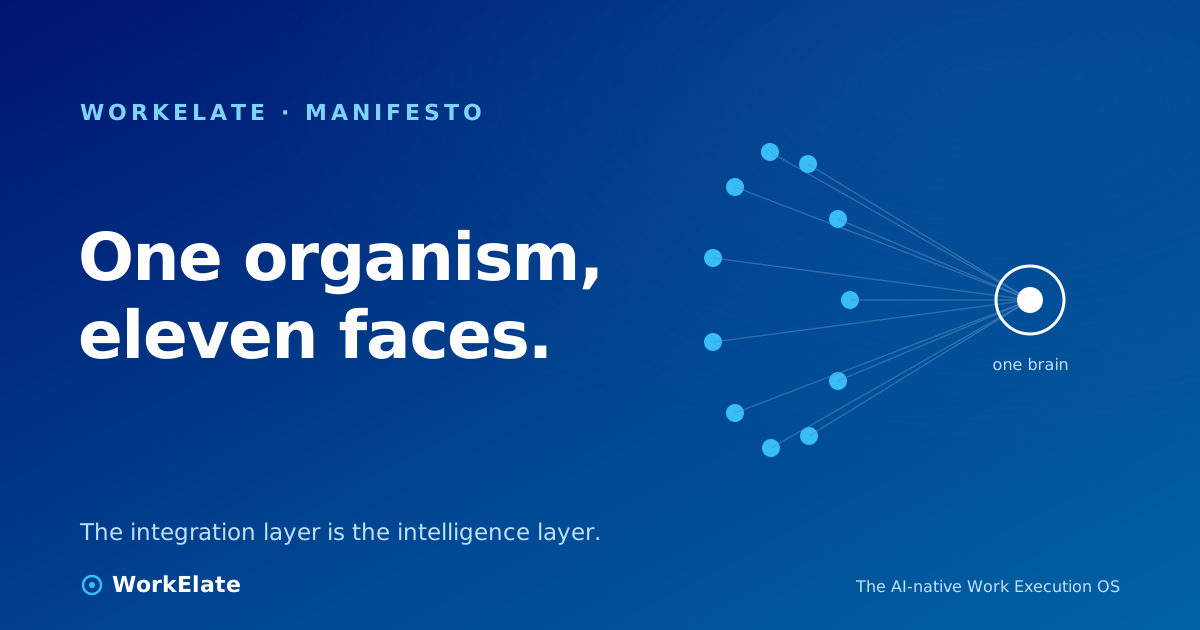
That's the layer WorkElate is built around: eleven surfaces — hub, weMail, chat, data, docs, ppt, calendar, task, board, journey, form — emitting into one cross-app work-graph, with one brain, WAO, reasoning over it through a sense → recall → reason → decide → act → remember loop. When a form's "book my time" question turns into a real bookable slot, that booking is emitted as work-state, not left in one app's table. Status stops being a thing your people produce and becomes a thing the system holds.
Notice what this does to the meeting. The standup doesn't get a tighter timebox — it loses its reason to exist. You don't gather to find out where things stand when where-things-stand is a field you read. The conversation you keep is the one always worth having — the judgment call, the trade-off. The one you drop was only ever a human reading a database aloud. The hours your senior people spend on that read are itemized in the real cost of a task is coordination. It's the same reason your task list is a lagging indicator — a list, like a status report, is a snapshot already gone — and the flip side of Slack is for conversation, not coordination: conversation belongs to people, state belongs to the system, and the theater starts the moment we make people produce the state.
One honest line, because precision is the brand: plenty of tools now summarize your activity into a tidy update. That's a faster narrator — still a narrator. The difference is where the state lives. Most tools infer your work-graph and can only read it; we emit it and can act on it. That's the position, and it's checkable.
▶ Watch on WorkElate Ask "what's the status of this client's work?" and read one grounded answer youtube.com/@WorkElate · videoId: TODO — swap when published