POV
Why Most Work Dies Between Intent and Action
Think about the last thing your team decided to do and didn't.
Think about the last thing your team decided to do and didn't.
Think about the last thing your team decided to do and didn't.
Not a thing you debated. A thing you decided. The meeting ended cleanly, the next step had an owner and a date, and everyone left agreeing it would happen. Then two weeks passed and it hadn't moved. When you asked, nobody had a good answer. The owner thought they were waiting on someone. That someone never got pinged. The reason it mattered had gone fuzzy. The intent was completely real. The action just never arrived.
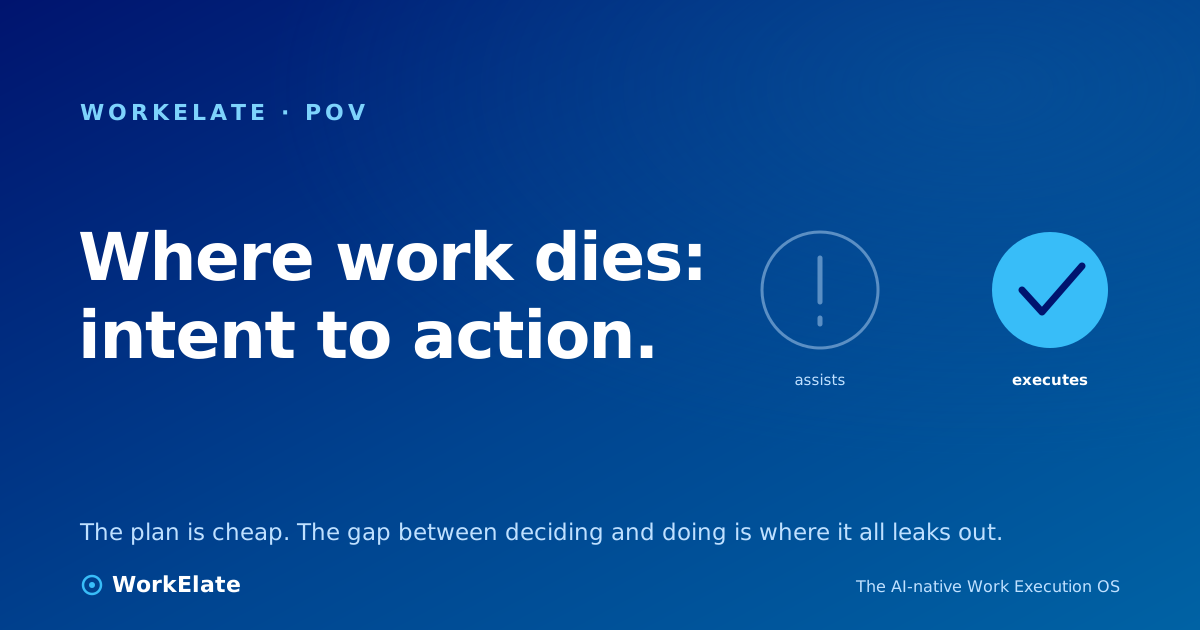
This is the most common failure mode in any company, and it is almost never a commitment problem. It's a structural one. There is a gap between deciding what to do and actually doing it, and that gap is where an alarming amount of work quietly dies.
Deciding feels like progress because the hard thinking is finished. You found the problem, aligned the people, wrote the step down. So execution feels like a formality — a thing that will just happen now that everyone agrees.
But intent and action live in two different worlds, and the second one is much harder than the first.
Intent happens in a meeting or a doc. One person can decide on behalf of many, in a single legible moment. Action happens in messy reality — asynchronously, across dependencies, against competing priorities, through interruptions and blockers and people who work different hours. Intent assumes perfect conditions. Action gets none of them. The decision is one clean event; the execution is a thousand tiny coordination acts strung out over days, and every one of them is a place momentum can leak out.
We over-invest in the half we can finish and under-invest in the half that actually produces the outcome.
It's worth naming the leaks precisely, because they look like bad luck and they're actually system behavior.
Action dies when context decays. The meeting ends, people return to their own work, a week passes, the urgency fades and the details blur. What felt crystal clear becomes fuzzy. People remember the goal but forget the specific next step, the dependency, the reason it mattered in the first place. And a task you no longer understand is a task you treat as optional. When something urgent arrives, that's the one you drop — not out of laziness, but because the context that made it real never traveled with it.
Action dies in the handoff. Person A finishes their part. Person B doesn't know. Or B knows but is buried. Or B starts but lacks the context A had in their head. The work stalls between people — in the seam that belongs to no one. Nobody deliberately let go of it. The system simply had no way to carry momentum across the gap from one person to the next.
Action dies when priorities collide. Everyone genuinely intended to execute. Then other work landed, something louder demanded attention, and the original intent got quietly deprioritized — not because it stopped mattering, but because nothing was enforcing that it keep mattering. Intent has no defender once the meeting is over. Whatever shouts loudest wins the day, and the thing you decided last week loses by default.
Notice what all three have in common. None of them is a motivation failure. Each is a failure to maintain something — context, a handoff, a priority — across time and across people. That maintenance is exactly the work no human is assigned to do, which is why it doesn't get done.
Companies that execute well do not have better intentions than the ones that don't. They have a better way of converting intent into action — one that doesn't lean on heroic effort or perfect memory, because both run out.
A real execution bridge has to do three things the average tool stack can't.
It has to preserve why the work matters, not just what to do — so the task survives the week and stays relevant even when louder things arrive. It has to carry the handoff — Person A finishing should automatically wake up Person B, with the context attached, even across different hours and different apps. And it has to act, not just remind — because a notification still puts the whole burden back on a human to remember, coordinate, and follow through. A nudge is not a bridge. A nudge is the gap, with a beep.
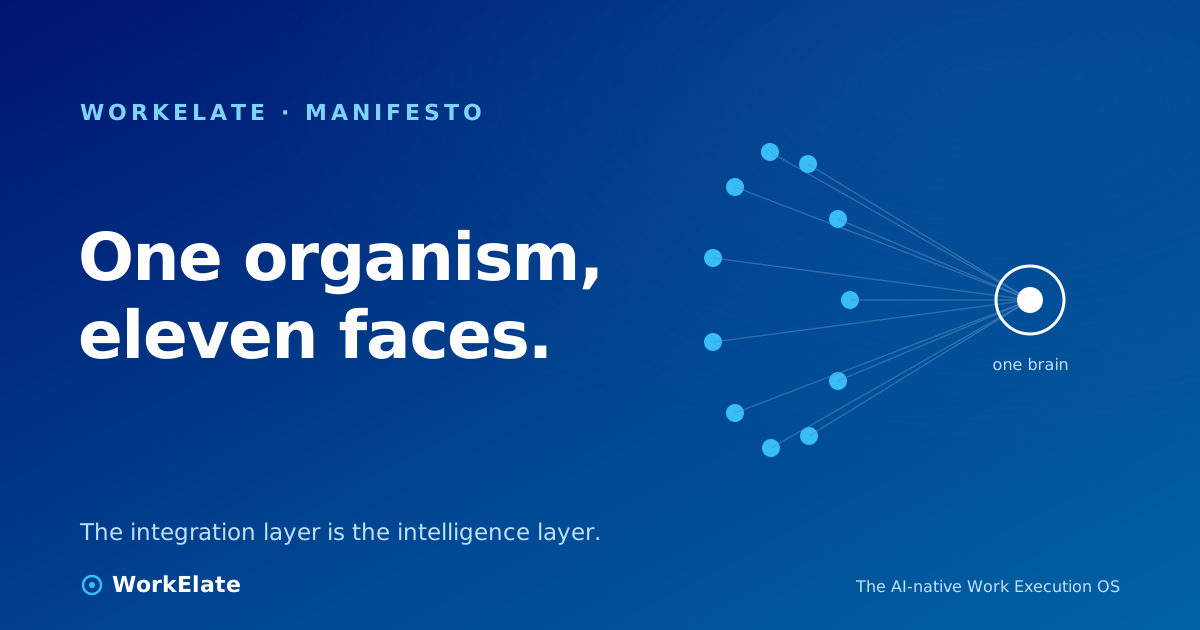
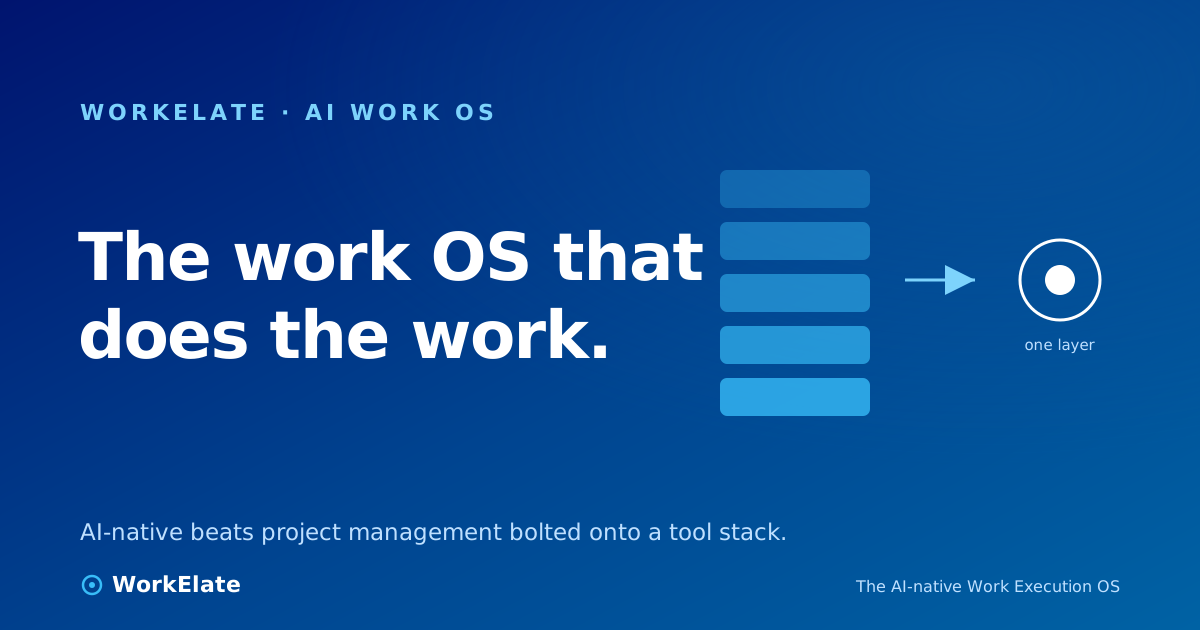
This is the part where most "AI at work" gets the shape wrong. A copilot that answers questions inside one app still leaves the coordination — the handoff, the chase, the re-asking — entirely on you. The leaks we've been describing don't live inside any single tool. They live in the seams between them. So the intelligence has to live above the stack, see the work as one connected graph, and do the mechanical coordination itself — on your confirmation, not behind your back.
That's the bet behind WorkElate. One brain across every app, watching the whole work-graph, that doesn't just tell you the handoff stalled — it carries it. You confirm; it executes. Suggest → Confirm → Execute. The visible step in the middle is the point: you stay in control of the decision, and the system takes the mechanical follow-through off your plate. (For the deeper argument, see why AI should execute, not assist and the real cost of a task is coordination.)
▶ Watch on WorkElate See WAO carry a handoff across apps youtube.com/@WorkElate · videoId: TODO — swap when publishedNone of this makes planning less valuable. It just relocates where the leverage is. The decision was always the cheap part; the gap after it was always where the value was won or lost. We spent a generation building tools to make planning prettier and the individual more disciplined — and the work kept dying in the same place, because the place was never inside one person or one app. It was in the distance between deciding and doing, and that distance is somebody's job now.
If execution is the only thing that actually compounds, here's the question worth sitting with: how much of what your team decided this quarter is still alive — and how much of it quietly drained out of a gap that nobody was watching?