Marketing
Why Most Small Marketing Teams Fail at Workflow Automation
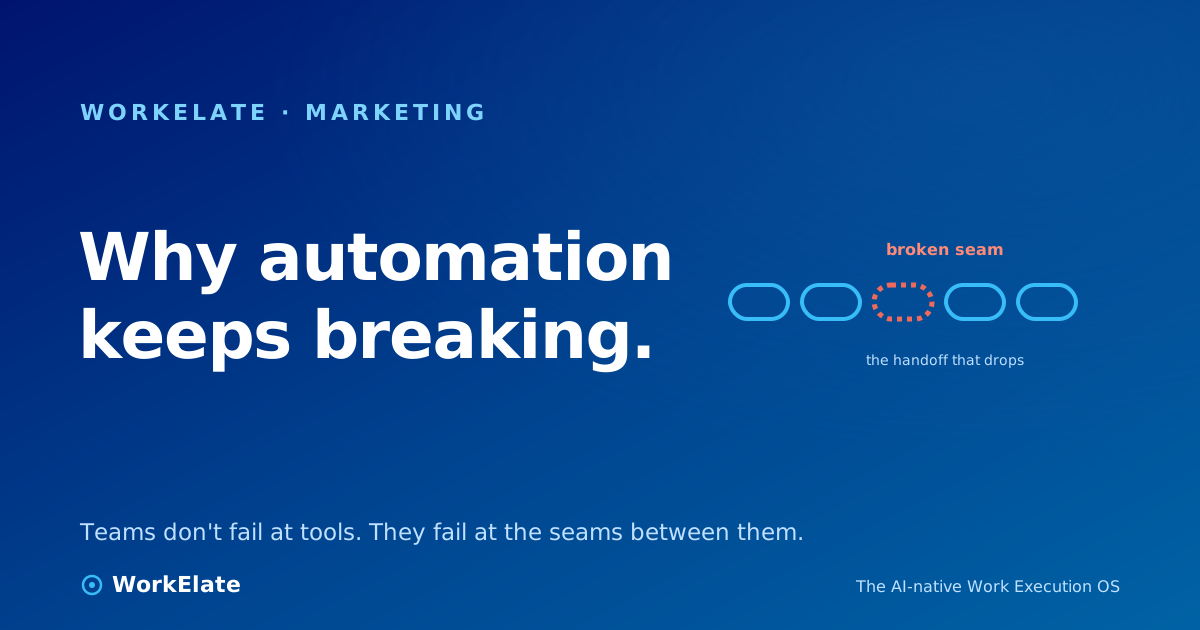
Small marketing teams don't fail at automation tools. They fail at the seams between them — the lead handoffs and data sync no Zap covers.
Small marketing teams don't fail at automation tools. They fail at the seams between them — the lead handoffs and data sync no Zap covers.
A five-person marketing team I talked with last quarter had wired up everything the guides told them to wire up. A form submission created a CRM contact. A new contact triggered a welcome email. A campaign launch posted to a Slack channel. A closed-won deal updated a row in a reporting sheet. On a whiteboard, the diagram looked like a machine. In practice, leads were still slipping through, and nobody could say where.
So they did what most teams do: they assumed the automation wasn't enough. They added more Zaps. The leaks didn't stop. They got worse — because every new automation added another seam, and the seams were where the work was actually failing.
This is the counter-intuitive thing about small-team automation, and it's worth saying plainly: the tools mostly work. The connections between them mostly don't. Your CRM is fine. Your email platform is fine. Your form builder is fine. What breaks is the handoff — the moment a lead leaves one tool and is supposed to arrive, intact and acted-on, in the next. That moment is almost never automated. It's glued by a human checking a tab, and that human is also doing four other jobs.
Marketing teams measure automation by counting triggers. "We automated lead routing." "We automated the nurture sequence." Each statement is true at the level of a single tool. None of them describes whether a lead that came in at 9:14am on Tuesday actually got a follow-up.
Here is what a "fully automated" lead lifecycle looks like at the seams, where a small team's automation typically stops at each tool's edge:
Each tool does its one job. But seam 1 assumes the form's field names match the CRM's. Seam 2 assumes the contact got tagged correctly so the right nurture fires. Seam 3 assumes the reporting sheet didn't double-count. When any assumption breaks, no alarm goes off. The trigger fired. The action "succeeded." The lead just quietly went nowhere — and you find out three weeks later when the pipeline number is short and you can't reconstruct why.
This isn't a small-team-only problem, but small teams feel it most acutely, for a structural reason: there's no one whose job is the seam. In a larger org, a marketing-ops person owns the plumbing. On a five-person team, the plumbing is everyone's job, which means it's no one's. The seam-checking is the first thing that gets dropped when a deadline hits — and a deadline always hits.
There's a second reason small teams get hit harder: the people doing the seam-checking are also your most expensive, most strategic people. On a big team, a junior coordinator can babysit the handoffs. On a small one, it's your marketing lead reconciling two spreadsheets at 6pm — the same person you hired to think about positioning and channels. Every hour spent confirming a Zap actually fired is an hour not spent on the work that only they can do. The cost of a leaky seam isn't only the lost lead. It's the strategic time burned proving the lead wasn't lost.
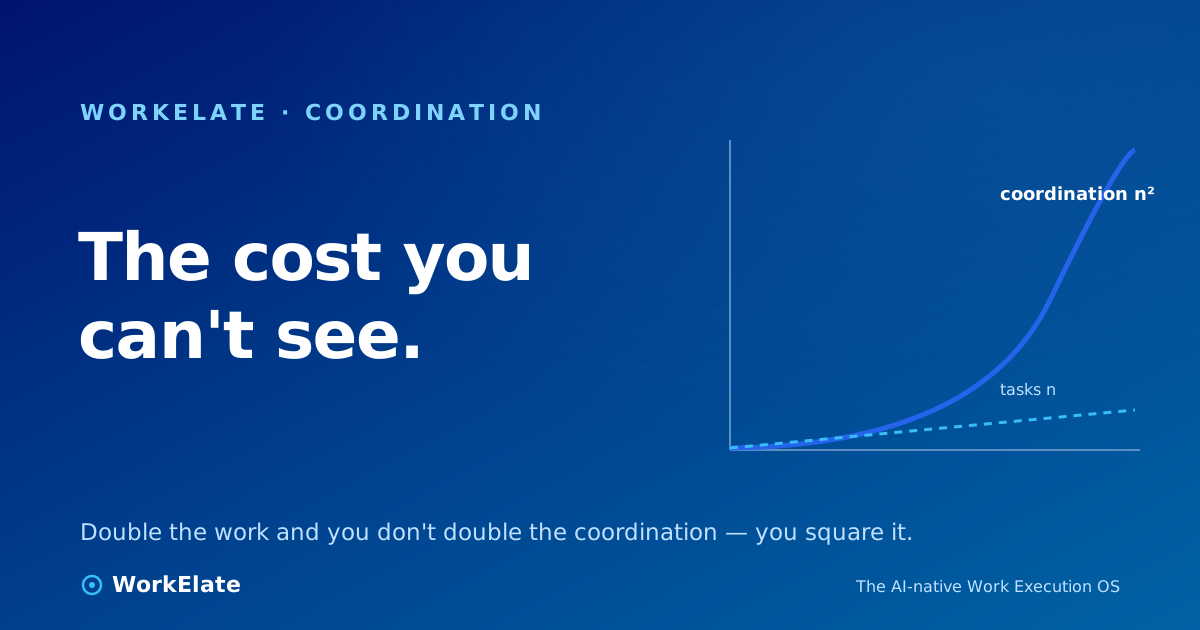
That last figure is the one to sit with. Add a sixth tool to your stack and you haven't added one new connection to maintain — you've added a connection to every tool already there. The work of keeping the stack in sync grows faster than the stack does. This is the same arithmetic we've written about in the real cost of a task is coordination: the visible work is the campaign; the invisible work is keeping every tool agreeing about the campaign, and the invisible work is the part that scales against you.
When we trace a stalled lead back through a small team's stack, the failure almost always lands in one of five seams. None of them is a missing automation. All of them are a missing handoff.
Notice what every one of these has in common. The failure is invisible by design. Rule-based automation tells you when it fires. It almost never tells you when the result of firing was wrong, stale, or dropped at the next door. It moves an action; it does not own an outcome. And the gap between "the action ran" and "the outcome happened" is exactly the gap a small team has no spare human to stand in.
"Automation connects tools. The seams are where you connect people, context, and accountability — and that's the part no trigger covers."
— WorkElateIf the problem is the seams, then adding automations inside each tool can't fix it — it just adds more seams. The honest fix is uncomfortable for anyone who has spent a year building Zaps: you need something that sits above the individual tools and can see a lead's whole journey, not just one tool's slice of it.
This is the reframe. For a small marketing team, the integration layer isn't plumbing you bolt on after the tools. The integration layer is where the intelligence has to live — because the seam is the only place that can tell whether a lead that entered actually got worked. A tool can confirm its own action succeeded. Only something watching across tools can confirm the lead didn't die in transit.
Practically, that means three things, in this order:
See the whole graph, not the triggers. Instead of a list of automations that fired, you want a single view of every lead and where it actually is — entered, enriched, routed, owned, contacted, stalled. When the unit of measurement is the lead's journey rather than the tool's trigger, the silent failures stop being silent. A stalled lead is visible the moment it stalls, not three weeks later in a short report.
Give every handoff an owner — a real one. "Routed to the team" is how leads die. Each seam needs a named owner and a way to surface, the moment a handoff doesn't complete cleanly, that this specific lead needs a human. Not a notification that the Zap ran. A flag that the outcome didn't.
Let something reason about the work, not just react to it. A rule does "if X, then Y." It can't notice that a high-value lead has sat untouched for two days while a low-value one got three follow-ups, because noticing requires judgment about context — value, workload, what's blocking what. That's the difference between a trigger and an agent, and it's the case we make for why AI should execute, not assist: a tool that only suggests still leaves the seam-checking on your plate.
This is the thinking behind a Work Execution OS like WorkElate. The apps — form, CRM-style records, email, boards, sheets — aren't the point. The point is the brain above them that reads the whole work-graph keyed to each lead and account, so the handoff between form and follow-up isn't a Zap you hope still works. It's coordination something is actually watching, end to end, and will flag to you the moment it breaks. One organism, not eleven disconnected ones taped together.
▶ Watch on WorkElate See a lead handoff that doesn't drop at the seam youtube.com/@WorkElate · videoId: TODO — swap when publishedTo be fair: if your stack is genuinely simple — one form, one inbox, a handful of leads a week — a few well-maintained Zaps may be all you ever need, and adding a coordination layer would be overkill. The seam problem is a scale problem. It shows up the moment you have enough leads and enough tools that no single person can hold the whole journey in their head. For most growing small teams, that moment arrives faster than they expect — usually right around the time they hire their second marketer and the handoffs become real.
You don't need to rip anything out to find out whether the seams are leaking. Pick your highest-value lead source and trace ten recent leads by hand, all the way from entry to last touch. Not in the dashboards — in the actual tools, one lead at a time. Count how many made it cleanly through every handoff. Count how many you can't even reconstruct. That second number is the one that should worry you, because it's the size of the gap your automation can't see.
If most of them made it, your seams are healthy and you've earned your Zaps. If they didn't — if leads are dying in transit and you can't say where — then the answer was never another automation. It was a layer that watches the handoffs you've been trusting a busy human to check between meetings. If you want the longer version of why bolt-on automation keeps disappointing small teams, we wrote it up in 7 marketing automation platform challenges small teams struggle with.
The teams that win aren't the ones with the most automations. They're the ones whose leads stop dying in the gaps between them. So here's the question worth sitting still for: if a lead went missing in your stack tomorrow, how long would it take you to notice — and would you ever find out where it slipped?