Marketing
7 Marketing Automation Platform Challenges Small Teams Struggle With
The 7 marketing automation challenges that quietly bury small teams — and a concrete, specific fix for each one. No fluff, no enterprise jargon.
The 7 marketing automation challenges that quietly bury small teams — and a concrete, specific fix for each one. No fluff, no enterprise jargon.
A two-person marketing team buys an automation platform on a Tuesday. By the following Tuesday, one of them is spending more time maintaining the automation than running campaigns. That is the quiet plot twist nobody mentions in the sales demo: the tool you bought to save time becomes a second job.
This is not a knock on automation. Automation works. The problem is that most platforms were designed for a company with a dedicated marketing-operations hire — and a small team does not have one. The same one or two people own campaigns, CRM hygiene, reporting, email sequences, and the customer journey, all at once. So every challenge below lands harder on them.
Here are the seven marketing automation challenges small teams actually struggle with, and a specific, do-it-this-week fix for each.
TL;DR — Small teams don't fail at automation because they're lazy or under-skilled. They fail because the coordination work between tools scales faster than the team does. The fixes are concrete: start with one workflow, kill duplicate automations on a schedule, align CRM sync before lead scoring, and centralize where you can so you stop paying the tax of copying data between disconnected systems.
---
Most automation platforms are priced and built for enterprise operations, which means the onboarding is built for an enterprise too. For a small team, "go live" turns into weeks of building workflows, wiring integrations, configuring triggers, importing lists, and learning an interface designed to show off every feature at once.
The deeper reason: platforms optimize for capability surface, not time-to-first-value. You need maybe 15% of the system, but you still have to walk through the other 85% to find your 15%.
The fix — ship one workflow, ignore the rest. Pick a single high-impact sequence (lead follow-up, onboarding email, appointment reminder) and get only that live this week. Resist the urge to "configure everything while you're in there." A platform with a shallow learning curve beats a powerful one you never finish setting up. If onboarding requires a technical implementation specialist, that platform was not built for a two-person team — and the demo flattered you.
A normal small-team stack is a CRM, an email tool, an analytics dashboard, a forms-and-landing-page builder, a collaboration app, and a reporting layer. Each is fine on its own. The damage is in the gaps between them.
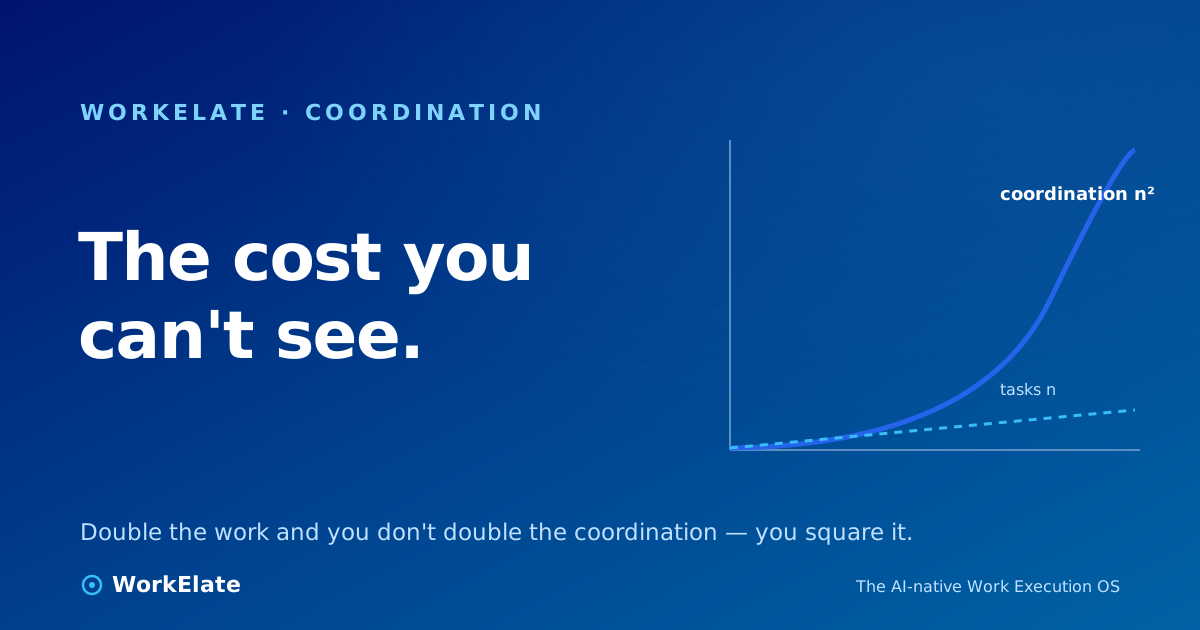
When those tools don't talk, you become the integration. You export from one, reformat, import to another. A lead fills a form here, but the CRM doesn't know for an hour. An approval sits in chat while the campaign waits. This is the coordination tax — and it scales worse than people expect. Two tools, one connection to maintain. Six tools, fifteen possible connections. The cost grows with the square of the surface area, which is exactly why a small team feels buried long before a big one does.
The fix — collapse the seams, don't add more tools. Every new tool you bolt on adds connections you now own. Favor platforms that centralize the workflows you switch between most. The goal isn't fewer capabilities — it's fewer handoffs you perform by hand. We dug into exactly this math in the real cost of a task is coordination.
Automation is sold as a time-saver, and it is — right up until it needs maintenance. Triggers break. CRM data gets dirty. Sequences reference a list that no longer exists. On a small team, the person who built the automation is also the person running today's campaign, so maintenance loses every time.
The cruel irony: a poorly maintained automation generates more manual work than no automation at all, because now you're cleaning up its mistakes too.
The fix — a 30-minute monthly automation review, on the calendar, owned by name. Once a month, audit every live sequence: remove what's outdated, fix broken triggers, clean the CRM rows that are obviously junk. Treat it like flossing — boring, fast, and far cheaper than the alternative. Put it on a recurring invite with a named owner so it can't quietly fall off.
Automation only pays off when the marketing system and the CRM agree on reality. In a lot of small businesses they don't: CRM sync lags, activity data goes missing, contacts duplicate, and lead scoring drifts out of alignment.
You can spot it by the symptoms. Leads get two of the same email. Sales misses a warm prospect because the "hot lead" flag never synced. The monthly report claims conversions that didn't happen. Follow-ups land a day late, after the buyer already moved on.
The fix — fix sync before you build scoring on top of it. Lead scoring layered on bad data just automates wrong decisions faster. First, get one clean, near-real-time sync between your forms, your CRM, and your email tool. Then dedupe. Only then turn on scoring and routing. The order matters: most "our automation is lying to us" problems are plumbing, not strategy.
▶ Watch on WorkElate What a lead looks like when marketing and sales share one view youtube.com/@WorkElate · videoId: TODO — swap when publishedEveryone starts with three clean workflows. A year later you have duplicate automations, conflicting triggers, overlapping campaigns, six layers of conditions, and naming conventions that contradict each other. Nobody on the team can confidently say what the system does anymore — so nobody wants to change anything, because one tweak might silently break three other things.
This is automation debt, and it hits small teams harder for a specific reason: bigger orgs document. Small teams build fast under deadline and skip the documentation, which is rational in the moment and brutal six months later.
The fix — name it, document it, prune it. Adopt one naming convention and apply it to every new workflow. Keep a single page that lists each automation, what triggers it, and who owns it — five minutes per workflow saves hours of archaeology later. And use the monthly review from #3 to retire anything that hasn't fired in 90 days. Automation you don't understand is a liability, not an asset.
A small team needs to know one thing above all: what is actually driving growth. Yet many platforms make attribution genuinely hard. The data you need is scattered across separate dashboards, so simple questions stay unanswered — which campaign converted, which channel influenced pipeline, what content performed, where leads dropped off, which workflow actually moved revenue.
When reporting is foggy, the damage is concrete: budget goes to the wrong channel, the team optimizes a vanity metric, decisions turn reactive, and leadership quietly loses confidence in marketing. For a team with a tight budget, that's not an inconvenience — it's a brake on growth.
The fix — pick three questions and instrument only those. Don't try to measure everything. Choose the three decisions you actually make with data (where to spend next, what content to make more of, which leads to route to sales) and make sure your stack answers those cleanly in one place. A report that answers three questions confidently beats a dashboard that hints at thirty.
This is the subtlest one. Automation is so engaging to build that teams start optimizing sequences, engineering funnels, and testing triggers — while the actual marketing quietly decays. Content gets thinner. Messaging gets vaguer. Customer understanding gets stale. The creative work that automation was supposed to free you for never happens, because you're busy maintaining the thing that was supposed to free you.
Automation is meant to carry execution, not replace the thinking. The best small teams keep the machine deliberately simple so their attention stays on clear messaging, real customer pain, fast execution, and good content.
"Automation should reduce the mechanical work so your best people can do the thinking — not become the thinking."
— WorkElateThe fix — cap your automation complexity on purpose. Set a rule: no new automation unless it removes more manual work than it adds maintenance. If a funnel needs a diagram to explain, it's probably costing you more attention than it returns. Protect the hours for strategy the way you protect a client deadline.
---
Read the seven back to back and a pattern appears. Almost none of these are automation problems in isolation. They're disconnection problems — the cost of stitching separate tools together by hand, then maintaining the stitches with a team that has no slack. Setup is painful because the tool is an island. Fragmentation, sync failures, and foggy attribution are all just data failing to cross a boundary. Automation debt and machine-tuning are what happens when keeping the seams alive becomes the job.
So the thing a small team actually needs isn't more automation. It's fewer boundaries to maintain: reduce context switching, connect the workflows, make visibility a default instead of a reporting project, and let the repetitive mechanical work happen without a person babysitting it.
This is the direction newer workflow platforms are taking. WorkElate, for instance, is building toward AI-native workflow orchestration that keeps collaboration, task management, forms, planning, and execution inside one connected environment — so the coordination work between tools shrinks instead of growing. The aim isn't "more automation." It's less operational friction, so a small team spends its hours on growth rather than tool management. We've written about why this shift is happening in why most small marketing teams fail at workflow automation and where it leads in the AI work OS replacing project management.
The honest takeaway: automation can absolutely help a small team move faster. But automation alone never fixes operational inefficiency — it just runs your inefficiency at higher speed. The teams that win are the ones who pick systems they can realistically manage with the people they actually have. Which raises the real question worth sitting with: how much of your week goes to doing marketing, and how much goes to keeping the marketing machine alive?
---
What is the biggest marketing automation challenge for small teams?
Managing complexity with too few people. A small team usually has one or two people owning setup, integrations, reporting, and ongoing workflow maintenance simultaneously — so every challenge compounds. The root cause is disconnection between tools, not a lack of features.
Do small businesses really need marketing automation?
Yes, but only the slice that removes repetitive mechanical work without adding operational complexity. Start with one high-impact workflow. If a piece of automation creates more maintenance than the manual work it replaced, it's a net loss — don't ship it.
Why do marketing automation projects fail?
Usually three reasons: automating too much too fast, relying on too many disconnected tools that don't share data, and skipping workflow planning and documentation. The result is automation debt — a tangle of workflows nobody fully understands and nobody wants to touch.
How can small teams simplify marketing automation?
Start with one workflow, reduce tool fragmentation, document logic and naming conventions early, fix CRM sync before layering on lead scoring, run a 30-minute monthly audit, and choose ease of use over feature count. Simplicity you can maintain beats power you can't.
What is automation debt?
The accumulated mess of duplicate automations, conflicting triggers, and inconsistent naming that builds up when workflows are created fast without documentation. It makes the system fragile — one change can break several others — and small teams accrue it faster because they rarely document under deadline.
---