Focus
What Is Context Switching? The Real Cost and How to Reduce It
Context switching is the hidden tax on focus. Learn what it is, the ~23-minute refocus cost, why it happens, and how to actually reduce it at work.
Context switching is the hidden tax on focus. Learn what it is, the ~23-minute refocus cost, why it happens, and how to actually reduce it at work.
You sit down to write the proposal. A Slack ping pulls you into a thread. The thread points at a doc, the doc is missing a number, the number lives in a spreadsheet, and the spreadsheet reminds you of an email you never answered. Twenty minutes later you are back in the proposal — staring at the cursor, trying to remember the sentence you were about to write.
That gap is context switching. It is one of the most expensive things that happens in a workday, and almost nobody budgets for it.
---
Context switching is the act of redirecting your attention from one mental context to another. Every context — a task, a tool, a conversation — carries its own state: what you were doing, what matters right now, what comes next. When you switch, your brain has to unload one set of state and load another.
That reload is not free. It costs time, energy, and accuracy. Do it twice a day and you'd never notice. Do it eighty times a day — which is closer to a normal knowledge-work pattern — and you arrive at 6pm exhausted with the real work still untouched.
The phrase borrows from computing on purpose. A CPU "context switches" between processes by saving the state of one and loading another, and the switch itself burns cycles that do no useful work. Human attention behaves the same way. The switch is overhead.
People use the two words interchangeably. They're different, and the difference matters.
Multitasking is trying to do two things at the same moment — listening to a call while answering a message. Your attention is split concurrently.
Context switching is moving your full attention from one thing to the next in sequence — write a sentence, answer the message, return to the sentence, jump to a dashboard. Your attention is whole each time, but it's being relocated constantly, and each relocation has a cost.
Most of what we call "multitasking" is actually rapid context switching. The brain doesn't run two focused tasks in parallel; it flips between them and pays the toll on every flip.
The clearest way to understand why switching hurts is a concept from organizational psychologist Sophie Leroy: attention residue. When you move from Task A to Task B before A is fully closed, a slice of your attention stays behind on A. You start B already diminished — slower, more error-prone, less creative — until the residue clears.
This is why an interruption costs far more than the interruption itself. A "two-minute" question isn't two minutes. It's two minutes plus the residue tail plus the time to rebuild the context you dropped.
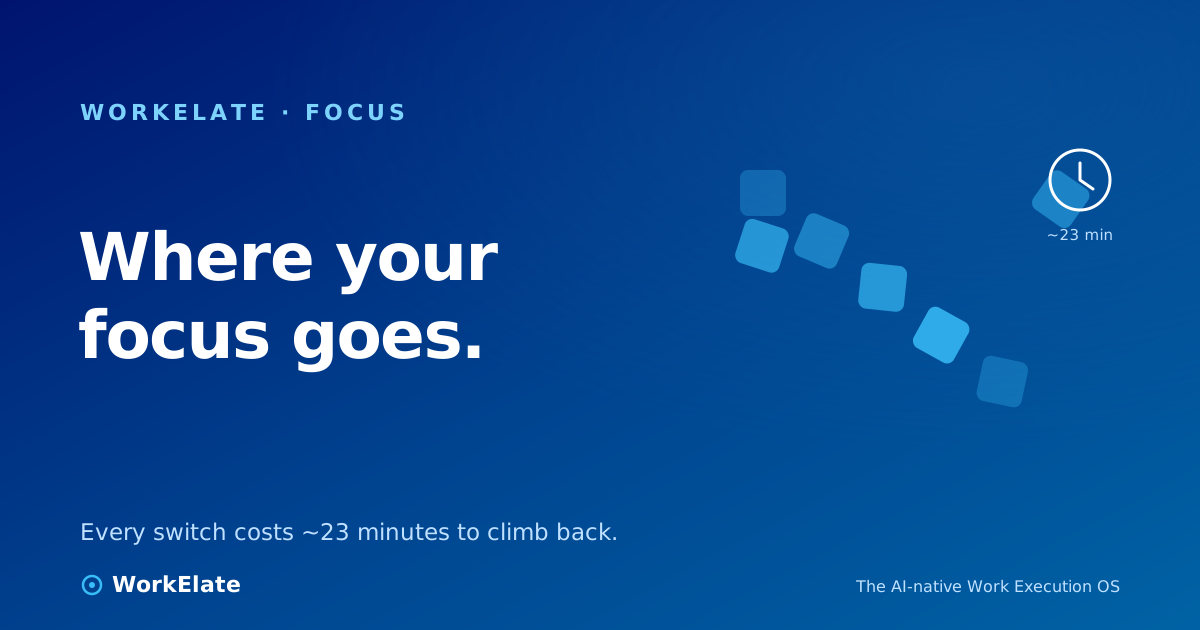
How long is that tail? The most widely cited figure comes from Dr. Gloria Mark at UC Irvine, whose research on workplace attention is the source of the popular "it takes about 23 minutes to get back on task after an interruption" statistic. It's worth being honest about that number: it's a research-backed estimate from observational studies, often repeated as if it were exact. The true refocus time varies with the complexity of the work, how deep you were, and how related the interruption was. The point isn't the precise minute count. The point is that the recovery cost is large, real, and routinely invisible on the calendar.
Here's the part most "focus tips" miss. People treat context switching as a discipline problem — turn off notifications, try harder. Some of it is. But the structural driver is disconnection: the work itself is scattered across places that can't see each other.
A single client request can touch a chat message, a task on a board, a document, a spreadsheet, a calendar invite, and an email — six separate surfaces, none of which carries the others' state. To act on that one request, you become the integration layer. You're the one ferrying context between tools, remembering what connects to what, re-explaining the same situation in each new tab. That ferrying is the switch.
This is the thing to be precise about: the villain is not the number of tools. Specialized tools are good — a real spreadsheet beats a fake one, a real whiteboard beats a doc full of boxes. The villain is that the tools are disconnected. Every gap between them is a place where a human has to carry the context across by hand. More tools only hurt to the degree they add more gaps.
That's why "just consolidate everything into one app" rarely fixes it. You can put eleven things behind one login and still force the same eleven mental reloads, because the apps don't share what they know. Connection is the fix, not consolidation for its own sake.
The personal cost is exhaustion. The business cost compounds:
You can't eliminate switching — collaborative work requires moving between things. You can dramatically cut the avoidable switches and protect recovery time around the rest.
Schedule uninterrupted time the way you'd schedule a meeting, and defend it. Even 90 minutes of true deep work outperforms a whole afternoon of fragments. "No-meeting" windows work because they make the protection collective, not heroic.
Group like with like. Answer messages in two or three windows a day instead of continuously. Do all your reviews together. Batching keeps you inside one context long enough to avoid paying the reload toll on every item.
Not every notification deserves a tap on the shoulder. Turn off the ones that don't change what you do in the next hour. Move "for your awareness" updates to a place you check on your schedule, not theirs.
This is the structural one, and the one most advice skips. Every time you copy a number from a sheet into a doc, re-explain a request in a new tab, or hunt across apps for "where did we land on this" — that's a gap doing damage. Reducing those gaps cuts switches you'll never get back with willpower. Look for connection between the places your work lives, not just fewer places.
A large share of switching is pure mechanical glue work: routing a task, posting an update, pulling the figure, sending the follow-up. None of it needs your judgment — only your attention, which is the scarce thing. When that glue work runs on its own, your switches drop because the reason for many of them disappears.
This is the gap WorkElate was built to close. It's a Work Execution OS — chat, mail, docs, spreadsheets, tasks, boards, calendar, forms, slides — but the point isn't the apps. The point is the One Brain underneath them: a single orchestrating intelligence (we call it WAO) that can see across every app and act, instead of leaving you to be the wire between them.
Because every app emits what happens into a shared cross-app work-graph, the system already knows that this message, that task, this document, and that calendar event are the same piece of work. The coordination you'd normally do by hand — the carrying of context from tool to tool — is exactly the part it can take off your plate. It follows a confirm-first reflex (suggest → confirm → execute), so it does the mechanical glue work while the judgment stays yours.
That's the honest scope of the claim. A connected work system doesn't make focus a moral achievement. It removes a large class of switches structurally — by making sure the context never had to be carried across a gap in the first place. To understand why we think the integration between tools is where the real leverage sits, see the real cost of a task is coordination. For the bigger shift this points to, AI work OS: replacing project management and invisible AI: the only AI that matters go deeper.
Watch: how a connected work-graph kills the switch See it on YouTube — @WorkElateContext switching is the mental cost of moving your attention from one task, tool, or conversation to another. Each switch forces your brain to unload one set of information and reload another, which takes time and energy and reduces accuracy.
No. Multitasking is trying to do two things at the same moment, with attention split concurrently. Context switching is moving your full attention from one thing to the next in sequence. Most "multitasking" is really rapid context switching.
The most widely cited estimate, from Dr. Gloria Mark's research at UC Irvine, is that it can take around 23 minutes to fully refocus after an interruption. Treat this as a research-backed estimate, not a fixed law — actual recovery time varies with the task and how deep you were.
Attention residue, a term from researcher Sophie Leroy, describes the part of your mind that stays stuck on a previous task when you switch to a new one before fully closing the first. It's why you start the next task already slower and more error-prone.
The main structural cause is disconnection: tasks, conversations, documents, and data living in separate tools that don't share state, so a person has to carry context between them. Frequent notifications and unprotected calendars make it worse. The problem is the gaps between tools, not the number of tools.
Protect uninterrupted focus blocks, batch similar work, turn off low-value notifications, and close the gaps between the tools where your work lives so context doesn't have to be carried by hand. Automating routine coordination removes the reason for many switches entirely.
---