Comparison
Slack Is for Conversation, Not Coordination
Slack won by making chat a searchable system-of-record. But conversation isn't coordination — and status trapped in messages is the coordination tax.
Slack won by making chat a searchable system-of-record. But conversation isn't coordination — and status trapped in messages is the coordination tax.
The most important thing to understand about Slack is that its hero feature was never chat.
This sounds wrong, because Slack is the chat app — the verb, the green checkmark, the place a billion messages a day land. But chat already existed when Slack launched. IRC existed. HipChat existed. What Slack actually shipped, and what made teams fall in love hard enough to spread it bottom-up without a sales team, was subtler: it turned team conversation into a searchable, integrated, transparent system of record. The back-ronym was the whole thesis — Searchable Log of All Conversation and Knowledge. Slack went from a scarcity-engineered August 2013 preview — roughly 8,000 invite requests on day one — to a $1B+ valuation in about 18 months, among the fastest-growing B2B apps ever. Not because it let people type to each other. Because it let people find what had been typed.
Hold onto that, because it's the key to the thing Slack can't do. Slack made conversation persistent and findable. It did not make work trackable. Those are not the same job.
Let's not strawman the most beloved enterprise tool of the last decade. Slack earned its place, and the reason is instructive.
Before Slack, work conversation was either ephemeral (IRC forgot everything) or siloed (email threads that fork and die). Slack's insight was that the conversation itself is an asset worth keeping — if you can search it, connect it to your other tools, and make it visible across the team. From launch it shipped persistent searchable channels plus deep integrations — GitHub, Dropbox, Google Drive — wired in from minute one. The "aha" wasn't "I can message my coworker." It was "I can search everything my whole company ever said, and my tools post into it automatically."
That's a durable form of leverage, and it's why Slack spread the way it did — grassroots, viral, a cult product in its 2014–2016 window, growing 5 to 10 percent a week with no sales team — all the way to a $27.7 billion Salesforce acquisition (closed July 2021). When something gets bought for $27.7 billion, you start by respecting it.
So this isn't a takedown. Slack is exceptional at what it was built for. The argument is narrower: the very thing that makes Slack great at conversation is the thing that makes it wrong for coordination.
Here is the distinction the whole post turns on.
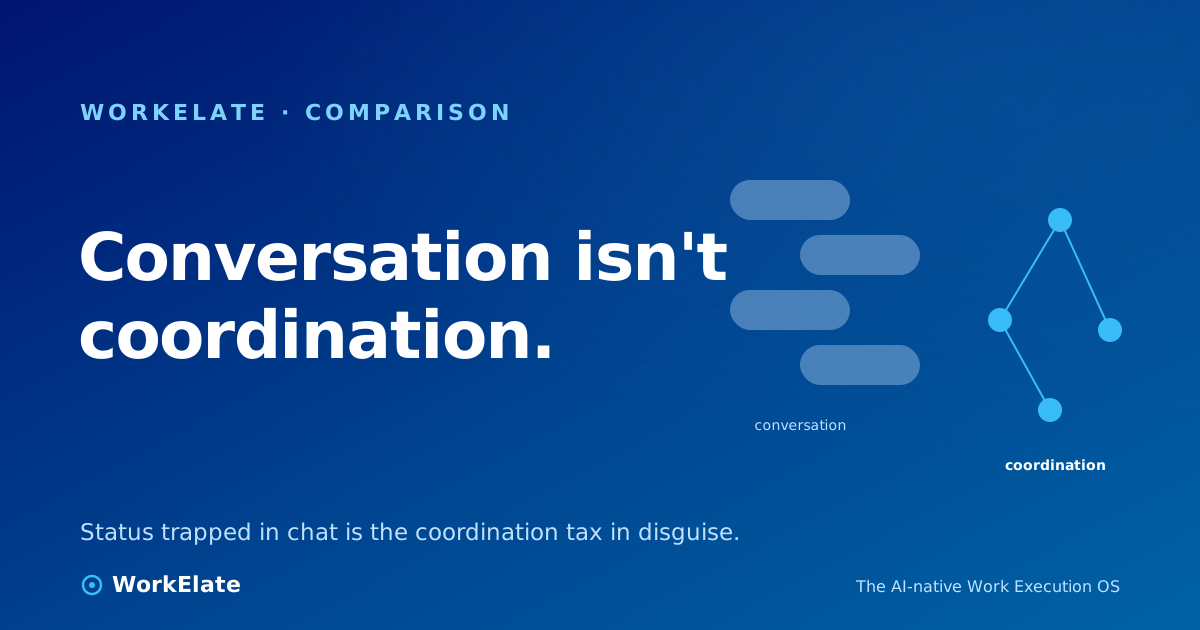
Conversation is a stream — chronological, human, associative. "Did we hear back from the client?" "Yeah, they want it Thursday." "Cool, who's on it?" "I think Priya?" That exchange is perfectly good as conversation; it carries meaning between people in the moment.
Coordination is a state — the answer to: what is the current status of this deliverable, who owns it, what is it waiting on, when is it due — answered the same way every time, by anyone who asks, without interpretation. Coordination isn't a conversation about the work. It's a model of the work that stays true after the conversation scrolls away.
When you try to coordinate through Slack, you're asking a stream to behave like a state. And it can't, structurally, for one reason: the work-state ends up living inside the messages. The decision that the deadline is Thursday exists only as a sentence someone typed at 4:47pm on a Tuesday. The fact that Priya owns it exists only as the word "Priya" with a question mark after it. Nothing holds that as status. To know the state of the work, you reconstruct it — scroll, search, interpret @mentions, piece together who said what. Call it what it is: thread archaeology.
Search — Slack's superpower — makes the archaeology possible, not unnecessary. Finding the message where someone said "Thursday" beats not finding it. But you're still finding a message and inferring a status from it — a different act from reading a status. Search turns a buried fact into a findable fact. It never turns a conversation into a system of record for the work — only for the talk about the work.
The phrase can sound abstract, so here's what it actually is when the work-state lives in chat. None of these is a fire — which is exactly why they never get fixed.
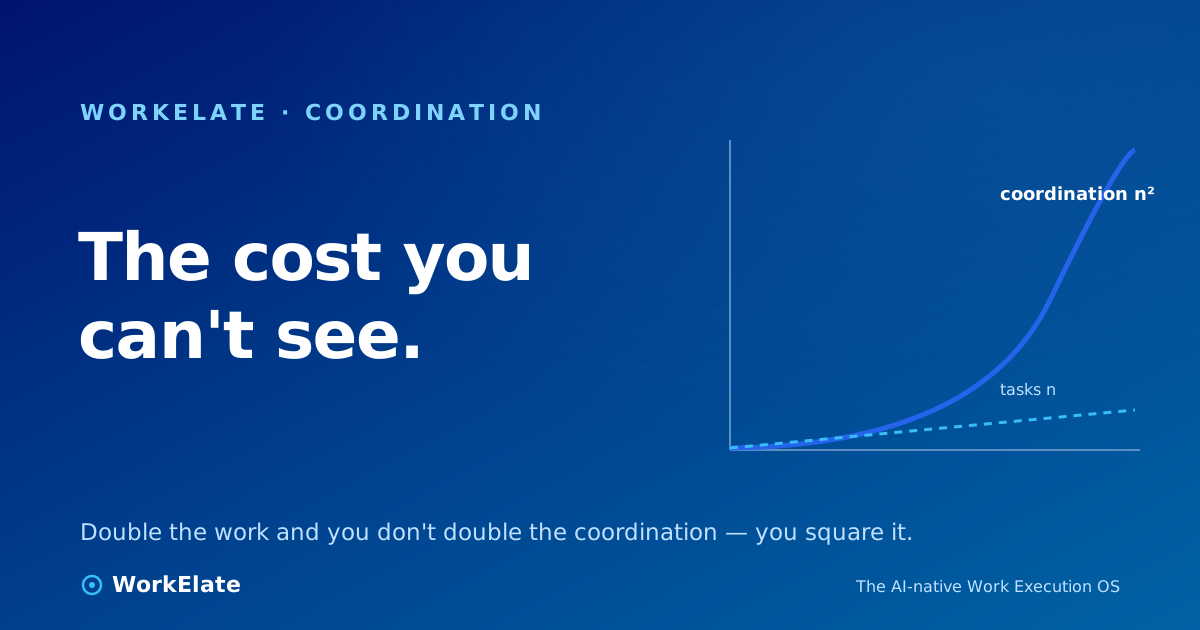
Add these up across a week and they're not a footnote. Your senior people — the ones whose judgment you're paying for — spend a real part of the day being the human index to a conversation. That's the tax, and it scales with exactly the thing you want more of: people talking.
There's a second lesson in Slack's history, and it's not the one people usually pull.
Microsoft unveiled Teams in November 2016 and bundled it free into Office 365's enormous install base. Slack was, by most accounts, the more loved product — it ran the now-famous full-page "Dear Microsoft" newspaper ad, widely read as bravado over fear. Teams out-distributed it on raw seat count anyway. Bundling beat product love. In July 2020 Slack filed an EU antitrust complaint accusing Microsoft of illegally tying Teams to Office.
The usual takeaway is "distribution beats product love at scale," and that's true. But there's a sharper point underneath it: a beloved single feature that can be free-bundled is exposed. Chat is a feature — and a feature can be cloned, given away, and stapled to a suite the customer already pays for. What's much harder to bundle away is a system: a connected model of an organization's work that gets more valuable the more of the work it holds, and that a competitor can't recreate by adding one more tab.
So "Slack for coordination" is a strategically uncomfortable place to stand, even setting the daily friction aside: you'd be putting your most critical work — the state of everything you deliver — inside the one layer that turned out most bundle-able and most commoditized. The work-state shouldn't live in the feature everyone can give away for free. It should live in the layer that compounds.
Fair — Slack didn't sit still. Workflow Builder added no-code automation; Canvas added an embedded doc surface; Slack AI added search answers and recaps. But look at the shape of these. Workflow Builder is deterministic if-this-then-that plumbing that can't judge whether this handoff is in scope or at risk. Canvas stores structured content; it isn't a model of work-state other surfaces emit into and act on. Slack AI summarizes a channel — it does the thread archaeology for you, faster. That's a better shovel, not the removal of the need to dig.
The structural fact survives all of it: when the system of record is the chat log, coordination is always inference — and you can't make it not-inference, because a stream of messages was never a model of the work.
If coordination needs state and chat only offers stream, the fix is easy to name and hard to build: put the work-state somewhere structured, keyed to the work itself, that any surface can write to and anyone can read from. Then conversation goes back to being conversation — which it's great at — and coordination becomes a thing you read, not excavate.
That requires properties chat structurally can't have. The surfaces of your work — form, task, doc, calendar, inbox — have to emit what happens into one shared model, not bury it in their own logs or in a message. That model has to be keyed to the work — this client, this deliverable — so "what's the real state of this, everywhere?" has one answer. And one intelligence has to reason over that whole model and act on it: not summarize the conversation, but update the status, route the handoff, surface the dependency before it bites — under your confirmation for anything that matters.
The dollar figure under the phrase "coordination tax" is in the real cost of a task is coordination, and the broader case for why this structured-state layer is displacing the old tracking tools is in how an AI work OS is replacing project management.
We'll be precise, because precision is the brand. WorkElate is not a better chat app, and we're not telling you to rip out Slack — conversation is a real job and Slack does it well. Keep it for what it's built for.
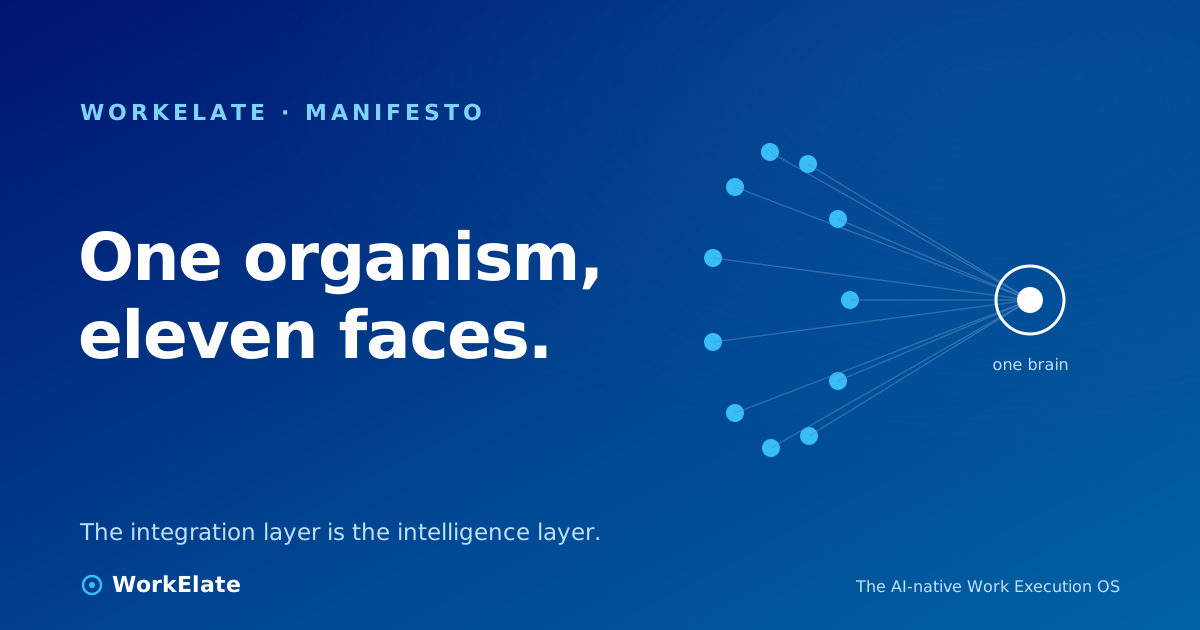
What WorkElate is built around is the layer underneath the conversation: eleven surfaces — hub, weMail, chat, data, docs, ppt, calendar, task, board, journey, form — that all emit into one cross-app work-graph, with one brain (WAO, the orchestrator) that reads that whole graph and can act back on any surface, through a sense → recall → reason → decide → act → remember loop, with confirm gates on anything that matters. The point isn't that we have a chat surface too. It's that the state of the work lives in a structured graph you query, not in a stream you excavate. Ask "what's the status of this client's work?" and the answer comes from a model, the same way every time — because it was emitted as it happened, not reconstructed after the fact.
One honest caveat, because honesty is the weapon: we're not the only software that can read across your stack — plenty of tools now index and summarize a chat log. What's different is where the work-state lives: in a graph the surfaces write to and the brain can act on, rather than trapped in the messages waiting to be dug back out. Most tools infer your work-graph and can only read it; we emit it and can write to it. That's the whole position, and it's checkable.
There's a longer thread on why this matters — why the AI that earns its keep is the kind that quietly holds the work-state so you don't have to — in invisible AI: the only AI that matters.
You can, and most teams do — which is exactly how the coordination tax sneaks in. The problem isn't that Slack is bad; it's that the work-state ends up living inside the messages. Knowing the current status means scrolling, searching, and inferring rather than reading a field. Slack is excellent for the conversation about the work; it was never a system of record for the work.
Search makes the archaeology possible, not unnecessary. Being able to find the message where someone said "Thursday" is genuinely better than not finding it. But you're still finding a message and inferring a status from it — a different act from reading a status that a system holds as state. Search turns a conversation into a findable conversation, never into a structured model of the work.
Conversation is a stream — chronological, human, in-the-moment. Coordination is a state — the current status, owner, dependency, and deadline of a deliverable, answerable the same way by anyone, after the conversation scrolls away. Chat is structurally a stream, so using it for coordination means asking a stream to behave like a state.
No — they're different jobs. Keep Slack for conversation; move the work-state out of the messages and into a structured, cross-app graph that surfaces can write to and you can read from. Then chat goes back to being good at what it's actually good at.