POV
Context Switching Is Coordination Failure
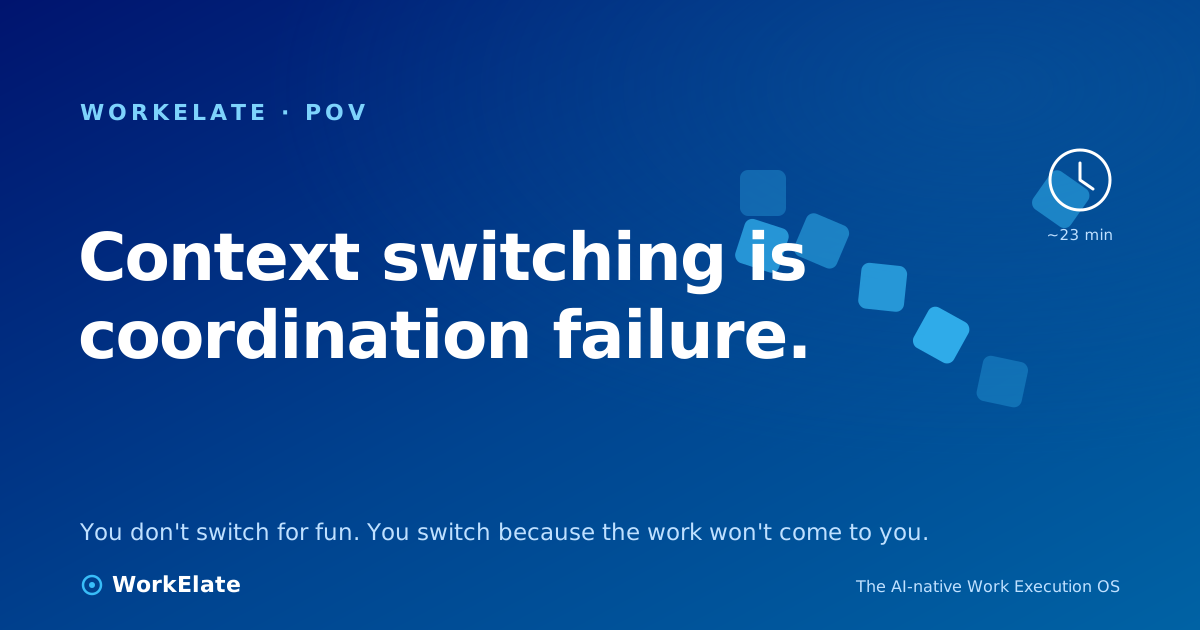
You don't switch tasks for fun. You switch because the work won't come to you. Context switching is a symptom of broken coordination — not weak discipline.
You don't switch tasks for fun. You switch because the work won't come to you. Context switching is a symptom of broken coordination — not weak discipline.
Nobody opens nine tabs because it feels good. You bounce from the card to the thread to the doc to the inbox because the one thing you actually sat down to do is missing a piece — an answer, an approval, a file someone said they'd send. You switch because the work won't come to you. So you go get it.
We've spent a decade treating that as a discipline problem. Turn off notifications. Time-box. Try harder to stay in one window. The advice assumes the switching starts in your head — that if you were just a little more focused, you'd stay put.
But watch yourself for one morning and you'll see the truth: almost every switch is triggered from outside. A "quick question" lands. A task you opened turns out to be blocked. Something looks urgent because it's loud, not because it matters. You don't leave your work — your work leaves you, and you chase the missing piece across five tools to bring it back.
That makes context switching a symptom, not a habit. The disease is coordination failure: work that can't tell you what's ready, what's blocked, and what genuinely needs you next.
The cost isn't the click. It's the reload. Sit back down at a task and the first stretch is pure reconstruction — where was I, what mattered, what did we decide. Research puts the recovery at roughly 23 minutes after a single interruption, and that's if nothing interrupts the recovery. People who switch all day never actually arrive anywhere. They run on partial attention, feel busy, and ship less. That's the whole reason modern work feels busy but goes nowhere.
And the trigger is rarely your fault. It's the hidden coordination cost of the task — the answer that lived in one person's head, the dependency nobody flagged, the status that was true an hour ago and isn't now. Every one of those forces a switch. Discipline can't fix a switch that the system itself demands.
The honest move is to stop coaching focus and start removing the reasons to switch. It helps to be precise about what context switching actually is — not multitasking, but the costly reload your brain pays every time the work makes you go elsewhere. When task ownership is unambiguous, the "who's doing what" lap disappears. When dependencies are tracked, blocked work raises its hand instead of sitting silent until you stumble on it. When priority is something the system computes rather than something the loudest message wins, the next action is just there.
That only works if the work holds its own structure. WorkElate keeps it in the cross-app work-graph — the live object that knows this card blocks that one, this thread has waited six days, this is ready and that is stalled. Because the graph holds the connections, you work on what's actually ready instead of what's yelling. The system carries the context, so your brain doesn't have to reload it every twenty minutes.
▶ Watch on WorkElate See work surface what's ready — instead of forcing a switch youtube.com/@WorkElate · videoId: TODO — swap when publishedYou can't kill context switching with willpower, because willpower was never the variable. The switch is the work asking for something the system should have handed it. Fix the coordination and the focus takes care of itself — which raises an uncomfortable question for every team running on grit. If your best people switch all day, are they undisciplined, or are they just doing manually what the system refuses to do for them?