POV
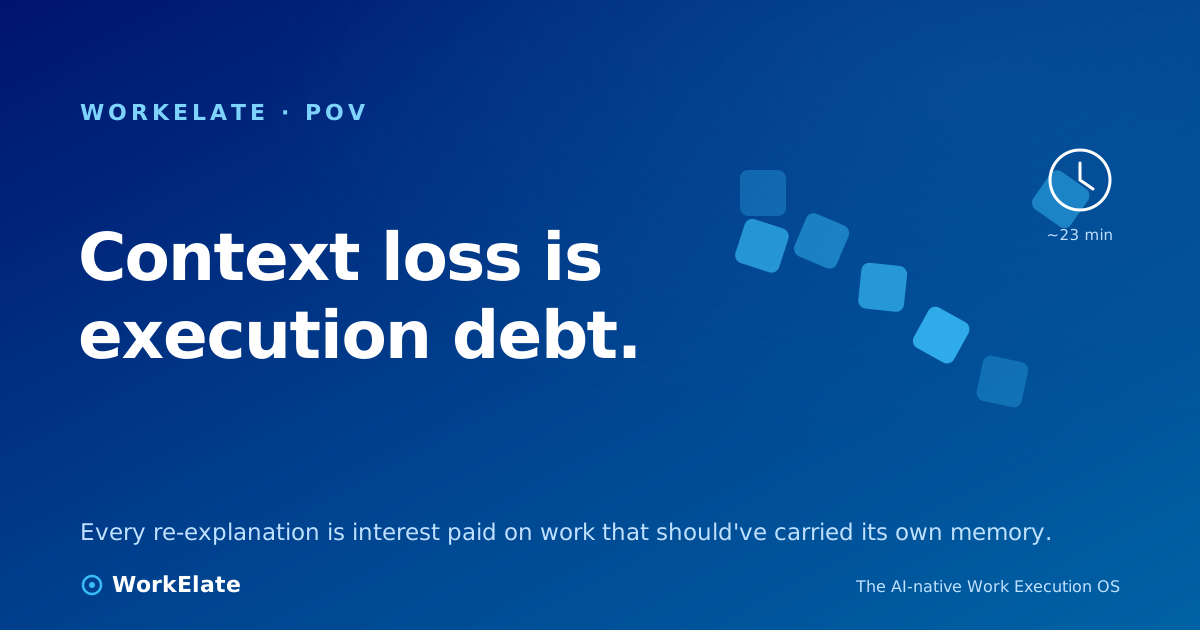
Context Loss Is Execution Debt
Every handoff where context is lost charges interest in re-explanation and rework. Work that carries its own memory stops the bleed.
Every handoff where context is lost charges interest in re-explanation and rework. Work that carries its own memory stops the bleed.
Watch a piece of work change hands. A designer finishes a flow and tosses it to engineering. The pixels arrive intact. The PNG is fine, the spec link works. But the why doesn't make the jump — the constraint that ruled out the obvious layout, the trade-off the team already argued through, the edge case a support ticket surfaced three weeks ago. None of that travels with the file. It stayed in the designer's head, or it's buried in a Slack thread nobody will scroll back to.
So engineering rebuilds it. They ask questions. They wait a day for answers. They guess at the parts nobody answers, and they guess wrong on roughly one in five. The work ships, but it ships slightly off-intent, and someone notices in review, and the loop starts again.
That gap — between what the work meant and what survived the handoff — is not a communication problem you can fix with a better standup. It's a debt. And like any debt, it charges interest.
When context is lost at a transition, you don't pay the cost once and move on. You pay it every time the work touches a human who wasn't in the original room. The interest comes due in three forms.
Re-explanation. Someone has to reconstruct what was already known. The designer gets pulled into a thread to re-answer a question they answered a month ago. Multiply that by every handoff, every new joiner, every "wait, why did we decide this?"
Rework. Execution that drifts from intent gets caught late and redone. The further the drift travels before someone notices, the more expensive the correction — a misread constraint costs minutes at design, hours at build, days in production.
Dropped threads. The cruelest one, because it's silent. A dependency nobody flagged. A follow-up that lived only in one person's memory and left with them. Work that simply stops, and no system ever notices it stopped.
A normal debt you can pay down. Execution debt compounds, because the conditions that create it are the conditions of everyday work: handoffs, tool switches, interruptions, new people joining mid-stream.
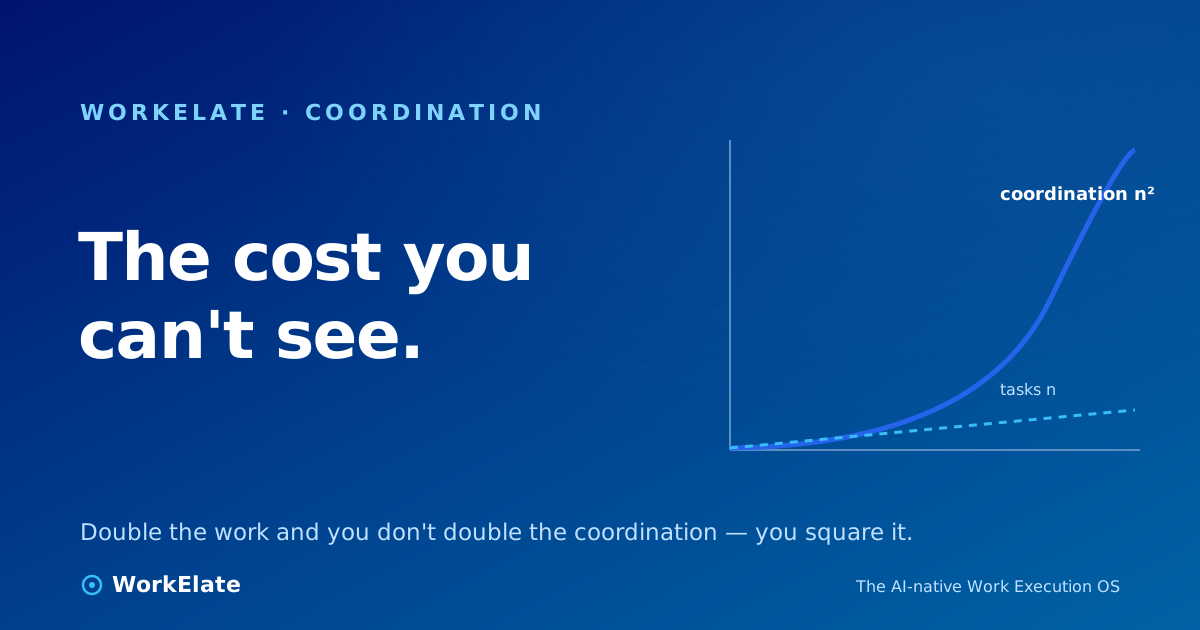
Each transition is a place where context can leak. The trouble is that the number of transitions doesn't grow with the size of your team — it grows with the connections between people. Add a person and you don't add one handoff; you add a handoff to everyone they coordinate with. The coordination surface widens faster than the headcount. That's the same reason the real cost of a task is coordination, not the doing.
And the context that leaks at each of those transitions doesn't sit in one place you could go tidy up. It's smeared across a chat tool, a doc, a card, a calendar invite, three email threads, and one person's memory. Reassembling it isn't a lookup. It's an excavation. By the time you've reconstructed enough context to act, the act is half the effort and the reconstruction was the other half.
This is also why context switching feels so much worse than the clock says it should. The minutes you lose aren't the switch itself — they're the reload. You sit back down at a task and spend the first stretch just rebuilding the state you had an hour ago. The debt isn't only paid between people. You pay it to your own past self.
The instinct is to try harder: better documentation, tighter handoff checklists, one more meeting where someone reads the context aloud. All of that is paying interest more politely. It doesn't retire the debt, because the debt comes from context living outside the work — in heads, in side channels, in places the next person has to go find.
The structural fix is to make the work itself the place the context lives. Not a doc about the work — the work-graph, where every task is linked to the decisions that produced it, the dependencies it sits between, the inputs it drew from, and the outputs it feeds. When work moves, the graph moves with it. The engineer who picks up the flow doesn't excavate; the rationale, the constraint, and the open thread are attached to the thing they were handed.
That's the difference between a tool that stores your work and a system that runs it. A folder of files is inert; it waits to be read. A work-graph is live; it knows that this card blocks that one, that this decision came from that ticket, that this thread has been waiting six days for a reply nobody made. When the connection between pieces of work is something the system holds rather than something a person remembers, dependencies don't manage themselves — but they finally can be managed, because they're no longer invisible.
▶ Watch on WorkElate See work carry its own context across a handoff youtube.com/@WorkElate · videoId: TODO — swap when publishedThe reframe is small and total. Stop treating lost context as the unavoidable friction of teamwork — the tax you pay for having more than one person. Start treating it as debt: a balance that grows quietly, charges interest in your team's best hours, and never appears on any ledger you look at.
Most teams have been servicing this loan for so long they've stopped seeing it as a loan at all. They call the re-explanation "alignment," the rework "iteration," the dropped thread "we'll catch it next sprint." But it's all interest on the same principal. The only way to stop paying is to stop borrowing — to make the work carry its own memory, so the next hand it lands in starts where the last one left off, not from scratch.