Common Workplace Chaos: 7 Problems Killing Team Productivity (and the Fix for Each)
Seven workplace chaos problems — silos, status, ownership, meetings, priorities, handoffs, stale data — each with a concrete fix. The pattern underneath all seven is disconnection.
WorkElate Team
Apr 25, 2026 · 6 min
Here is the thing nobody puts on the org chart: most "workplace chaos" is not a people problem. Your team is not lazy, disorganized, or bad at their jobs. They are spending a third of the week being the wiring between tools that don't talk to each other — copying a decision from a thread into a card, asking someone for a file that already exists, rebuilding context they had yesterday and lost overnight.
That is the real shape of team productivity problems. Below are the seven you'll recognize on sight. Each gets a concrete fix — not "communicate better," which is advice, not a system. And by problem seven you'll see the one thing all seven share. It isn't the number of tools you use. It's that the tools, and the work inside them, are disconnected.
TL;DR — Workplace chaos shows up as seven symptoms: information silos, fragmented communication, unclear ownership, meeting overload, inconsistent processes, priority confusion, and disconnected tools. Each has a real fix. But fixing them one at a time is whack-a-mole, because they all grow from the same root: work that lives in pieces nobody can see end to end. Connect the work, and most of the seven stop happening on their own.
01
Information silos
Knowledge trapped in one inbox, one drive, one person's head. When they're out, work stops.
02
Fragmented comms
The decision lives in a thread, the task in a board, the file in a chat. Nobody knows where "latest" is.
03
Unclear ownership
Two people do the same thing; one critical item nobody owns. Things fall through the cracks.
04
Meeting overload
Back-to-back calls to re-sync on status — meetings that exist only to rebuild context.
05
Reinvented wheels
Every project starts from scratch. No templates, no captured lessons, quality swings wildly.
06
Priority confusion
Everything is "urgent." Loud beats important. Scope creeps with no visible trade-off.
07
Disconnected tools
Copy-paste between systems. An update in one place never reaches the others. Everyone works off stale data.
Problem 1: Information silos and lost knowledge
The symptom: A client's last three decisions live in one account manager's inbox. The brief is on someone's desktop. When that person takes a Friday off, the work simply waits for Monday. When they quit, it walks out the door with them.
Why it's expensive: Knowledge workers lose up to a fifth of the week just looking for things they already have — searching, re-asking, recreating work that already exists. That's a day a week spent finding instead of doing.
The fix: Stop treating documents and decisions as files people remember to save somewhere. Put the work in a shared space where the doc, the spreadsheet, and the thread that produced them sit together and stay searchable — not because everyone is diligent, but because the system captures it by default. The goal isn't a tidier drive. It's that no single person is a single point of failure.
Problem 2: Communication overload and fragmentation
The symptom: The decision happened in a chat. The task that implements it is on a board. The file it needs is attached to an email. To understand one piece of work, you reassemble it from four places — and you're never sure you found the latest version.
Why it's expensive: Critical updates get missed. The same conversation happens twice. Decisions slow to a crawl because half the meeting is people catching up on context the rest already have.
The fix: Anchor communication to the work item, not the messaging tool. A discussion should hang off the task, the doc, or the account it's about — so the context travels with the thing it describes. When the conversation and the work are the same object, "where's the latest?" stops being a question.
Problem 3: Unclear ownership and accountability
The symptom: A task sits untouched for a week because everyone assumed someone else had it. Meanwhile two people independently build the same deck. When it goes wrong, the conversation is about who was supposed to, not what's next.
Why it's expensive: Quality drops, deadlines slip, and managers spend their week chasing status instead of leading. Following up is not leadership — it's tax.
The fix: Every work item has exactly one owner, a due date, and a visible state — and that visibility is automatic, not something a human reports in a standup. The point isn't to assign blame faster. It's that "who owns this and where is it" is always answerable without asking a person.
THE POINT
Status should be something the system knows — not something humans produce.
When the system holds the state of the work, half of these seven problems never start.
Problem 4: Meeting overload and poor meeting quality
The symptom: Calendars fill with back-to-back calls, most of which exist to answer one question: "where are we?" Makers get no uninterrupted block to actually make anything. Meetings start without agendas and end without owned action items.
Why it's expensive: Deep work needs long, quiet stretches; a day chopped into 30-minute sync meetings has none. And the irony is brutal — most of those meetings are coordination overhead, re-syncing context that a connected system would already hold.
The fix: Default to async. Most status updates should be read, not attended. When the work's state is visible without a meeting, you only meet for the things meetings are actually good at — judgment, debate, trust. Reserve the calendar for decisions, not status. (For why "we'll sync up later" quietly fails, see the lie of syncing up later.)
Problem 5: Inconsistent processes and reinvented wheels
The symptom: Three people run the same kind of project three different ways. New hires get whatever onboarding their trainer remembers that day. A mistake you fixed last quarter happens again because the lesson lived in someone's memory, not the system.
Why it's expensive: Quality swings with whoever's doing the work. You can't scale a team whose knowledge is stored in individual heads — every new hire needs a babysitter, and management overhead grows as fast as headcount.
The fix: Templatize the repeatable. Turn your best version of a recurring workflow into the default starting point, so good practice is the path of least resistance instead of an act of discipline. Build institutional memory into the system, not into your most experienced person's recall.
~20%of the week knowledge workers lose just searching for information they already have
~23 minto fully refocus after a single context switch — the real cost of fragmentation
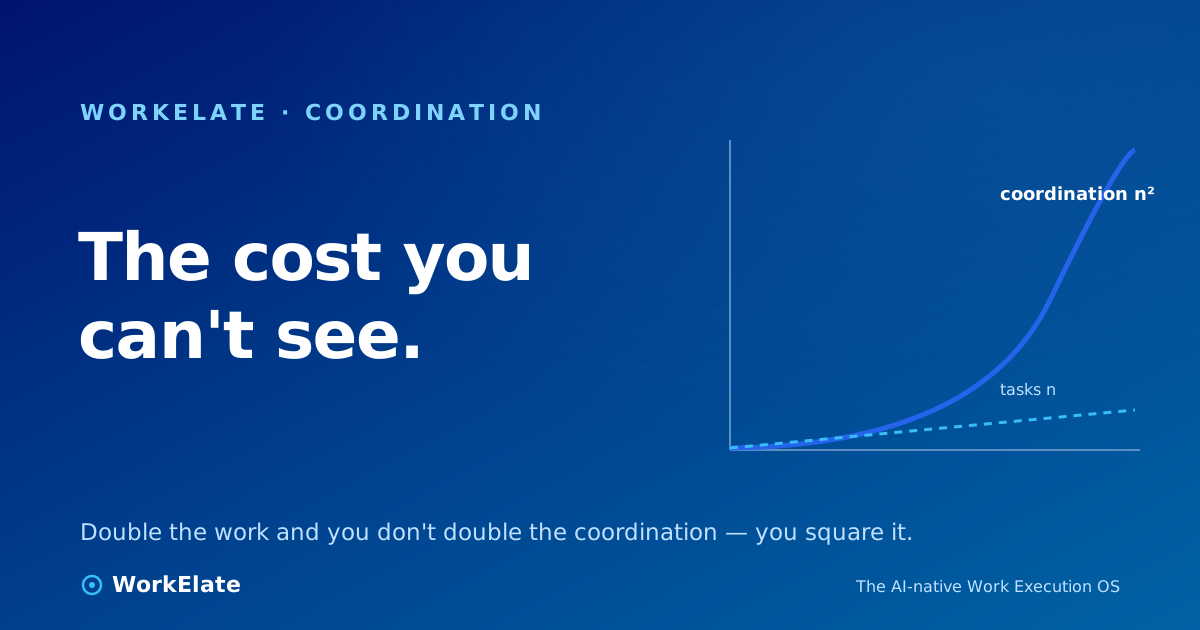
n²how coordination overhead scales with team size — not n
Problem 6: Priority confusion and scope creep
The symptom: Everything is flagged urgent, so nothing is. Loud requests jump the queue over important ones. Scope quietly expands — "while you're in there, can you also…" — with no matching change to timeline or staffing.
Why it's expensive: Teams burn out trying to do all of it at once. Strategic work gets shoved aside for reactive firefighting. Stakeholders lose trust as promised dates slip for reasons nobody can quite name.
The fix: Make priority explicit and visible to everyone — not a ranking that lives in one manager's head. And make scope changes cost something on purpose: surface the trade-off ("this pushes that") at the moment of the ask, not at the post-mortem. When the trade-off is visible, "everything is urgent" loses its power.
Problem 7: Disconnected tools and manual data entry
The symptom: A status changes in one tool. Now someone has to remember to change it in two others. Information gets copied between systems by hand, which means it gets copied wrong, and half the team is working off a version that was true an hour ago.
Why it's expensive: Manual data entry is an error generator. Worse, it's invisible labor — your best people quietly spend hours being the integration nobody budgeted for.
The fix: Stop being the wiring. Either the tools share a live source of truth, or you work where they already do. The aim is a single, current picture of the work that updates itself — so a change made once is true everywhere, and nobody's job is "keep these four systems in sync."
The pattern under all seven
Read the seven fixes back to back and the same word keeps surfacing: connected. Knowledge that's connected to where work happens. Conversations connected to the items they're about. Ownership and status the system holds, not humans. Tools that share one live picture.
So the villain was never the number of tools. A team of twenty might run a chat app, a board, a doc editor, a calendar, and a spreadsheet — that's not too many; each one earns its place. The damage comes from those surfaces being islands, with humans paid to row between them. That's the actual root of most team productivity problems: not sprawl, but disconnection.
This reframe matters because it changes what you go fix. Chase the seven symptoms one at a time and you're playing whack-a-mole forever — solve silos and ownership re-breaks, solve meetings and priority confusion creeps back. Fix the disconnection and most of the seven stop happening on their own, because the conditions that produced them are gone. (It's the same reason the real cost of a task is coordination, not the task itself.)
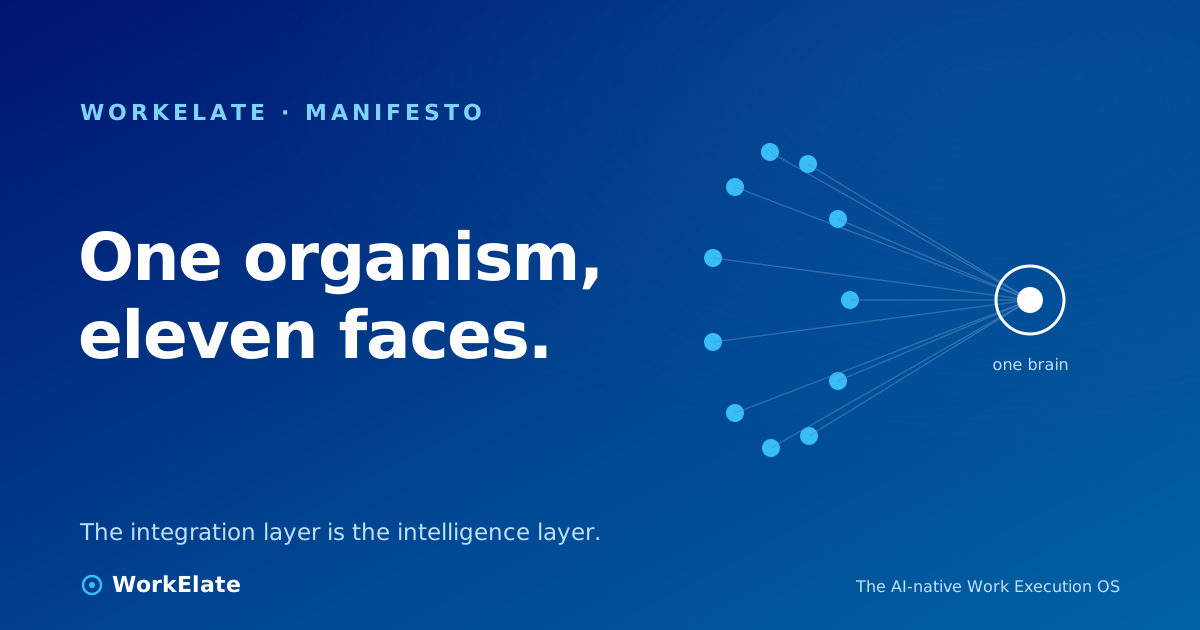
That's the bet behind WorkElate: not another tool to add to the pile, but one connected workspace where the apps your team already uses — chat, board, docs, calendar, data, mail, and more — share a single picture of the work, and an orchestrating layer keeps the state current so people don't have to. The same idea, said plainly: the integration layer is where the productivity actually lives.
Almost always disconnection — not a lack of effort. When knowledge, conversation, ownership, and status live in separate tools, humans have to manually carry information between them. That carrying is where errors, delays, and dropped balls come from. The chaos is a symptom of a broken system, not a broken team.
Will adding more software fix it?
Usually not. Adding a tool adds another island to row to. What helps is connection: either tools that share a live source of truth, or a workspace where the work already lives together. The fix is fewer seams, not more apps.
Which of the seven problems should we tackle first?
Find the one that costs you the most and start there — for many teams it's silos (problem 1) or disconnected tools (problem 7), because those two feed the other five. But notice they share a root, so the highest-leverage move is usually attacking the disconnection itself rather than each symptom in isolation.
Is this just a "communication" problem we can solve with better habits?
No. Habits don't survive a system that fights them. You can't discipline your way out of a tool that won't tell you what's blocked, or a status that's only true until someone forgets to update it. Better systems make better habits the default; willpower alone can't hold seven leaks shut.