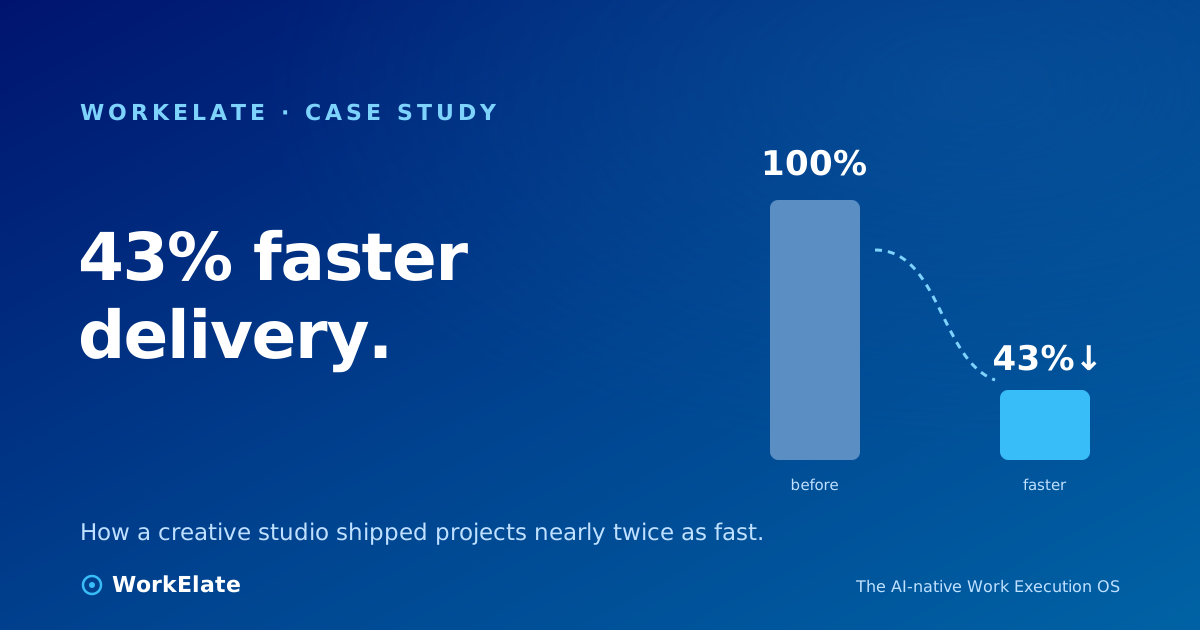
How BrightRiver Creative Cut Project Delivery Time by 43%
A 40-person creative studio removed the coordination drag between brief, design, review, and client handoff — and shipped projects 43% faster. The story, the numbers, the honest caveats.
WorkElate Team
Apr 26, 2026 · 7 min
⚠️ PUBLISHING GATE — do not ship as-is. Confirm "BrightRiver Creative" is a real, approved
customer reference with signed permission to use its name, logo, and quotes before publishing.
Every name, number, and quote below is tagged [VERIFY]. Replace each [VERIFY] with a confirmed
value (and a source) or remove the claim. If BrightRiver is a scenario rather than a signed
reference, reframe the whole piece as an illustrative scenario and say so in the first line. Do
not invent people or quotes.
The brief was approved on a Monday. The work didn't actually start until Thursday.
Nobody at BrightRiver Creative [VERIFY] had been idle in between. The account lead had the brief
in an email thread. The designers were waiting on assets that lived in a shared drive nobody had
linked. The producer was rebuilding the timeline by hand, in a third tool, because the one with the
brief and the one with the files couldn't see each other. Three days of perfectly busy people, and
the project hadn't moved.
That gap — between "approved" and "started" — is where a creative studio quietly loses its margin.
It isn't a talent problem. BrightRiver's [VERIFY] forty people are good at design. The problem is
the work between the design: carrying the brief to the canvas, the canvas to review, the review to
the client, and the client's notes all the way back. This is the story of a studio that stopped
paying that tax — and shipped roughly 43% faster [VERIFY] as a result.
The before-state: six tools, and the seams between them
Walk a single BrightRiver [VERIFY] project end to end and you cross a border at every step. The
brief sits in one place. The design files in another. Feedback in a chat thread. The schedule in a
project tool. Client sign-off in email. Reporting in a spreadsheet someone updates on Friday.
None of those tools is bad. Several are excellent. But the seams between them are where the work
stalls — because a seam is a place a human has to stand and carry information across by hand. The
account lead re-types the brief into the task tool. The designer screenshots the canvas into the
chat for review. The producer reconciles three different versions of "done." Every handoff is a
person doing the work of glue.
The cost showed up in the obvious places — slipped dates, duplicated effort, a client waiting on a
reply that was technically sent but in a thread the right person never saw [VERIFY]. And it showed
up in a less obvious place: the studio's best designers were spending a real slice of their week not
designing, but coordinating.
▤ The turn: four disconnected handoffs → one work-graph, one brain
The turn: stop carrying the work between tools
WorkElate didn't ask BrightRiver [VERIFY] to throw out the way it works. A studio still needs a
place to brief, a place to design, a place to review, a place to talk to a client. WorkElate is
eleven of those surfaces — hub, weMail, chat, data, docs, ppt, calendar, task, board, and form —
but the surfaces aren't the point. The point is what sits underneath them.
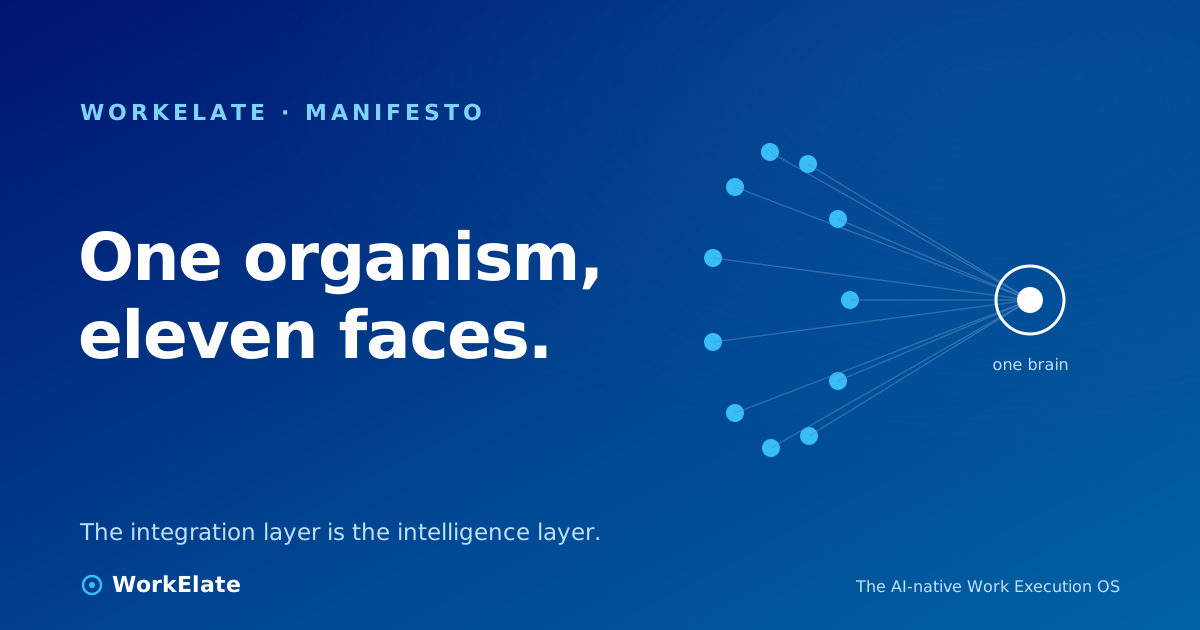
Underneath is one orchestrating intelligence the team calls WAO, and a single **cross-app
work-graph** keyed to the client engagement. Every app emits what just happened — a brief approved,
a board updated, a review comment left, a client email answered — into that shared graph. So WAO
doesn't have to guess the state of a project by reading scattered tools after the fact. It already
knows, because the apps told it.
That's the difference that matters, and it's worth saying plainly: most AI tools sit outside your
stack and try to infer the state of your work by reading it. WorkElate emits the graph from inside
the apps and can write back to it. The seam where a human used to stand and carry information becomes
a place the system already understands.
"The studio didn't get faster because people worked harder. It got faster because nobody had to carry the work across the gaps anymore."
— BrightRiver Creative [VERIFY]
And because WAO can act, the carrying gets done for you. The reflex is always **suggest → confirm →
execute** — WAO proposes the next move and a human approves it before anything client-facing
happens. A brief approved in docs can become a structured task board, a kicked-off schedule, and a
client-facing form [VERIFY] — drafted by the brain, confirmed by the producer, instead of
hand-assembled across three tools. The mechanical slice of coordination — the re-typing, the
status-chasing, the "did anyone reply to the client?" — is the part that gets handled. The judgment
stays with the humans who were always good at it.
The after-state: 43% faster, and the number is the easy part
43%[VERIFY]faster project delivery, brief to client handoff
~5 hrs[VERIFY]per person per week returned from coordination to craft
1 graphone shared work-graph the brain reads and writes across every app
The 43% [VERIFY] is the headline, but it's the downstream effect, not the cause. The cause is that
the three days between "approved" and "started" mostly disappeared — and so did the smaller versions
of that gap at every other handoff. When the system already knows the state of the work, the studio
stops spending hours reconstructing it.
What didn't change is as important as what did. BrightRiver's [VERIFY] designers still design.
Their producers still make the calls only a human should make. The client still sees a person, not a
bot. WorkElate took the glue work off the people who were too good to be doing it — and left the