POV
You're Not Managing Work. You're Managing the Pings About the Work.
Most of your day isn't spent managing work — it's spent triaging notifications about work. That's the coordination tax, itemized. Here's the fix.
Most of your day isn't spent managing work — it's spent triaging notifications about work. That's the coordination tax, itemized. Here's the fix.
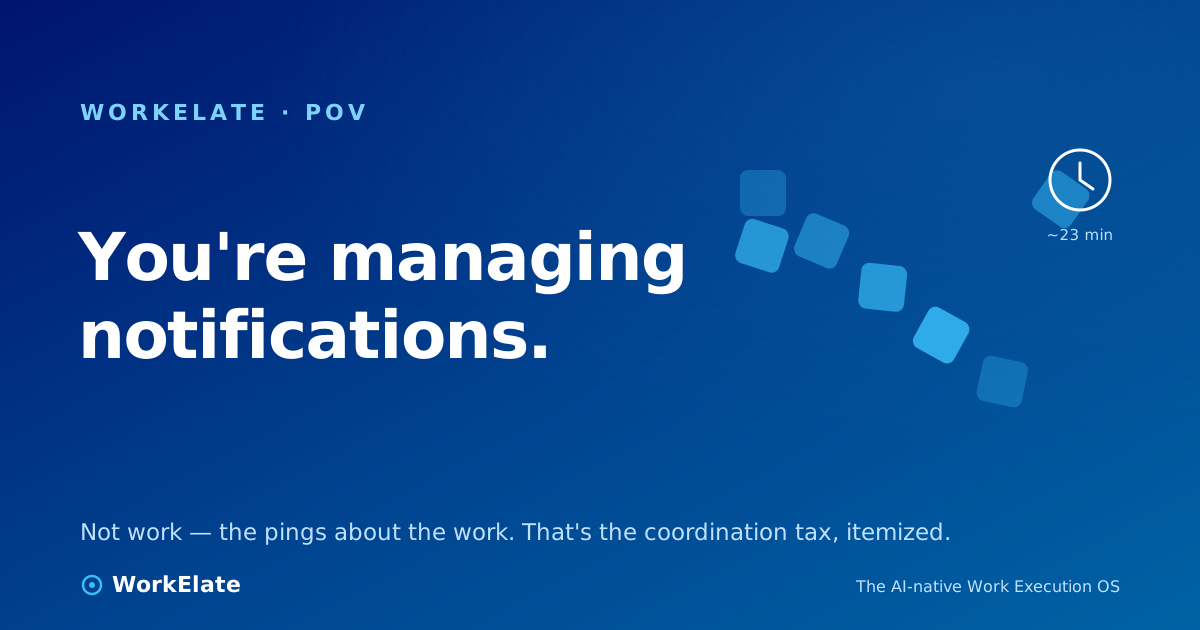
Open your work notification log from yesterday and read it like an itemized bill. A status change you didn't need to see. A comment on a doc that resolved itself two replies later. A mention that was really just an FYI. A "can you take a look?" that turned out to be a thirty-second yes. A due-date reminder for a task that already shipped. Add them up. That number — not your task list — is what actually ate your day.
Here's the reframe, stated plainly: most of what you call "managing work" is managing the pings about the work. The two feel identical from the inside. They are not. Managing work means the next thing happens, the dependency clears, the outcome lands. Managing notifications means you triage alerts, answer pings, and stay abreast of a stream of things that already happened. One moves the work forward. The other moves you — back and forth, all day, between contexts you didn't choose.
Every tool you own is honest about one thing: it will tell you when something happens inside it. A task changes state — ping. Someone comments — ping. A form gets a response — ping. None of those tools knows whether you are the right person to receive that ping, or whether it needed a human at all. So the default is to send it to everyone, just in case. The interruption is free for the sender and expensive for you.
That expense is real and it's measurable. The research on this is not subtle: it takes roughly twenty-three minutes to fully refocus after a single interruption. You don't get twenty interruptions a day and lose twenty minutes of typing. You lose the deep state behind it — the held context, the half-formed plan, the thread you were pulling. A calendar that looks 60% free can still be 0% deep, because the gaps are sawn into fragments too small to think in.
The usual advice is to mute, batch, and set boundaries. That treats the symptom. The notification isn't the disease — it's the visible edge of a deeper problem: the coordination between your tools runs through a person, and that person is you.
Think about what a single ping is actually asking. "This happened — now you decide what it means and what's next." That's a coordination decision dressed up as an alert. When work crosses a boundary — chat to task, task to doc, form to calendar — the connective tissue ("this response should become that task, for this person, because of that conversation") lives nowhere except your head. So the tools fall back on the only mechanism they have: ping the human and hope the human routes it. Muting doesn't remove the routing job. It just removes your visibility into it, which is how the important handoff ends up buried under the trivial one.
Notice the pattern across all four: the work itself was fine. The coordination about the work is what cost you. That's the coordination tax, and notifications are how you pay it — one interruption at a time, with your attention as the currency.
Here's the shift. A notification exists because a human has to decide what a piece of work means and where it goes next. Take that decision off the human, and most notifications simply have no reason to fire.
That requires something the average tool stack doesn't have: a single intelligence that sees the whole work-graph — every client, task, doc, and conversation, and the connections between them — rather than ten tools each shouting about their own corner. When the connections live in the system instead of in your head, the system can do the routing. A task completes; instead of pinging the next person to please start, it triggers their step with the full context already attached. A form response arrives; instead of waiting for a human to decide what it means, it becomes the right task for the right owner. The handoff happens. Nobody gets paged to make it happen.
At WorkElate this is the job of WAO — the orchestrator that runs across all eleven apps as one brain. It works on a confirm reflex, not a blank cheque: suggest → confirm → execute. So the goal isn't an empty inbox. It's a different inbox — one that triages on your behalf and hands you a short list of what genuinely needs a human, with everything else already in motion. The signature line for it is exactly that: three things need you; two I already handled.
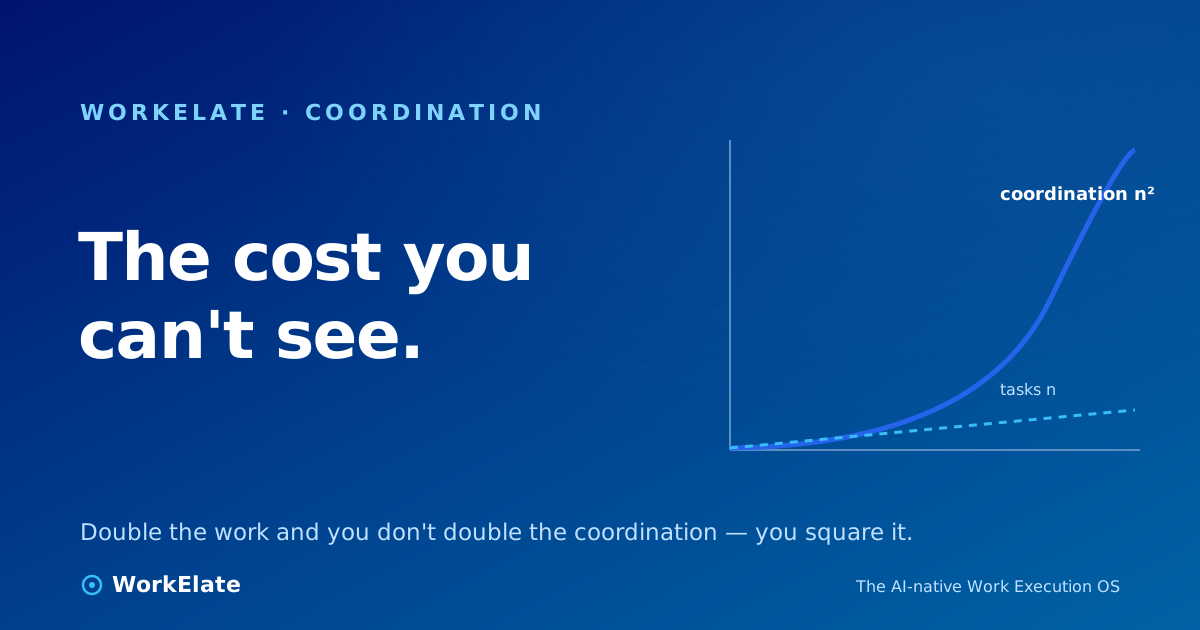
Notice that middle number, because it's why "just be more disciplined" eventually fails. Notifications don't grow with your task count — they grow with the connections between tasks and people, which is closer to n². Two people on three tasks, you can hold the pings in your head. Fifty people across eleven tools, you cannot. The volume crosses from annoying to unmanageable, and the only humane answer is to stop being the router. (Why one context switch costs more than the time it takes →)
If most of your notifications are coordination you've been doing by hand, then the way to reduce them was never a better mute filter. It was a system that owns the wiring — that knows the work-graph well enough to move work across boundaries without paging a person at every seam. The good orchestration is the kind you don't notice, because the interruption that never fires is the one you never have to recover from.
So the real question isn't "how do I get fewer notifications?" It's "why am I the one routing the work in the first place?" Answer that, and the pings mostly answer themselves.
▶ Watch on WorkElate See WAO route a handoff so the ping never fires youtube.com/@WorkElate · videoId: TODO — swap when publishedRelated reading: The real cost of a task is coordination · Invisible AI: the only AI that matters