POV
The Board Always Lies
A card moves from "In Progress" to "Done." It feels like progress. It isn't, necessarily. It's a claim — typed by a person who wanted to look like they were keeping up.
A card moves from "In Progress" to "Done." It feels like progress. It isn't, necessarily. It's a claim — typed by a person who wanted to look like they were keeping up.
A card moves from "In Progress" to "Done." It feels like progress. It isn't, necessarily. It's a claim — typed by a person who wanted to look like they were keeping up.
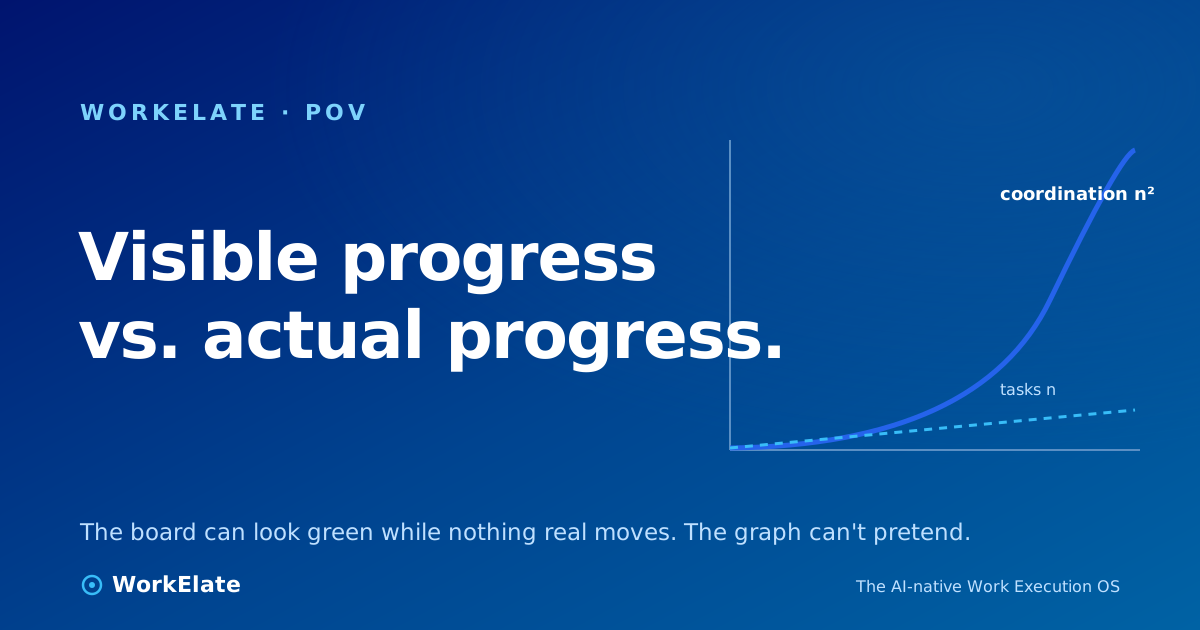
That's the quiet problem with every status board you've ever managed. The board doesn't watch the work. It watches the human reporting the work. And the human, under pressure, reports optimistically. So the board fills up with green, and the green tells you almost nothing.
The board always lies. Not because anyone is dishonest — because the board only knows what it's told.
Think about what actually fills a status update. A card dragged to a new column. A "looking good, on track" in the standup. A document marked complete. A meeting that "moved things forward." Every one of these is a person producing the appearance of motion. They're real activities. They're just not the same thing as the outcome.
This is why a project can be 80% green and 100% stuck. The design is "done" — but the API it depends on was never started, and nobody updated that card because nobody owns it. The handoff was "sent" — but it landed in an inbox no one reads. The board shows a tidy march toward the finish. The actual work is tangled three steps back, in the gaps between the cards, where status updates don't reach.
Here's the shift. Instead of asking people to report progress, watch the work emit it.
When a real thing happens — a form gets a real bookable slot locked, a deck finishes generating, a spreadsheet row changes, a doc gets co-edited, a calendar event is actually created — that event is recorded the moment it occurs. Not described. Recorded. WorkElate calls the trail of these events the work-graph: the connected record of what genuinely moved across every app, keyed to the client and the project.
The work-graph can't pretend. A human can drag a card to "Done." A human cannot make the downstream event appear in a system that only logs events that really fired. If the scheduler never locked the slot, there's no slot-locked event — no matter how green the card is. The story and the receipts finally have to match.
That's the whole difference between a tool that displays your work and a system that runs it. One trusts the report. The other trusts the trace.
When progress is something the system observes rather than something people produce, three things stop happening. People stop spending Friday afternoons manufacturing status. Managers stop being surprised in week six by work that was "fine" in every update. And the gaps between apps — the place real projects actually die — stop being invisible, because the work-graph is exactly the thing that spans them.
WorkElate's One Brain reads this graph. It doesn't ask your team how things are going. It already knows, because it watched every real event land. That's not a prettier dashboard. It's a different source of truth.
So the next time a board goes all green at once, don't relax. Ask the harder question: did anything actually emit? Or did everyone just agree, politely, on the same comfortable story?
The board will tell you what people hope is true. The work-graph will tell you what is.
▶ Watch on WorkElate See WAO read the work-graph instead of the board youtube.com/@WorkElate · videoId: TODO — swap when publishedKeep pulling the thread: your task list is a lagging indicator, why manual status updates are coordination theater, and the real cost of a task is coordination.