Build in Public
Thank You, Product Hunt — You Named the Friction We've Been Chasing
A genuine thank-you to the Product Hunt community, and what their feedback taught us: the thing wearing people down isn't the work — it's the coordination around it.
A genuine thank-you to the Product Hunt community, and what their feedback taught us: the thing wearing people down isn't the work — it's the coordination around it.
A founder left a comment under our Product Hunt launch that we keep coming back to:
"I'm not tired of work. I'm tired of chasing context across twelve tabs."
We didn't write that line. We wish we had. It says, in one breath, the thing we've spent two years trying to say in paragraphs. So before anything else: thank you. Thank you for showing up, for arguing with us, and for telling us — specifically, in your own words — what your Tuesday actually feels like.
This is a thank-you note. It's also a confession that the comments taught us more than the upvotes did.
We'll be honest about the numbers, because honesty is the only kind of credibility we're interested in: the launch was modest. We didn't top a chart. What we got instead was a thread — dozens of comments from founders, operators, and product leads who didn't just react with an emoji. They explained their lived reality. People wrote three-paragraph descriptions of how their week leaks. That's the kind of feedback you can't buy and can't fake, and it was worth more to us than a badge.
Reading it back, the comments formed a surprisingly consistent X-ray of modern work. Here's what they showed us.
We expected to hear "I have too much to do." We barely heard that at all. What we heard, over and over, was something different — and more specific:
That last one stung, because we've all been in it. None of this is emotional burnout. It's system fatigue — the slow drain of doing, by hand, the work of holding everything together. Your best people are spending their best hours being the glue between tools that don't talk to each other.
"The work isn't the problem. The part where I stitch six tools together every morning — that's the problem."
— a Product Hunt commenter, paraphrasedAnd here's the part that bothered us most: people described this as if it were weather. Unavoidable. Just the cost of having a job. That quiet acceptance is the exact assumption we built WorkElate to argue with. The tax isn't a law of nature. It's a design failure — and design failures can be fixed.
It would be easy to read those comments as "people have too many tools." That's the wrong lesson, and we'd be hypocrites to push it — WorkElate is itself many surfaces: a hub, weMail, chat, docs, a spreadsheet, boards, a calendar, forms. The problem was never the number of tools. It's that they're disconnected. When your systems don't share a memory of the work, humans become the connective tissue — relaying, re-explaining, copy-pasting, reminding. That doesn't scale. It just quietly converts your team's attention into overhead.
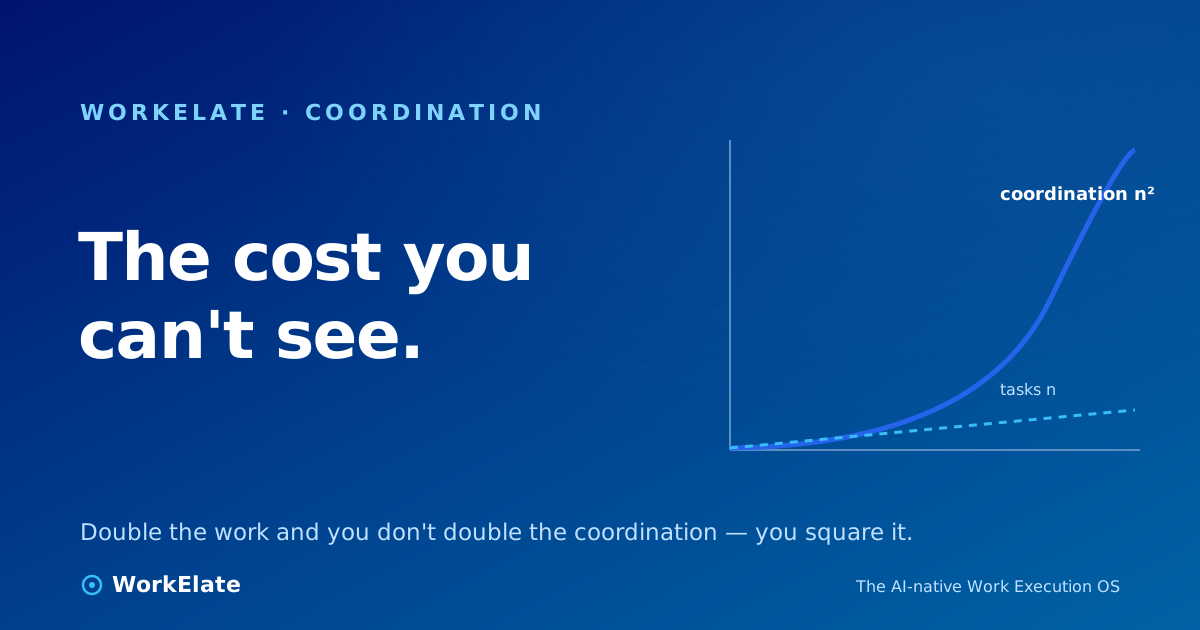
This is the idea we keep circling, and the launch only sharpened it: the real cost of a task is coordination, not the task itself. A task you can do in ten minutes can cost an hour once you count the chasing, the asking, and the "wait, where did we land on this?"
Feedback only counts if it bends the roadmap. A few things we're working on now, traceable directly to what you told us:
We're not going to pretend all of this is shipped today. Some of it is live, some of it is in flight. We'll keep telling you which is which, because that distinction is the whole brand. We'd rather earn your conviction with what's true than your applause with what isn't.
▶ Watch on WorkElate See WAO handle the coordination across apps youtube.com/@WorkElate · videoId: TODO — swap when publishedIf you want to understand the bet underneath all of this — why we think the connective layer between your tools is the intelligence layer — we wrote it down in our concept note on the future of work, and in the plainer story of why we built WorkElate to get work done, not manage it.
To everyone who commented, challenged, and shared a piece of their actual week: thank you for thinking out loud with us. You didn't just react to a product. You named a problem that usually stays invisible — and naming it is the first half of solving it.
So here's the question we're sitting with, and we'd genuinely like your answer: if the coordination tax disappeared tomorrow, what would your team finally have time to do?