Case Study
How Apex Strategy Cut Journey-Map Delivery From 6 Weeks to 4
A CX consultancy moved its journey-mapping work onto one AI brain across every app — and shipped maps 30% faster. The story, the numbers, the honest caveats.
A CX consultancy moved its journey-mapping work onto one AI brain across every app — and shipped maps 30% faster. The story, the numbers, the honest caveats.
⚠️ PUBLISHING GATE — do not ship as-is. Confirm "Apex Strategy Consultants" is a real,
approved customer reference with signed permission to use its name, logo, and quotes before
publishing. Every name, number, and quote below is tagged[VERIFY]. Replace each[VERIFY]
with a confirmed value (and a source) or remove the claim. If Apex is a scenario rather than
a signed reference, reframe the whole piece as an illustrative scenario and say so in the first
line. Do not invent people or quotes.
It always started the same way. A new CX engagement landed, and somewhere in a senior
consultant's week a quiet countdown began — not on the work that clients actually paid for, but on
the work around it. Pulling interview notes out of one tool. Rebuilding personas in another.
Rebuilding the same journey diagram a fourth time because the client's feedback lived in an email
thread nobody had reconciled with the canvas. Six weeks per map [VERIFY], and a sizable slice of
those six weeks was spent moving information between tools that couldn't see each other.
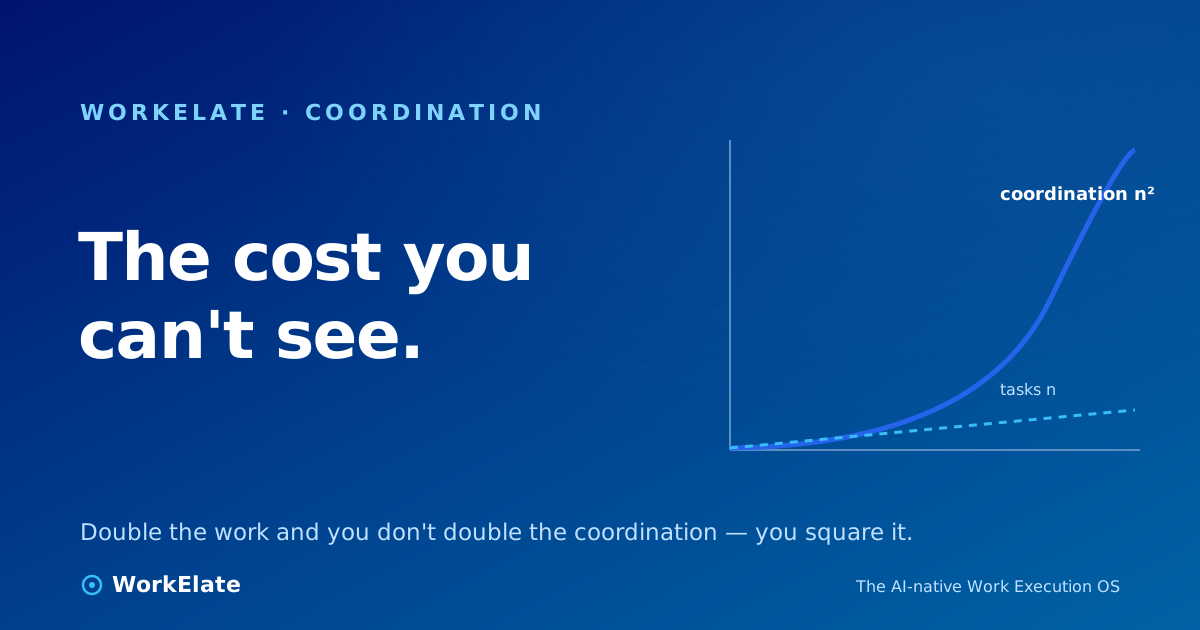
That slice has a name. It's the coordination tax — the glue work your best people are forced to do
when your apps don't share a brain. This is the story of how one consultancy stopped paying it.
Apex Strategy Consultants [VERIFY] is a premium CX-transformation firm. Its core product is the
journey map: a rigorous, research-backed picture of how a customer actually experiences a brand,
moment by moment. Done well, it's worth a great deal. Done with disconnected tools, it's slow.
Here's what a single engagement looked like before [VERIFY]:
spreadsheet, a doc, and a mail thread.
night, before the next review.
None of those steps were the thinking. They were the carrying. And because the carrying scaled
with every project, a consultant could only run 2–3 maps a quarter [VERIFY] before the
overhead swallowed the calendar. The board always lied a little — it said "in progress" on work
that was really stuck in a copy-paste queue between four apps.
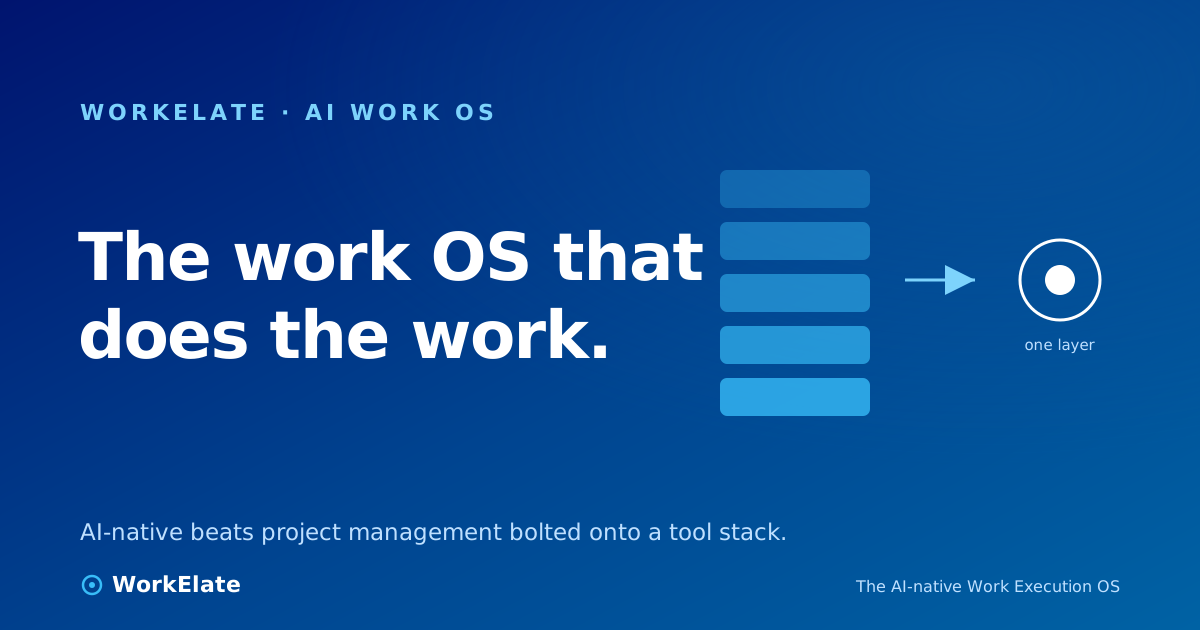
The change wasn't "add another tool." Apex already had plenty. The change was moving the work onto
a platform where every app reports into one Brain — what WorkElate calls WAO, the AI
orchestrator that sits above the apps rather than inside any one of them.
The mechanism is the cross-app work-graph. Instead of each app keeping its own private island of
information, every app emits what happened into a shared graph keyed on the client engagement. The
research notes, the personas, the canvas, the client's emailed feedback — they stop being four
disconnected files and become one connected object the AI can read and act on.
That distinction is the whole story. Most AI tools can read across your stack and then hand you a
summary. WorkElate owns the surfaces, so WAO can do the carrying itself — draft the persona in
docs from the research already sitting in data, surface the changes on the board canvas, and
flag the client feedback that arrived by mail against the exact step it touches. The consultant
stays in charge; WAO does the glue. Suggest → confirm → execute.
For Apex [VERIFY], that meant the senior people spent their hours on the judgment — *what does
this journey actually reveal* — instead of on the re-keying. The same map, with most of the
carrying removed.
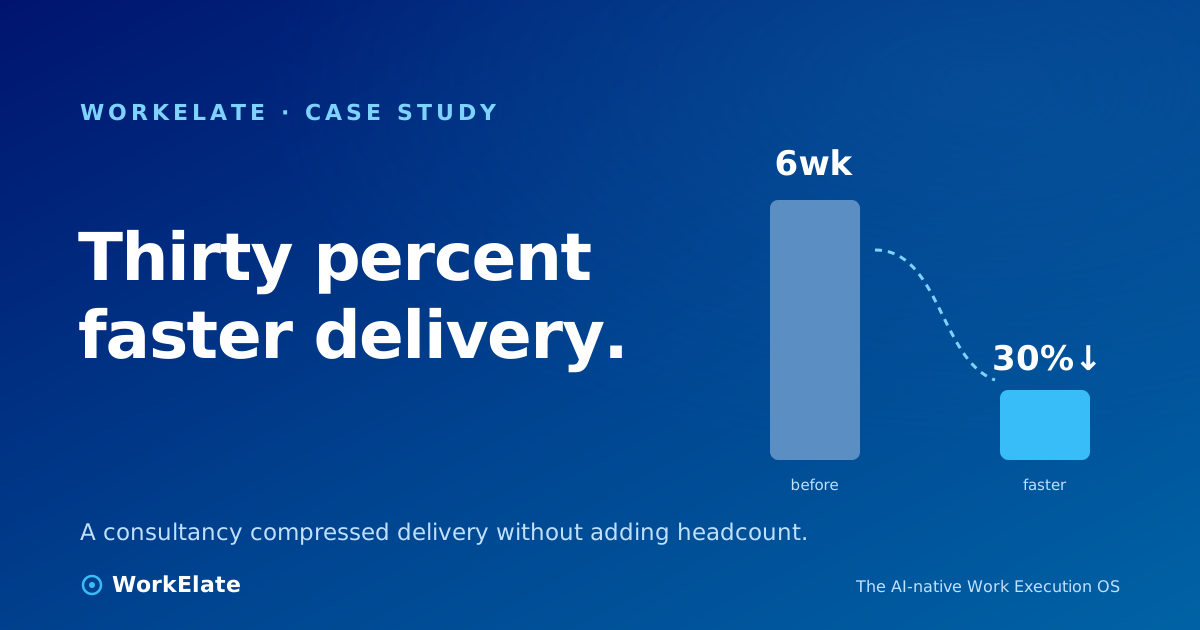
Within three months [VERIFY], delivery time on a journey-mapping engagement fell from six weeks
to four — a 30% cut [VERIFY]. Consultant capacity went from two-or-three maps a quarter to
six-or-seven [VERIFY], because the overhead that used to scale with every project no longer did.
And by retiring a stack of single-purpose tools, Apex reports saving roughly ₹8 lakh a year
[VERIFY] on software alone.
"We weren't slow at journey mapping. We were slow at everything around journey mapping. That's
the part WorkElate took off our plate." — [VERIFY: confirm a real, named, approved quote — do
NOT publish an invented one]
The 30% is the headline, but the more durable result is what it freed. Capacity that used to be
eaten by glue work became capacity for more engagements — or for doing the existing ones deeper.
That's the shape of the win whenever you stop paying the coordination tax: the time doesn't just
shrink, it moves up the value chain.
▶ Watch on WorkElate See WAO carry work across data, docs and board youtube.com/@WorkElate · videoId: TODO — swap when publishedIt's tempting to read this as "good tool, faster team." It's more specific than that. Three things
made the difference, and they're the same three that make any cross-app handoff possible:
A copilot bolted into each app is brilliant inside its own four walls and blind to everything else.
Apex's problem lived between the apps, so a per-app assistant couldn't touch it. WorkElate runs a
single orchestrating intelligence across every surface — so the persona drafted in one place and
the feedback that arrived in another are visible to the same mind. (We unpack why this matters in
why AI should execute, not assist.)
Plenty of AI can infer a picture of your work by indexing your tools. WorkElate's apps emit
the graph, which means the AI can also write back into it — move the work, not just describe it.
That's the line between a summary and a result. (More on why
the integration layer is the intelligence layer.)
The six weeks were never really about the difficulty of journey mapping. They were about the
carrying between disconnected tools — which scales worse than the work itself. Take that away and
the timeline collapses, because you removed the part that was secretly the bottleneck. (We make the
full case in the real cost of a task is coordination.)
A clean before/after deserves a skeptic's footnote, so here's ours. WorkElate's claim is not that
it generated a finished journey map autonomously while the consultants watched. The maps are still
the firm's craft. What changed is that the mechanical work around the craft — the gathering, the
re-keying, the reconciliation, the chasing of client feedback across tools — moved onto one brain
that can see the whole engagement and act across the apps with the consultant confirming each step.
That's the eliminable slice. We claim that slice and no more.
If your delivery timeline is padded with glue work between tools that can't see each other, this is
a story you can probably retell with your own numbers. If your bottleneck is genuinely the
thinking, no platform fixes that — and we'd rather tell you so.
So the question to sit with isn't "how do we go faster?" It's quieter than that: *how much of your
delivery time is the work — and how much is just carrying it between tools that should have shared
a brain all along?*