POV
The Best AI at Work Is Invisible
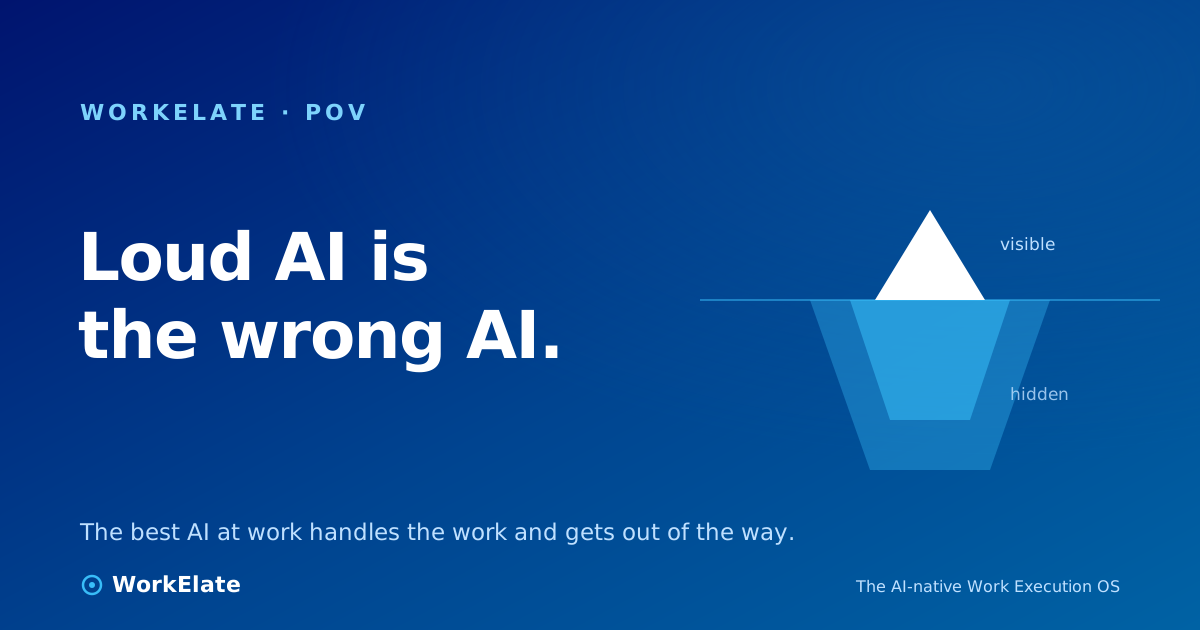
Loud AI performs and demands your attention. Invisible AI executes across your apps and surfaces only what needs you.
Loud AI performs and demands your attention. Invisible AI executes across your apps and surfaces only what needs you.
There are two kinds of AI showing up at work right now.
The first kind performs. It opens a chat window and waits. You type, it answers, you read, you copy, you paste, you check. It shows its work because it wants credit. Every interaction is a small audition, and you are the judge who never gets to leave the room.
We call this powerful. It isn't. It's loud.
Loud AI adds a layer. Before, you had your work. Now you have your work, plus the AI, plus the job of managing the AI. It moved the bottleneck from "doing the task" to "supervising the thing that does the task." That's not leverage. That's a new direct report who needs everything spelled out and still wants a gold star.
The second kind is quieter, and it's the only kind that matters.
Invisible AI doesn't mean hidden. You can still see exactly what it's doing — that visibility is the whole point, because trust lives on the surface, not under it. Invisible means it doesn't make you babysit it. It works across your inbox, your calendar, your boards, your docs — the apps you already live in — and it handles the coordination quietly, in the spaces between them.
Then it comes back with one line: three things need you, two I already handled.
Read that again. The two it handled, it didn't perform for you. It tracked the dependency, moved the work, kept the context attached, and told you afterward. The three that need you, it didn't act on alone — it surfaced them, showed its reasoning, and waited. Suggest, confirm, execute. You stay in command of the decisions that carry weight; you stop being the router for the ones that don't.
That's the difference. Loud AI gives you a better tool. Invisible AI gives you back your attention.
Here's the part most people miss: invisibility isn't a smaller ambition than power. It's a harder one. Anything can demand your attention — a notification can do that. Earning the right not to need it takes context the AI doesn't usually have: who's waiting on what, what changed since this morning, which thread is one reply from closing. A chatbot can't be invisible, because a chatbot doesn't know your work. It only knows your last message.
This is what WorkElate is built to be — one brain that sees across every app and does the coordination work in the background, surfacing only what's yours to decide. Not a faster way to talk to AI. A reason to stop talking to it.
The test for any AI at work isn't how impressive it looks when it answers.
It's how little you have to look at it for the work to move.
The loud ones want to be noticed. The good ones want you to forget they're there — right up until the moment they hand you the three things only you can decide, and quietly mention the two they already took care of.