What Is Context Switching? Costs and How to Reduce It
In short
Context switching is moving your attention from one task, tool or conversation to another, and each move has a cost in time and accuracy. You reduce it by protecting focus, batching small work, and keeping related work in one place.
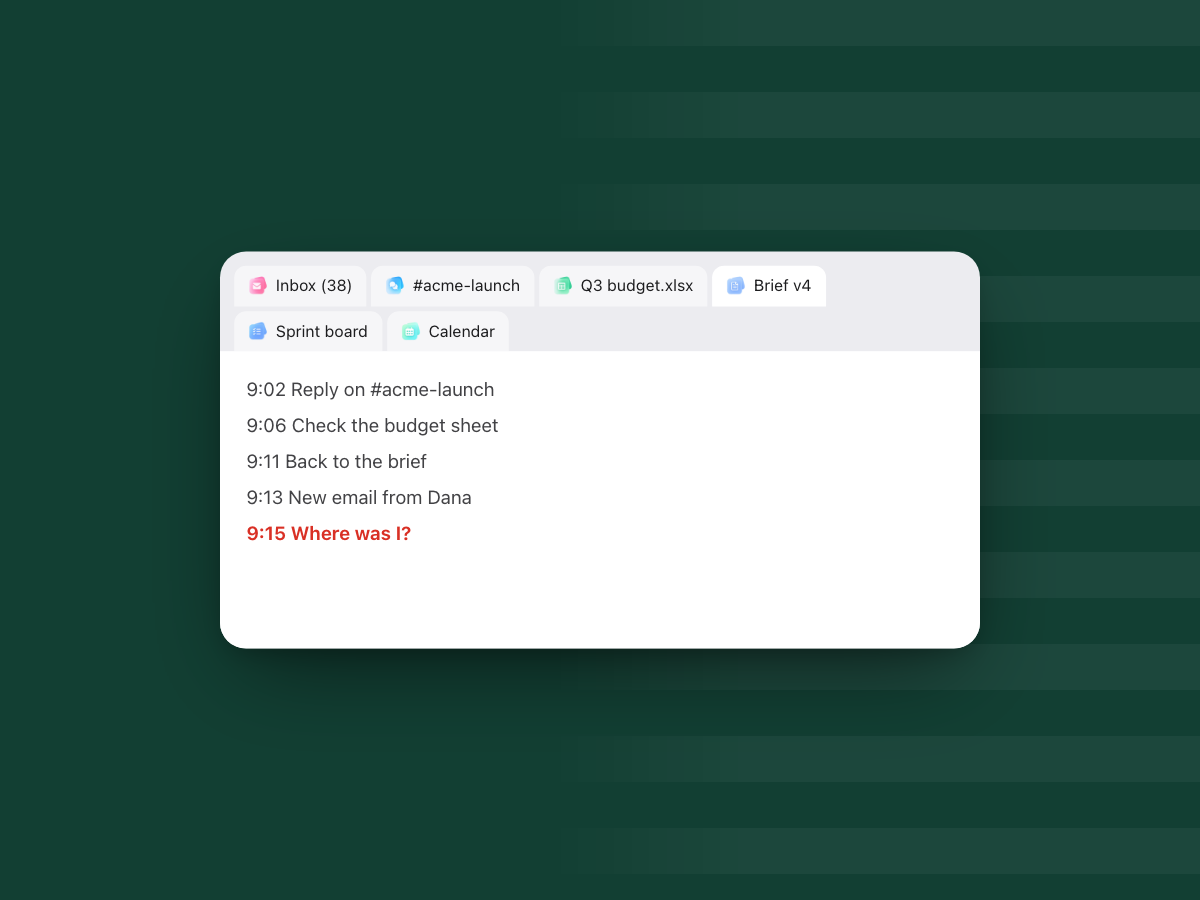
You sit down to write a proposal. A chat ping pulls you into a thread. The thread points to a doc. The doc is missing a number. The number is in a spreadsheet, and the spreadsheet reminds you of an email you never answered. Twenty minutes later you are back at the proposal, trying to remember the sentence you were about to write.
That gap is context switching. It happens to everyone, and almost nobody plans for it.
What is context switching?
Context switching is the act of moving your attention from one task, tool or train of thought to another. Each context carries its own state: what you were doing, what matters, what comes next. When you switch, your brain sets one state down and picks another up.
The term comes from computing. A processor switches between programs by saving one program's state and loading another's, and the switch itself does no useful work. Human attention behaves in a similar way. The move is overhead.
A few switches a day are normal and fine. The trouble starts when the day is made of them.
Is context switching the same as multitasking?
No, though people use the words as if they were. Multitasking means trying to do two things at the same moment, like answering a message while listening on a call. Context switching means moving your full attention from one thing to the next, in sequence.
Most of what people call multitasking is really fast switching. The brain does not run two focused tasks side by side. It flips between them, and each flip has a cost.
How much does context switching cost?
Research points to a real cost, though the exact number depends on the person and the work.
The American Psychological Association summarizes work by University of Michigan researcher David Meyer and colleagues: each switch may cost only a few tenths of a second, but repeated switching adds up, and Meyer has said the mental blocks it creates can cost as much as 40 percent of someone's productive time (APA, "Multitasking: Switching costs"). Treat 40 percent as an upper bound for heavy switching, not an average.
The most quoted figure, "23 minutes to refocus", is often misread. In a 2006 interview, UC Irvine researcher Gloria Mark said interrupted work in her field studies was resumed, on average, 23 minutes and 15 seconds later (Gallup, "Too Many Interruptions at Work?"). That is the time until people got back to the task, often after doing other things in between. It is not a lab measure of how long focus takes to return.
The honest summary: single switches are small, many switches are expensive, and the cost rarely shows on a calendar.
Why does switching leave you slower on the next task?
Business school researcher Sophie Leroy named the reason: attention residue. When you move from task A to task B before A is finished, part of your attention stays on A. In her experiments, people who switched away from unfinished work did worse on the next task (Leroy, 2009, Organizational Behavior and Human Decision Processes).
This is why a "two-minute question" costs more than two minutes. You pay for the question, then for the time your mind spends half on the old task, then for rebuilding where you were.
What causes context switching at work?
Notifications get the blame, and they do play a part. But the bigger cause is structural: the pieces of one piece of work live in different places.
One client request can touch a chat message, a task, a doc, a spreadsheet, a calendar invite and an email. Six places, none of which knows about the others. To act on that one request, you carry the context between them by hand. Every carry is a switch.
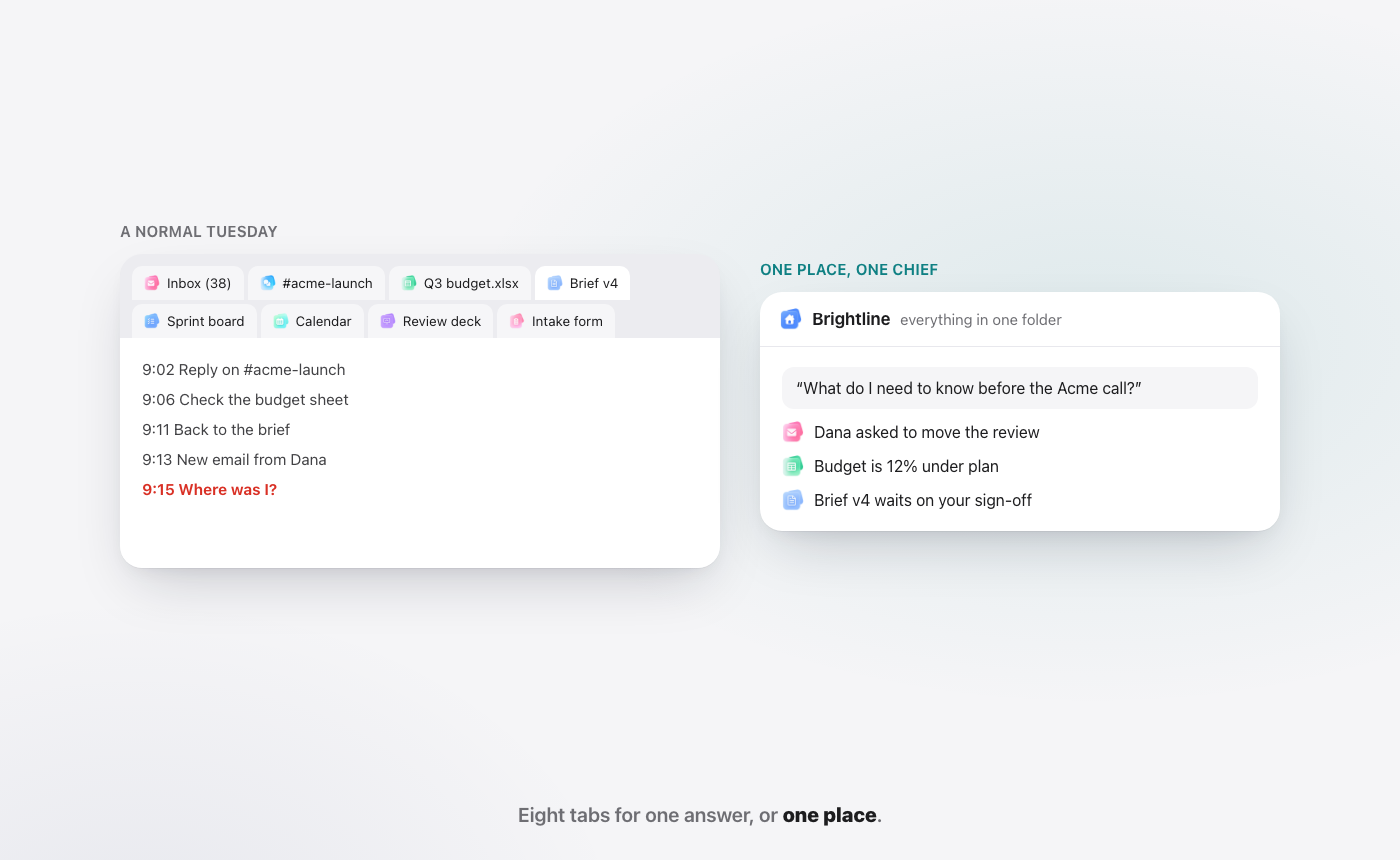
The issue is not the number of apps. Good specialist apps are useful. The issue is that the work is split across them, so you become the link. We cover the hidden cost of that linking in the real cost of a task is the coordination around it.
How do you reduce context switching?
You cannot remove it. Team work means moving between things. You can cut the switches you do not need and protect time around the rest.
- Protect focus blocks. Put 60 to 90 minutes of focus time on the calendar and defend it like a meeting. Team-wide quiet hours work better than one person trying alone.
- Batch small work. Answer messages in two or three windows a day. Do reviews together. Staying in one mode avoids paying the switch cost on every item.
- Mute low-value alerts. Keep alerts that change what you do in the next hour. Move the rest to a place you check on your own schedule.
- Finish or park cleanly. Before you switch, write one line on where you stopped and what comes next. It gives the old task a place to rest, which helps you let go of it.
- Keep related work together. Store everything about a client or project in one place, so one request does not send you across six apps. See all-in-one vs best-of-breed tools for how to choose a setup that does this.
- Hand off the gathering. Pulling a number into a draft or checking whether a task moved does not need your judgment. Let software do the gathering, and keep the decisions.
Where does WorkElate fit?
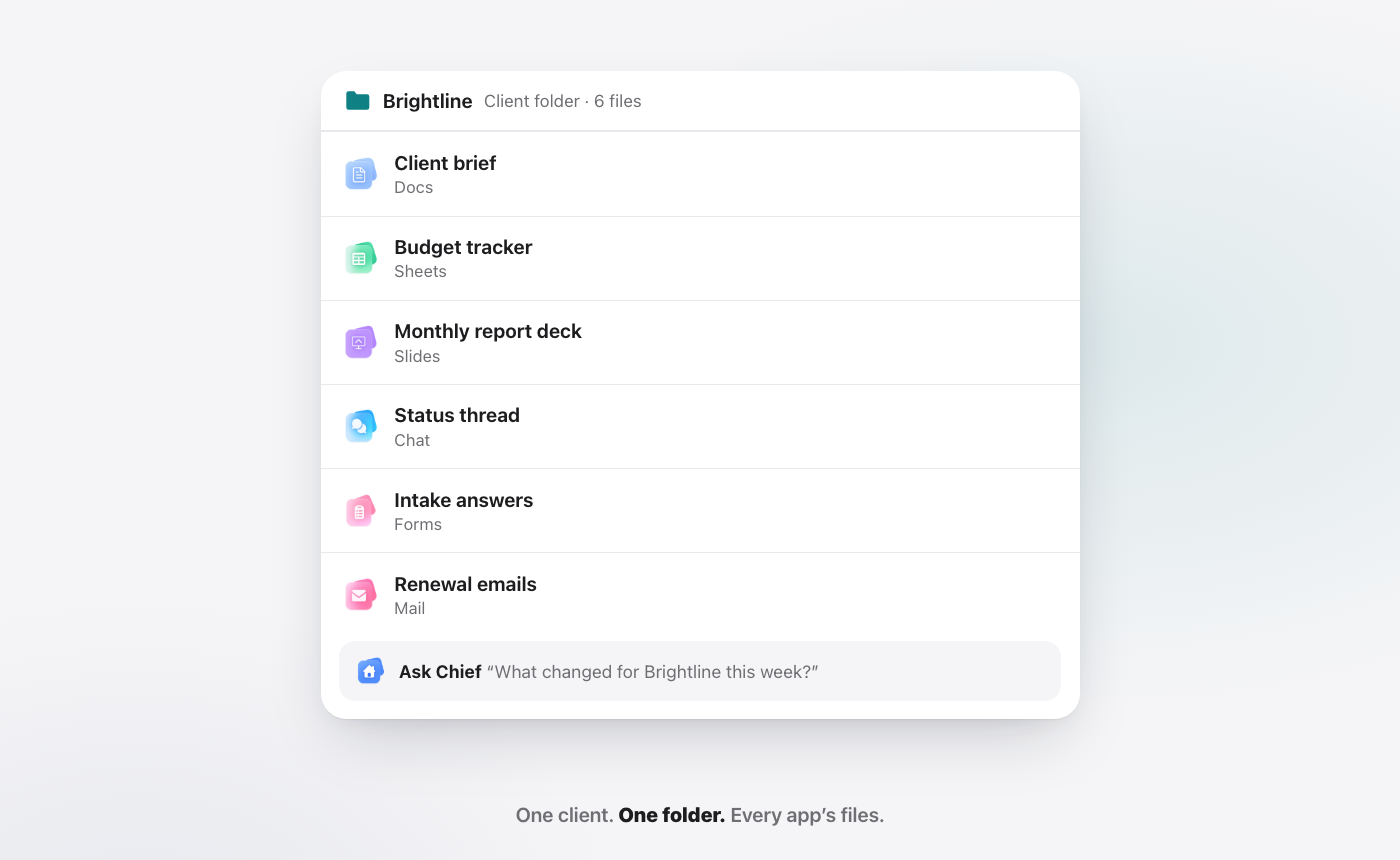
WorkElate is an AI-native office suite: Docs, Sheets, Slides, Mail, Chat, Calendar, Tasks, Canvas, Forms and Journey, with Hub as home. Each client gets one folder that holds every app's files, so the brief, the budget sheet and the deck sit together.
Chief, the AI inside the suite, works across all of those apps. Ask for the Q3 numbers to go to Priya and it reads the sheet and drafts the email in place, instead of you copying between tabs. It asks before anything sends, and it re-reads every change it makes. AI is included on every plan, with no add-on (pricing).
It will not make your calendar calmer on its own. It does remove a class of switches: the ones where you were only carrying context from one app to the next.
FAQ
What is context switching in simple terms?
Context switching is moving your attention from one task, tool or conversation to another. Each move makes your brain set down one set of details and pick up another, which costs time and can lower accuracy, especially when switches happen many times a day.
What is an example of context switching at work?
You are writing a report, a chat message asks for a file, you open a spreadsheet to find it, and you notice an unanswered email. Each jump between the report, chat, sheet and email is a context switch, even if each one only takes seconds.
Does it really take 23 minutes to refocus?
Not exactly. Gloria Mark of UC Irvine said in a 2006 interview that interrupted work was resumed, on average, about 23 minutes later. That measures time until people returned to the task, often after other work, not a fixed time to regain focus.
What is attention residue?
Attention residue is the part of your attention that stays on a previous task after you switch away from it. Researcher Sophie Leroy showed that people who leave work unfinished tend to perform worse on the next task, because part of their mind is still on the first one.
How can I stop context switching?
You cannot stop it fully, but you can cut it. Protect focus blocks, batch messages, mute low-value alerts, write a quick note before you switch, and keep everything about one project or client in one place so a single request does not send you across many apps.
Keep your work in one place. Start free.


