POV
The Hidden Cost of 'Just One More Feature' Is Coordination
Every feature you add is a new coordination surface — a thing to keep current, hand off, and explain. The real bill for 'one more feature' isn't the build time. It's the wiring.
Every feature you add is a new coordination surface — a thing to keep current, hand off, and explain. The real bill for 'one more feature' isn't the build time. It's the wiring.
"Just one more feature" sounds like a cost you already know how to price. A few more days of build time, a little more code, a slightly longer launch. So you say yes, because the build is the part you can see.
But the build is the cheap half. The expensive half arrives later, quietly, and it never shows up on the estimate.
Here's the part nobody puts in the ticket: every feature you ship is a new coordination surface. It's a thing someone now has to keep current. A thing that has to be explained to the next person who touches it. A thing that has to be handed off when its owner is on holiday. A new edge in the web of "wait, who knows how this works?" The feature is the noun. The coordination is the verb it commits you to, every week, forever.
When you scope a feature, you price the building of it. You almost never price the coordinating of it.
But a feature isn't a thing that exists once. It's a thing that has to be kept alive — a doc that goes stale, an owner who fields questions, a line in every new hire's onboarding. And it interacts with the eight features you shipped before it, each interaction a thread someone now holds in their head. You didn't add a feature. You added a node — and nodes don't add coordination, they multiply it.
That's why the tenth feature feels heavier than the first, even when it took the same week to build. The first feature had nothing to coordinate with. The tenth has nine.
This is why "we need more features" so rarely fixes the thing it's aimed at. The pain on a team is hardly ever a missing capability. It's the disconnection between the capabilities you already have — the handoffs that don't land, the status that lives in someone's head, the context that has to be re-explained on Tuesday because no system held it.
Adding a feature to that doesn't reduce the disconnection. It adds one more surface across which things can fall out of sync. You wanted less coordination overhead, and you bought yourself more.
The honest move, when work feels heavy, isn't "what's the next feature?" It's "what's the coordination this work already demands, and what's holding it — a system, or my people's memory?" If the answer is memory, no feature will save you. You need something that reads across the surfaces you have. (We make that case in Your Workflow Doesn't Need More Features.)
The reason this stays invisible is that the coordination a feature creates doesn't live in the feature. It lives in the chatter around it — the Slack thread, the standup, the "hey, does this still work the way I think?" The feature holds its own little island. The wiring between islands lives in people's mouths.
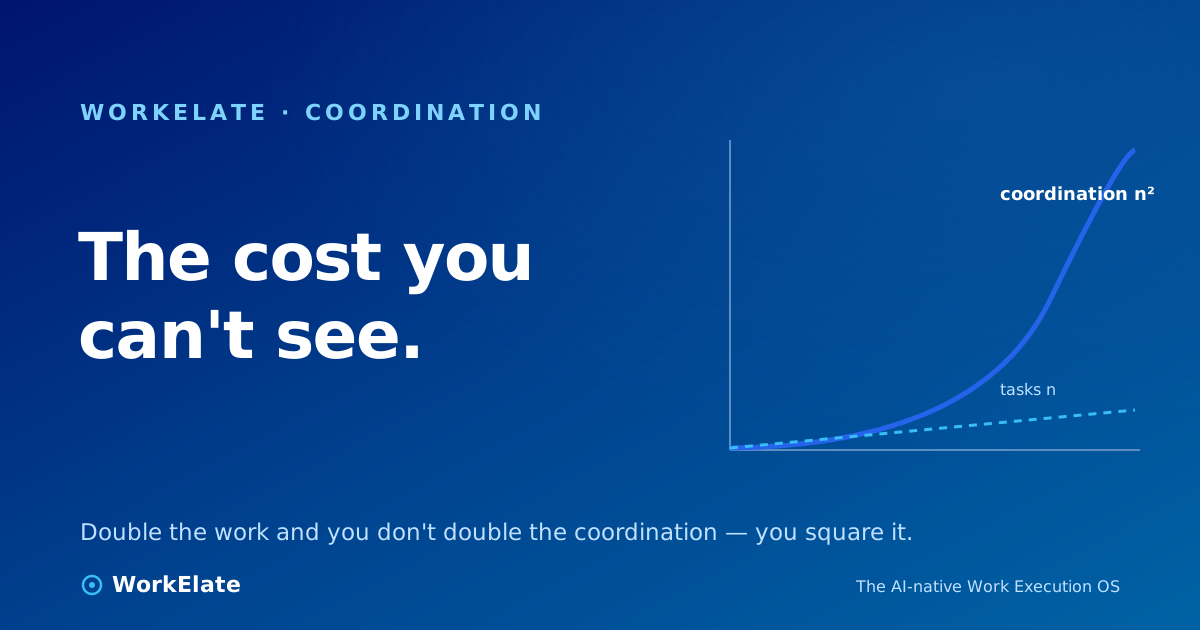
That's the shift WorkElate is built around. Every app — task, calendar, docs, board, the rest — emits what happens into one shared work-graph, keyed on the client and the account. One brain, WAO, reads across all of it. So the coordination a feature creates becomes something the system holds — a dependency it already knows, a handoff it can draft, a status it can surface — instead of something a human has to carry. It does the mechanical coordination and waits for your call on anything that carries weight: suggest, confirm, execute. The coordination doesn't vanish. It moves out of your people's heads and into the thing that holds the work. (The deeper version of this argument — that the real unit of cost is coordination, and it scales roughly with the square — is The Real Cost of a Task Is the Coordination It Creates.)
▶ Watch on WorkElate See WAO hold a handoff across apps youtube.com/@WorkElate · videoId: TODO — swap when publishedSo before you say yes to one more feature, price the real cost. Not the days to build it — the years of keeping it current, handing it off, and explaining it to the next person.
Most of the time, the thing you're missing isn't a feature. It's the wire between the ones you've got.